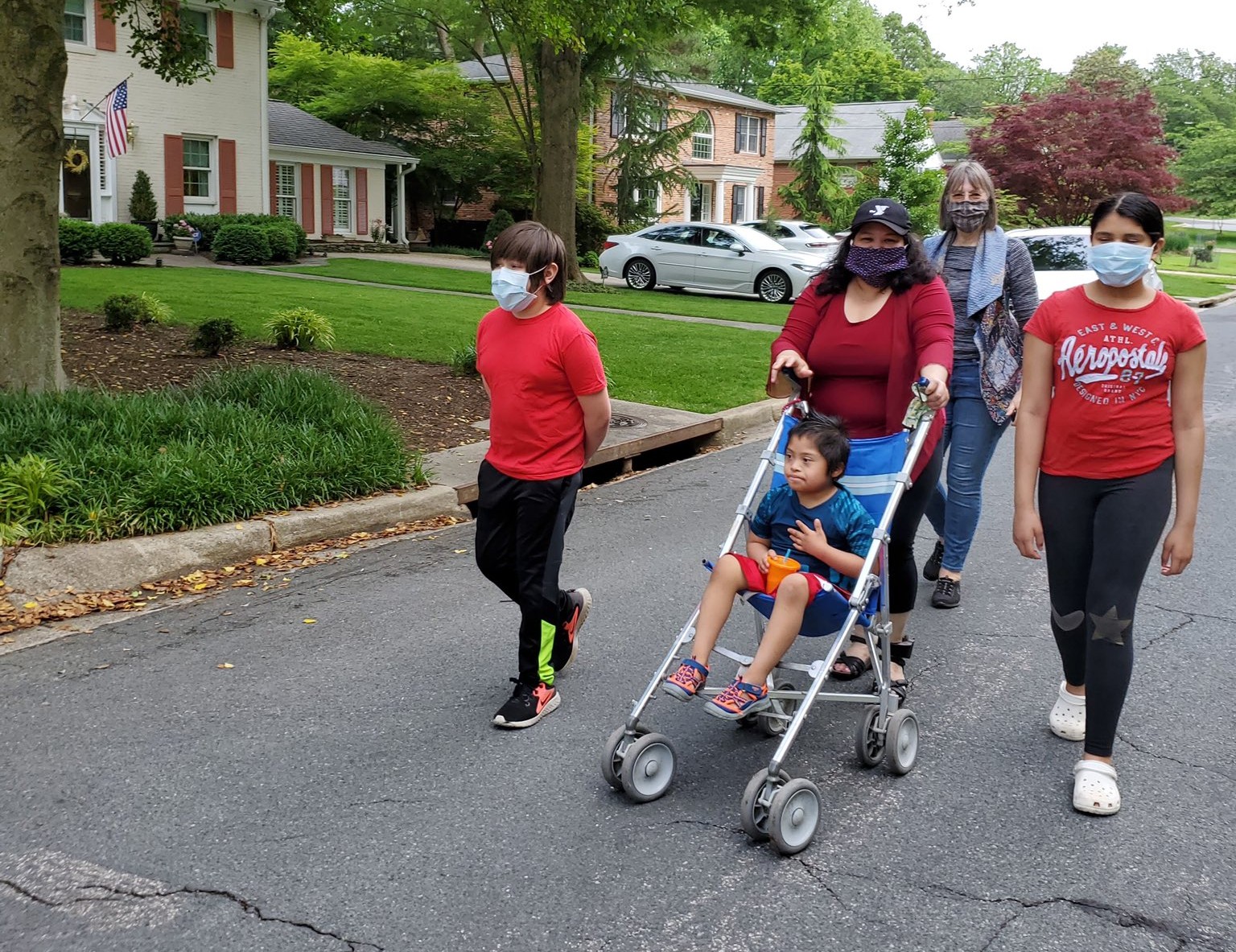
Rosa Gutiérrez Lopez emerged from her apartment on May 29 to enjoy the simple pleasure of walking in her Bethesda neighborhood.
But she was not walking out of her home after a three-month quarantine. Gutiérrez Lopez was taking her first steps in public in more than a year. The Salvadoran immigrant has spent the past 18 months inside the grounds of the Cedar Lane Unitarian Universalist Church in Bethesda, where she claimed sanctuary in 2018. In late May, Immigrations and Customs Enforcement granted her a stay of removal that allows her to move around the D.C. area for at least 60 days. Her stay is pending an appeal before the Board of Immigration Appeals, according to an ICE spokesperson. ICE determines the length of stays on a case-by-case basis.
“Being quarantined is one thing because you know at any moment you can go out and be free,” says Omar Angel Perez, who leads the Congregation Action Network, a group of 60 D.C.-area churches committed to providing shelter for immigrants threatened by deportation. “Versus being confined and the moment you step out of the church, you’re at risk. There’s a big difference.”
Gutiérrez Lopez entered the United States in 2005 after fleeing gang violence in her native El Salvador. She sought asylum in the U.S. and was ordered deported in 2006 after failing to appear for an immigration hearing, but her lawyers delayed her exit by filing stays of deportation. In 2017, ICE cracked down on Gutiérrez Lopez, ordering her to wear an ankle monitor and check in every two weeks. By December of 2018, ICE ordered her to self-deport.
A mother of three children born in the states, including a young son with Down syndrome, and another son born in El Salvador, Gutiérrez Lopez feared leaving her life in America behind. Instead of returning to El Salvador, she took shelter at Cedar Lane Unitarian Universalist Church. ICE’s policy prevents the agency making arrests in “sensitive locations,” including houses of worship, schools, and health care facilities.
Her case marked the first public instance of a D.C.-area church offering sanctuary to an immigrant facing deportation. In October 2018, a Charlottesville church offered shelter to a Guatemalan woman after ICE ordered her removal. Gutiérrez Lopez’s lawyer was not aware of other immigrants who have taken shelter in the region since then.
Gutiérrez Lopez was not immediately able to comment for this story.
The congregation provided her with an apartment on the church’s grounds, a six-acre, wooded campus in Bethesda. Her children came to live with her over the summer while volunteers from the community stayed with her 24/7.
“While sanctuary provides safety and security to the person, it is still a form of confinement in that she was not able to go outside or do anything that other people are able to,” says Abhi Janamanchi, senior minister at Cedar Lane. “So we mobilized a whole group of volunteers within the congregation and especially communities part of the network, who volunteered their time and efforts to support Rosa and her children.”
The phalanx of volunteers made grocery runs, set up medical appointments for her children, and also provided companionship. Janamanchi describes the outpouring as a multifaith effort, with more than 200 volunteers coming from Methodist, Episcopal and Jewish congregations, as well as non-affiliated members of the community. When the coronavirus limited personal contact, potentially exacerbating Gutiérrez Lopez’s isolation, the volunteers kept up a steady stream of Zoom calls and grocery drop offs.
But the pandemic may have also played a role in convincing ICE to grant the stay of removal, according to Gutiérrez Lopez’s lawyer, Jasmin Tohidi.
“That was one of the grounds we raised,” Tohidi says. “We raised health issues. If [her children] got sick, she couldn’t accompany them to hospital.”
Gutiérrez Lopez can move within the D.C. region but if she wants to leave for more than 48 hours, she must receive permission beforehand, according to Tohidi. ICE spokesperson Kaitlyn Pote confirms in an email to DCist that she will also be required to do monthly check-ins with the agency.
“Stay grants are generally based on humanitarian needs to allow an individual under an order of removal a limited period of time to get their affairs in order, prior to departing the United States,” Pote wrote. “Stays of removal are not long-term solutions to immigration issues, nor are they intended to subvert lawful orders of removal.”
With the stay allowing Gutiérrez Lopez some time to breathe, Tohidi is working on reopening the case and if that’s successful, filing a motion to change venue. Tohidi hopes to transfer the case from Texas to the Baltimore or Arlington Immigration Court, where the Fourth Circuit Court of Appeals has better case law for cases involving gang violence, she says.
“We’re trying to keep hopeful,” Tohidi says.
Janamanchi has gained hope after hosting Gutiérrez Lopez for the last 18 months. A Christian who was actively involved in her church in Fredericksburg, she has a strong faith in both religion and in humanity, he says.
“We really learned a lot from Rosa, witnessing her deep faith and her sense of hope, in the midst of shared hopelessness and despair,” Janamanchi says. “She has a deep faith and belief in God and really looks to God for guidance and strength and courage. She also has that deeper faith in people and of things working out.”
This story has been updated to correct the new name of the Congregation Action Network.
Previously:
Facing Deportation, This Undocumented Mother Is Taking Sanctuary In A Bethesda Church