 Daniella Cheslow
 Elliot C. Williams
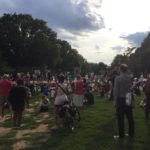
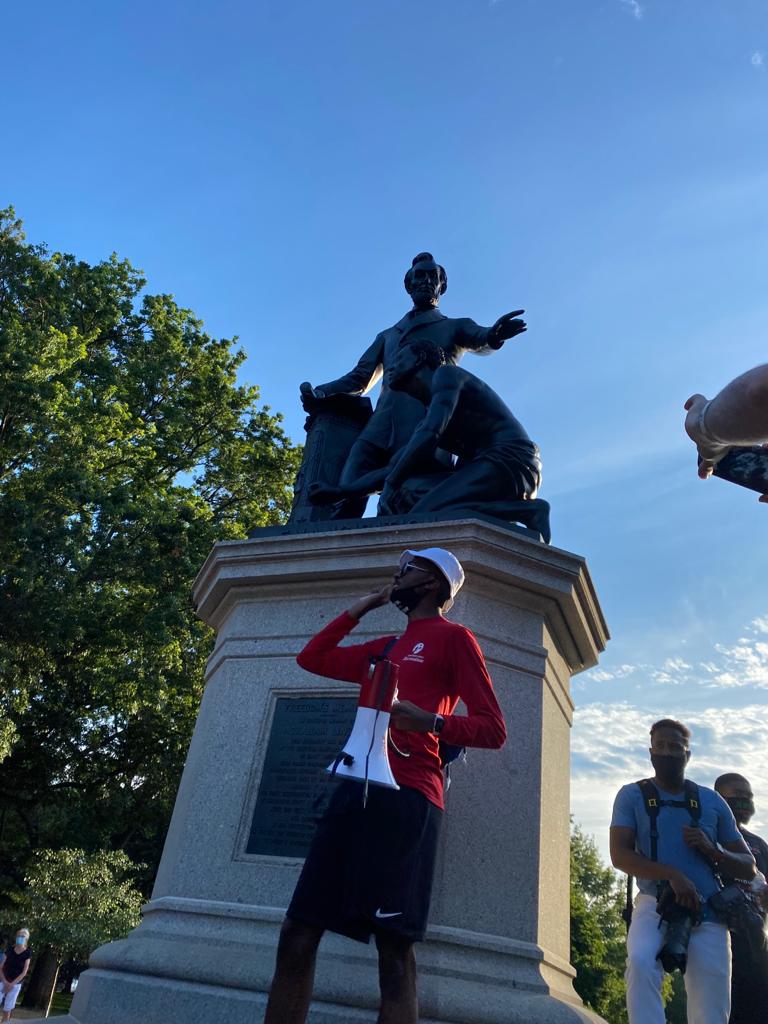
A crowd of about 150 protesters gathered at Lincoln Park just after 7 p.m., calling for a controversial statue of Abraham Lincoln to be removed. Members of the group said it would not attempt to pull the statue down immediately but would come back on Thursday evening with ropes to do just that.
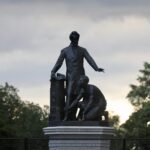
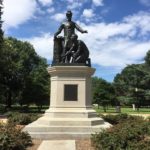
The memorial, depicting Lincoln towering over a kneeling formerly enslaved person with broken shackles on his wrists, has been the subject of a petition calling for its removal in recent weeks. By Tuesday evening, the petition—which says the statue displays “degrading racial undertones”—had nearly reached its 5,000-signature goal. (The petition has since surpassed 5,000 signatures and a new goal of 7,500 has been set.)
D.C. Delegate Eleanor Holmes Norton also announced she would introduce legislation to move the statue to a museum.
Ahead of the protest, dozens of Metropolitan Police Department officers gathered at the park, and at least three Park Police officers stood near the perimeter as well.
At the base of the monument, Glenn Foster, 20, a rising junior studying government at Harvard University, shouted that the statue embodies white supremacy and the disempowerment of Black people. Foster helped organize the demonstration and said he’s the founder of the Freedom Neighborhood, which describes itself as “a youth-led revolution for our generation” on its Instagram profile.
“You’re looking at this and you’re seeing a hand over Black people, and that’s always what it has been—that we’ve had a hand over us when it comes to our freedom, when it comes to our liberation, when it comes to being empowered, and that’s not right,” Foster said. “This statue represents something that is far worse for Black people. It shows that we’re going to get our freedom on their timeline, and that’s not right.”
At the start of the demonstration, Joanne Hatfield, a park neighbor, interrupted and pleaded for the group not to tear the statue down, but she was quickly shouted down by protesters. Hatfield, 62, said that an effort to tear down the statue would be a “publicity stunt” and that federal police would never allow it.
“I would just like a peaceful outcome and to have the discussion,” Hatfield, a white woman, told DCist/WAMU. “It’s good to raise awareness, but this is a federal park and the way to do it is to write to Congress and get them to change their mind. I mean, it is possible to move it. We just had it cleaned. Maybe it could go to Lincoln’s Cottage or something. I don’t think it should be done by mob mentality.”
Another neighbor, Erik Prince, a 44-year-old African American man, said he came out to the protest energized by young people driving the movement, and that to him, the statue represents the subservience of the enslaved Black man at Lincoln’s feet.
“The issue is that for far too many people it’s still that same type of mindset, where subconsciously, a lot of people still think of Black people in that way,” Prince said. “I think it should be torn down, and I’m of the mindset that it should not be placed in a museum—placed in a museum, to what end?”
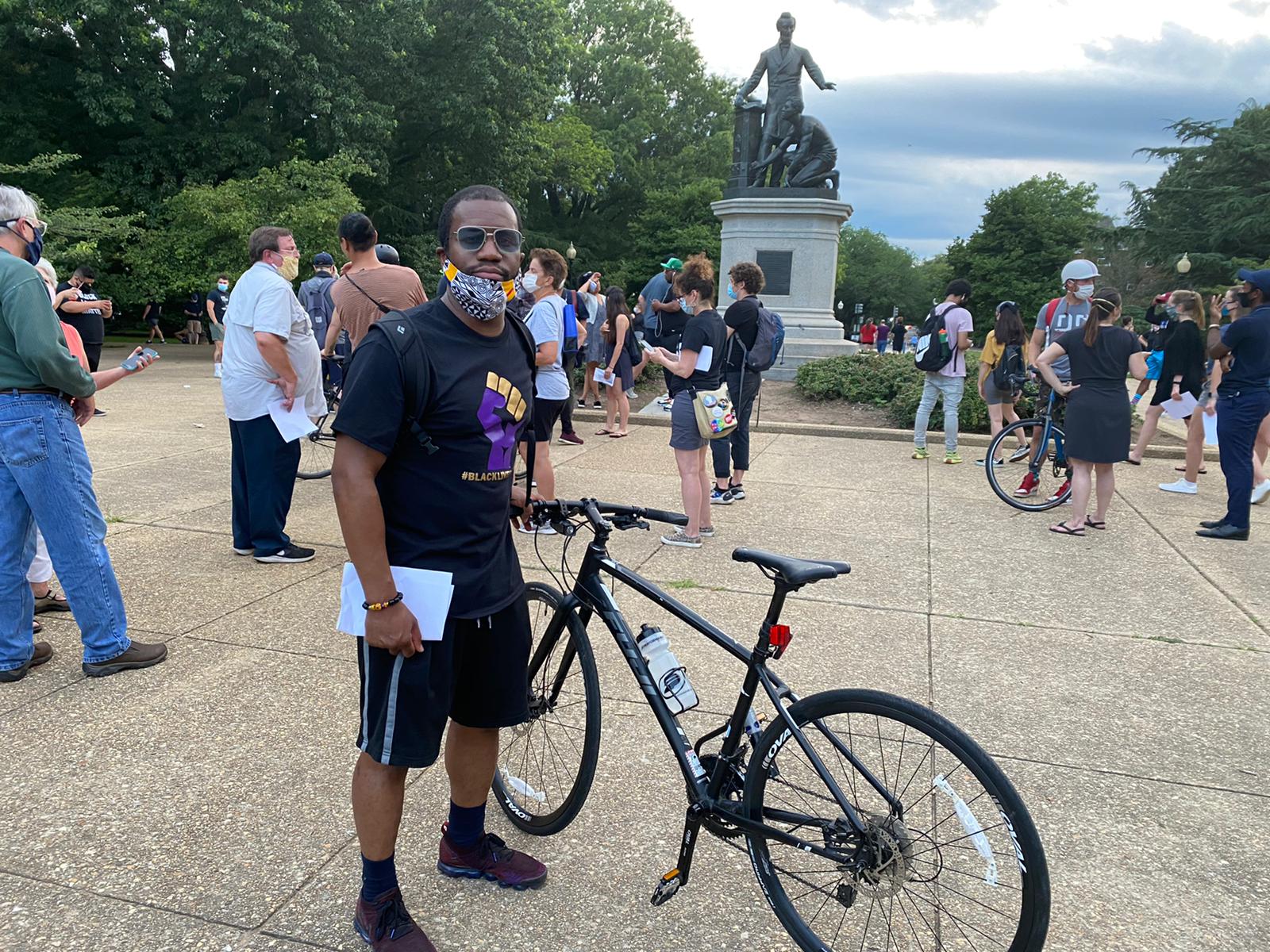

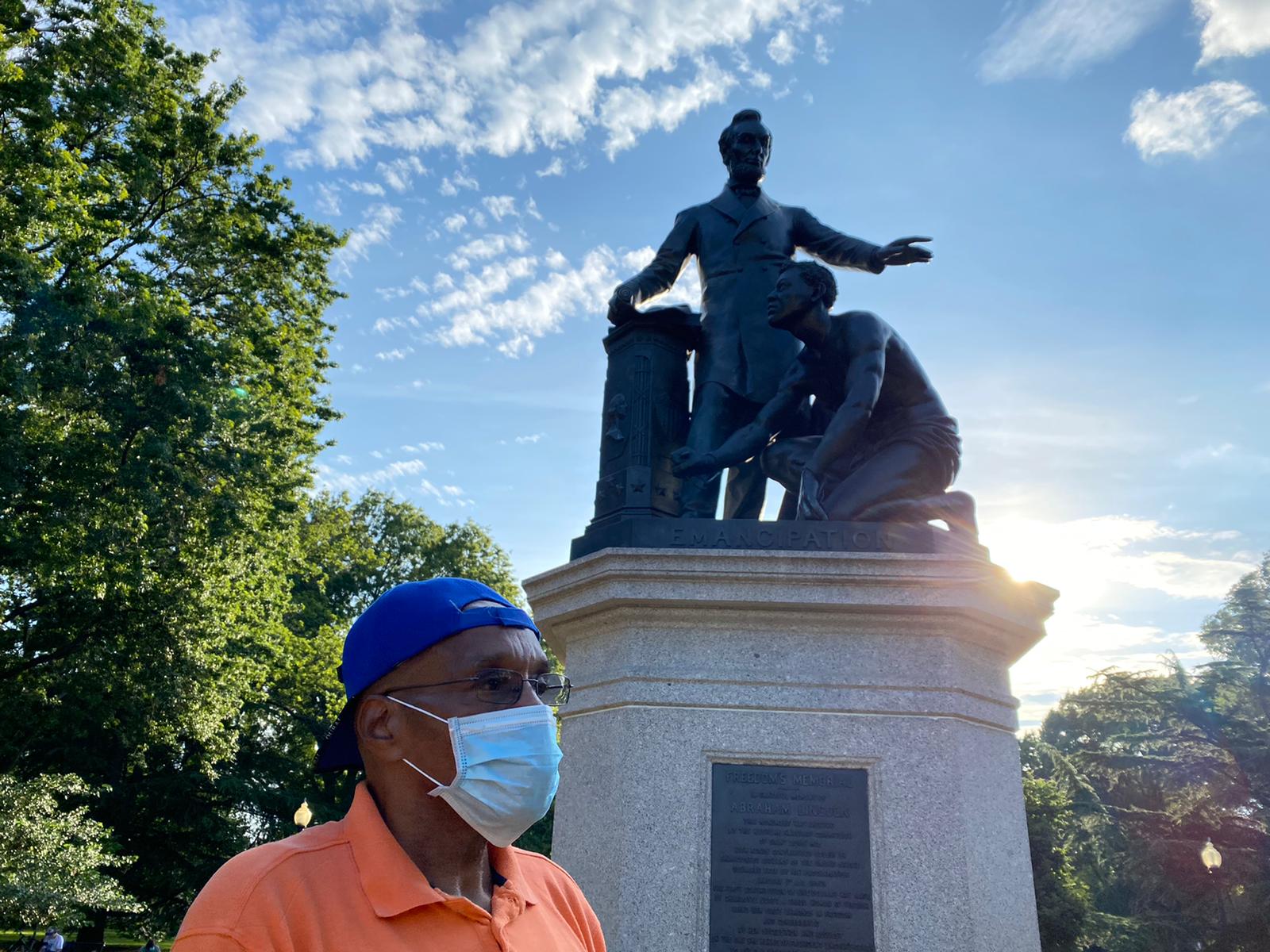
Charles Simons, a Black retired Army serviceman who lives in the neighborhood, stopped by to see the statue before the protest began.
“[The statue] doesn’t make me feel bad, because I know what Lincoln did. I never looked at this particular monument in a negative way,” said Simons. He added that statues of Confederate soldiers and officers should come down, and that military bases named in honor of Confederates should be changed.
“Younger people, they see things that perhaps we overlooked or didn’t really care about. But I can understand,” Simons said of bases like Fort Lee in Prince George’s County, named after Robert E. Lee. “I think the names should be changed, and I think eventually they will be changed.”
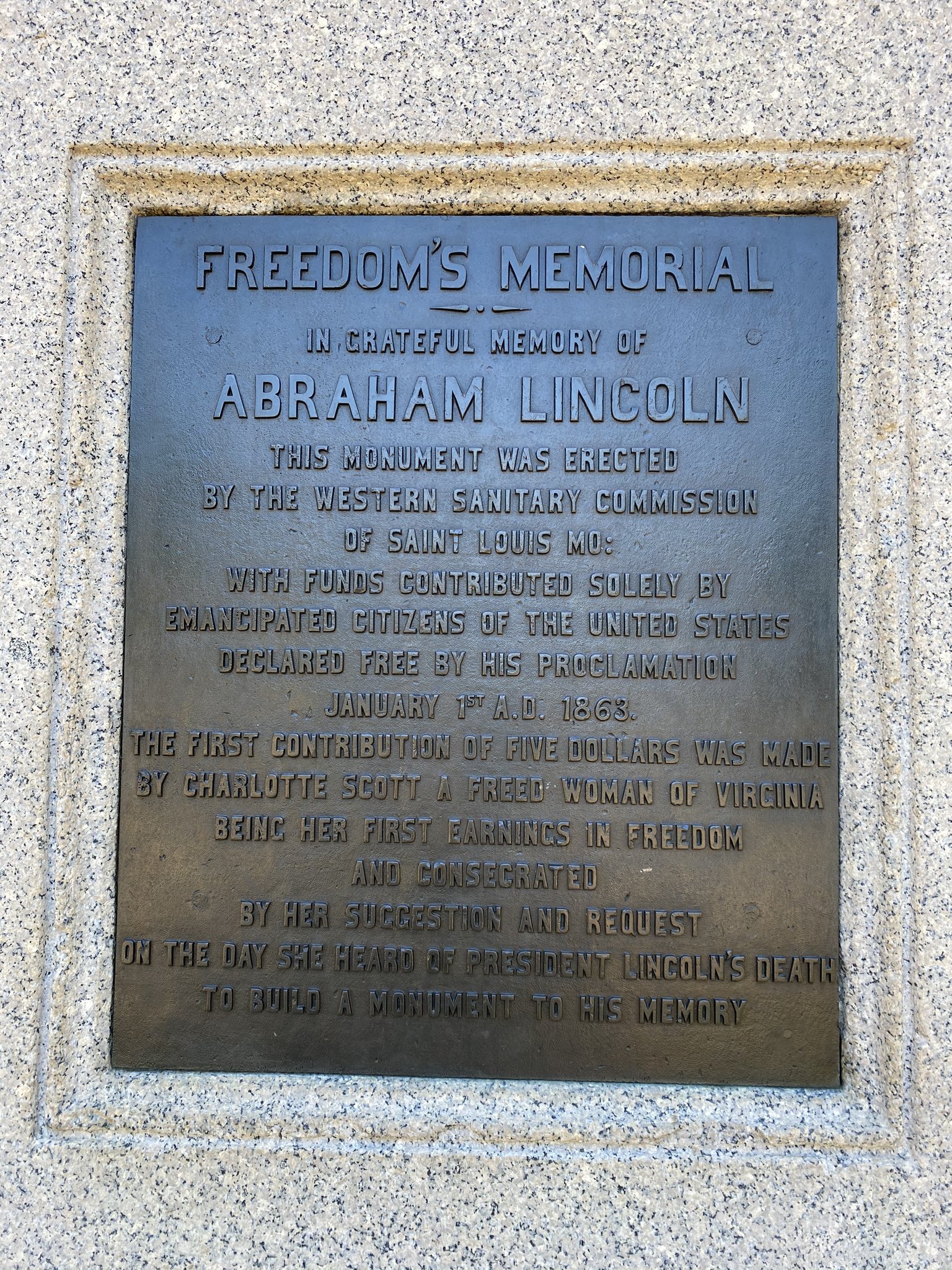
While the fundraising campaign for the statue was started by former enslaved person Charlotte Scott, those funds—along with its creative direction—were ultimately managed by white people. Frederick Douglass gave an oration at the statue’s 1876 unveiling, in which he didn’t spare his criticism of the 16th president:
“Abraham Lincoln was not, in the fullest sense of the word, either our man or our model. In his interests, in his associations, in his habits of thought, and in his prejudices, he was a white man. He was preeminently the white man’s President, entirely devoted to the welfare of white men.”
But Douglass also praised Lincoln, adding that “he delivered us from a bondage, according to Jefferson, one hour of which was worse than ages of the oppression your fathers rose in rebellion to oppose.”
Other sources quote an attendee who said that Douglass thought the statue “showed the Negro on his knees when a more manly attitude would have been indicative of freedom.”
This week, the debate over the statue’s legacy has spilled online. “I just really disagree with this move,” tweeted author G. Derek Musgrove about Norton’s bill to remove the statue. “The statue may have been crafted by a sculptor who cared little for black folk, but black folk paid for that statue with the pennies they could scape together just years after they emerged from slavery.”
Even rapper and actor Ice Cube weighed in, saying it’s “time to commission a different statue of Abe Lincoln.”
After shouting down Hatfield—the woman who defended the statue—Alexandria resident Dania said Hatfield was using her privilege to “silence those whose voices needed to be amplified, and that wasn’t OK.”
“This was a black neighborhood, and [that] is not the case now. And yet [the statue] still stands, taunting those that are affected by these types of images and symbols that glorify oppressors,” said Dania (who declined to share her last name). “This is a false narrative to say that Abraham Lincoln was the one who doctored and pushed the Emancipation Proclamation when in fact, for him, it was a political move. I think the statues need to go down, and whether they go down lawfully or peacefully is not my concern.”
His megaphone broken, Foster shouted into the crowd, “Thursday at 7 p.m. we’re tearing this motherf***** down,” effectively ending the protest.
This article previously stated that Frederick Douglass said the statue “perpetuated negative stereotypes about African Americans” in his oration. It has been updated to reflect his exact language and reports of his comments at the time.