Rachel Kurzius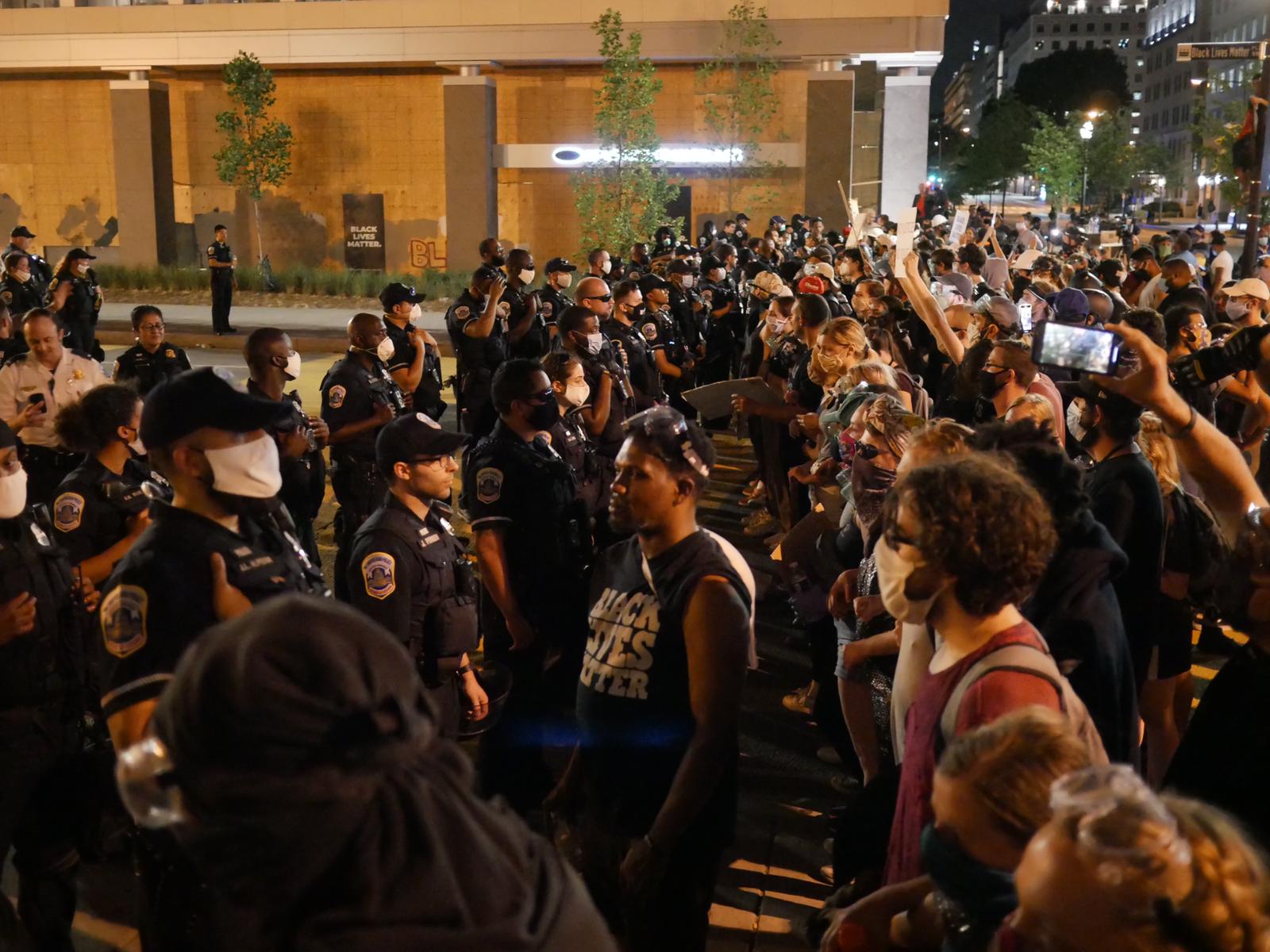
The D.C. Council passed emergency police-reform legislation on June 9 that included measures to bar Metropolitan Police Department officers from using chemical irritants, like pepper spray or tear gas, and less-lethal projectiles, like rubber bullets, to disperse First Amendment activities.
Unlike permanent legislation, emergency legislation in D.C. does not require a 30-day Congressional review. It takes effect for 90 days after the mayor signs it or if 10 business days pass without a veto, whichever comes first. The Council submitted the police reform bill to the mayor’s office on June 22. Mayor Muriel Bowser has said she will sign the legislation after the D.C. attorney general’s office reviews it, but it currently isn’t in effect. She has until July 7 to either sign or veto it (the law would also go into effect if she does neither).
On June 22, D.C. police officers used pepper spray on protesters near Black Lives Matter Plaza in the afternoon, and again that evening in Lafayette Square to stop a “large group that was attempting to deface and destroy” a statue of Andrew Jackson, the Metropolitan Police Department said over email. The next day, MPD deployed sting balls and OC spray against protesters in Black Lives Matter Plaza, which the department said was a response to “instances of individuals igniting of fireworks, intentionally setting fires, throwing projectiles, Molotov cocktails, and smoke grenades at officers in the area.”
D.C. police maintain that their actions would have been permissible under the emergency reform bill.
“Under the existing and proposed legislation, MPD members in riot gear shall be deployed on First Amendment assemblies when there is a danger of violence,” MPD spokesperson Brianna Jordan said over email. “The use of a chemical irritant is reasonable and necessary to protect officers or others from physical harm or to arrest actively resisting subjects and may be used during a First Amendment assembly when assembly participants are committing acts of public disobedience endangering public safety and security.”
But the author of the police reform bill is not so sure about that.
Ward 6 Councilmember Charles Allen, who chairs the Committee on the Judiciary and Public Safety, says over email that he spoke with D.C. Council attorneys on Tuesday, and “it’s not clear if the amendment and language around tear gas and pepper spray would have applied” to the incidents on June 22. That’s why he wants to a public hearing to make sure “we get the language right” for the permanent bill.
Allen went on to criticize MPD’s actions in handling protesters this week. “We don’t need a hearing to know peaceful protestors should never be subjected to what we saw [on June 22]. Watching MPD officers in full riot gear working side-by-side with the same U.S. Park Police that previously violently responded to protestors and media, it is clear the use of chemical irritants escalated tensions and may have infringed on First Amendment rights,” says Allen. “It is the kind of behavior that has drawn so many out to protest in the first place.”
Assistant Chief Jeffrey Carroll explained why MPD officers wear riot gear in a Police Executive Research Forum virtual town hall last week, before the latest incidents occurred. “We can’t put on hard gear, helmets, or personal protective equipment to protect officers unless there’s an actual threat of danger, so individuals who begin throwing items or things of that nature,” he said.
Edward Maguire, a professor of criminology at Arizona State University who wrote a guidebook for policing protests, says that overall, when police across the country respond to a peaceful or largely peaceful protest, “if they respond to that type of incident as if it’s a riot, they are going to create a riot. People, when they perceive the police to be acting unfairly, will be defiant.” The big mistake law enforcement makes while policing demonstrations, he says, “is treating the entire crowd as if it’s homogenous, or if the behavior of a small group of people represents an entire crowd.”
This debate over policing tactics is part of a larger conversation happening in D.C., and around the country, over potential changes to law enforcement budgets, practices, and culture. These discussions are largely prompted by protests that began in late May over the death of George Floyd in Minneapolis police custody, and have grown as demonstrators call out police violence and anti-Black racism. At a budget hearing for MPD last week, nearly all of the 90 witnesses called on the D.C. Council to reject Bowser’s proposed 3.3% increase for MPD, and instead, to defund the department.
Ward 1 Councilmember Brianne Nadeau has come out in favor of defunding MPD, and she introduced permanent legislation to bar D.C. police from using chemical irritants during protests. She disapproved of MPD’s actions this week, too. “Our police department claims that they do not need reform and that they have sufficient de-escalation training, but the actions that continue to take place at First Amendment demonstrations say otherwise,” she said in a statement.
D.C. Police Chief Peter Newsham had harsh words for the D.C. Council after it unanimously passed the emergency legislation addressing D.C. police — which also bans the use of chokeholds, speeds up the release of body-worn camera footage and names of officers in involved in fatal shootings, makes changes to the independent Office of Police Complaints, and other measures. Newsham told officers that the legislative body “completely abandoned us … They forgot about our 20 years of reform, and they insulted us by insinuating that we were in an emergency need of reform.”
Deputy Mayor for Public Safety Kevin Donahue told the D.C. Council that Newsham’s comments were said in an attempt to reassure his patrol officers while “trying to acknowledge a belief he had that those officers were having their hard work questioned or lumped in with the worst aspects and elements of their profession nationally.” A survey released by the D.C. Police Union stated that 98.7% of members agreed with Newsham that the D.C. Council “has abandoned the police.”
At-large Councilmember David Grosso says that he believes Newsham “represents the old-school approach of, ‘let’s just lock him up and throw away the keys’ … If MPD really cared about reform, they would already implement the changes the council asked them to implement. They have never done any reform unless they’ve been forced to do it by the federal government, outside courts, or this council.”
Grosso, who was the only councilmember to vote against Newsham’s confirmation to be chief, says he stands by that vote. Indeed, he is currently circulating a letter to his colleagues to call on Newsham to resign, and, if he refuses, for Bowser to force him to step down. While he doesn’t expect a majority of the council to sign on, he thinks a handful of his colleagues will.
“The Chief has the Mayor’s support,” Susana Castilo, a spokesperson for the mayor, says over text. The mayor’s office has not responded to a comment about D.C. councilmembers’ criticism about MPD’s actions this week. Since the health crisis began, Bowser has held near daily press conferences on weekdays, but she hasn’t done so since the incidents of police violence this week.
However, the Bowser administration did provide a statement from Deputy Mayor Donahue: “The District Government’s top priority is the safety of its residents and visitors. Our goal at Black Lives Matter Plaza is to ensure that all who visit enjoy it as a place to peacefully reflect, nonviolently demonstrate, and proactively strategize. We will continue to monitor the ways in which we can ensure the Plaza is a welcoming place for all.”