Margaret Barthel
 Natalie Delgadillo
Victoria Clark recently went shopping for the first time since COVID-19 forced many people to go into virtual lockdown to stem the spread of the virus. Her parents were in town visiting from North Carolina—also a first for her since the pandemic hit the U.S.—and they all decided to go out together to celebrate.
Clark, who lives in Ward 7, knew there was risk in going shopping and the visit. But she decided to take the risk anyway.
“I mean, it’s just the fact that I hadn’t seen my family in so long,” she says. “But also, when I heard that D.C. was going into Phase Two it was like, ‘If things are opening back up then maybe I can start trying to regain some normalcy and do some things that I would have done before COVID.’”
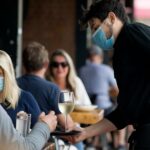
More people are venturing out once again as D.C., Maryland and Virginia reopen their economies. People are gathering (and sometimes even crowding) in restaurant patios and parks, and some businesses are beginning to open up indoor spaces, too.
Local officials are still urging the public to practice social distancing and wear masks, and some have expressed worry that residents will take the reopening as a reason to start slacking off.
Those concerns may be coming true.
People’s scrupulousness in following public health guidance is starting to wane, says Dr. Amanda Castel, a professor of epidemiology at George Washington University.
“It’s hard to discern whether it’s fatigue, or just the fact that people don’t think that they’re vulnerable to the virus,” Castel says. “I think people start to become a little bit apathetic and think that it’s not really going to affect them.”
Castel says only about half of the people she sees out are wearing masks, a number that worries her.
“I would hope that mask wearing would be a trend in the other direction, so that it becomes an integrated and integral part of our new normal,” she says while sighing.
Sam Lane, who lives in Bloomingdale, says he has noticed his mask habits changing.
“When I’m around people I wear a mask, but if I’m alone and just walking or running, I don’t,” he says. “But definitely before I would be wearing a mask full time.”
Even those who are being very vigilant say they’ve relaxed a bit. Taylor Duenas is pregnant, and trying to minimize her exposure to the virus before she delivers — she’s heard that if she tests positive for the coronavirus, she might not be able to hold her newborn after giving birth. Duenas says she sometimes accompanies her husband to pick up takeout a few blocks from their home in Northwest D.C.
“I’ve been a little bit more adventurous, like in that I’ll walk with him,” she says.
As people become less cautious, the internet is taking notice.
https://twitter.com/kathe_mammele/status/1270848843018633216
https://twitter.com/_nutellalatte/status/1278319008757014530
With businesses reopening their doors, the public health message — which was once ‘stay at home as much as possible’ — now feels a lot less clear cut to many area residents. They say their decisions about seeing friends and family, taking a weekend away from the city, or going to a restaurant or another local business are increasingly guided by individual evaluations of risks and benefits, not official guidance.
Victoria Clark says it’s bewildering trying to navigate making those decisions.
“I’m confused,” she says. “Here, it seems like they’re saying things are getting better, but then you read the news and things are getting worse everywhere else, and it’s like, are things really getting better, or should I be more cautious?”
Taylor Duenas isn’t sure how to interpret the reopening guidance, either.
“I can’t believe that it’s any safer to suddenly have 50 people together,” she says. “But I think that it’s one of those things where somebody who gets hopefully paid a lot more than I do has to do the cost-risk analysis and says, ‘OK, you know, people are going to meet up, or people deserve to go to houses of worship’ or whatever it is and determine what’s the safest number for us to allow that to happen.”
It’s all a compromise, according to Castel, the GWU epidemiologist.
“The public health guidance for the reopening phases is a delicate balance between the will of the people and the need to resume some sense of normalcy and also to re-stimulate the economy while still curbing the spread of coronavirus,” she says.
Castel says there are a series of questions for people to ask themselves in evaluating what risks they’re comfortable taking. Those questions go beyond any age or health considerations that might make someone especially vulnerable to the coronavirus.
“If you go out with your friends, you are potentially exposing yourself to any exposure they may have had — so having conversations with people about what they have been doing and how many other people have they’ve been interacting with,” she says, noting that people should also think about whether they or their friends have been traveling, particularly to or from coronavirus hotspots.
Simone Agoussoye, a Ward 8 resident, says she and her husband have different levels of comfort with socializing. Her husband, who she says is a “germofreak,” is still going to work for Amazon, but is worried about her going out to visit friends who just moved into a new home.
“They’re like, ‘Oh, you want to come see my new place?’ And for me, my husband’s like, ‘Absolutely not.’ Like, no, just because things are opening up doesn’t mean that you can go.’ But I’m like, ‘They’re my friends.’”
Duenas says she’s trying hard not to judge people who are going out and about more than she is. Many of her friends are single and living alone, and she’s glad they’re reclaiming a sense of normalcy in their lives.
“I’m mostly excited I guess, especially for my friends who live alone, who are able to finally reconnect with the things that provide them so much joy,” she says.
Many locals say they’re feeling more comfortable being around other people outside in parks, restaurant patios and newly opened streateries.
Clark, for instance, says she’s not really wearing a mask in the park these days, though she did earlier in the pandemic.
“Things are opening up so it must be at least a little bit better,” she says, explaining her rationale. “And I feel like the park is a little bit lower risk to go without a mask.”
https://twitter.com/adjoabasamoah/status/1261789535584780289
https://twitter.com/joshcsva/status/1277067273812017152?s=21
Castel says while being outside is safer than being inside, she still urges people to avoid outdoor spaces that are crowded.
“If you want to go to the park and you want to be with a group of people, keep your group small,” she advises. “If you get to the park and you realize that it’s jam packed, and there’s no way that you really can safely distance yourself from other people, then I think you have to consider leaving.”
Castel also notes that local residents can take advantage of publicly available data in making decisions, too.
“If you’re living in an area where the percent positivity is going up, then maybe you should reconsider going out and doing certain activities that might increase your risk,” she says.
“If you’re in an area where the numbers seem to be trending down consistently, then you may feel somewhat reassured that as long as you continue to practice social distancing and wear a mask and do proper hand hygiene, that the risks of transmitting the virus or getting exposed to the virus are relatively low,” Castel says.
Clark has her neighborhood on her mind, too. She says the lack of health care access in her ward is a factor in the decisions she makes.
“I live in Ward 7. There’s no health care over here,” she says. “So I really need to gather all the information and see what risk I’m comfortable taking.”
And while people are beginning to let their guards down, the virus is still a persistent worry.
“I definitely think that people are going to get too comfortable and we are going to have another wave,” says Agoussoye.