At the start of the year, DC Central Kitchen, a prominent nonprofit founded in 1989 that now serves thousands of residents annually, was busy operating two key community food programs in the District.
The organization’s Healthy Corners program provided fresh produce and healthy snacks to 50 corner stores across the city, while their Healthy School Food program made freshly cooked meals for 16 public schools. Of these 66 locations, most were located east of the Anacostia River, in wards 7 and 8, where three-quarters of D.C.’s “food deserts” are found, according to a 2017 study. While precise definitions vary, food deserts generally refer to areas where access to grocery stores is low, and they often correlate with poverty rates and transportation gaps.
But in March, when COVID-19 hit the region, DC Central Kitchen faced an unprecedented challenge, just like other local anti-hunger organizations did. The nonprofit’s supply chain was affected by transportation issues, and it had to find a way to sustain all its feeding operations without any volunteers. About 16,000 volunteers normally help DC Central Kitchen each year, but because of the coronavirus, the organization suspended its volunteer program indefinitely.
“There’s no part of our operation that didn’t feel the direct effects of [the coronavirus crisis],” says Alexander Moore, DC Central Kitchen’s chief development officer.
Across the city, people were flocking to grocery stores and purchasing food in bulk, which strained supplies and resulted in long lines. Still, for many residents of wards 7 and 8, food scarcity was nothing new. Both wards have roughly 80,000 residents each, and yet they have only three full-service grocery stores between them (Ward 7 has two while Ward 8 has one). Their respective ratios of residents to grocery stores appear to be far higher than the U.S. average: In 2011, data from the U.S. Census Bureau and the Food Marketing Institute, a trade association based in Arlington, showed a national average of 8,800 residents per grocery store. (Wards 7 and 8 also have fewer than a dozen sit-down restaurants.)
These conditions have meant plenty of work for local food-assistance programs during the pandemic—and further discussions about how free, nutritious food can be provided sustainably to residents who need it. Food charities say the coronavirus has underscored the reality that their clients need more grocery stores and fresh food options near their homes, even as the charities are adapting to the crisis and are providing tons of supplies.
As Moore and his team strategized about how to continue feeding residents who lack nutritional options as the pandemic stretched on, they learned that residents didn’t want canned-food donations or even premade meals. Instead, residents said they wanted access to healthy ingredients that they could prepare for themselves.
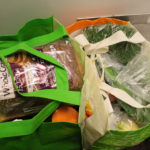
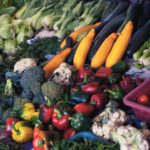
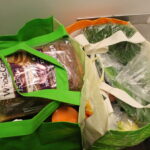
Working with more than 25 farms in the area, DC Central Kitchen began assembling 10- to 12-pound bags of fresh produce, or enough to feed a family of four for three days, according to the nonprofit. Each bag is filled in the same way, containing two fruit items (3 pounds total), two starchy vegetables (3 pounds), two non-starchy vegetables (2 pounds), and two leafy greens (2 pounds). Although the produce varies based on availability, it generally has included items like sweet potatoes, onions, mushrooms, apples, oranges, spinach, and squash.
DC Central Kitchen is distributing the bags at public schools, via mutual aid groups, and through a new pilot program run by nonprofit D.C. Greens and ride-hailing company Via that allows seniors to place home deliveries over the phone. Since March, the organization has given out 38,854 bags, or the equivalent of 393,372 meals, with most of the bags distributed in wards 7 and 8. Those wards, which are predominantly Black, have seen a disproportionate number of COVID-19 deaths as compared to the shares of D.C.’s population they represent, according to city data. (Black D.C. residents have died at disproportionate rates from the coronavirus, comprising 46% of the city’s population but 74% of the more than 560 total deaths to date.)
Despite DC Central Kitchen’s output, Moore says charitable food can’t be the solution to hunger in the U.S. “The scale of the challenge before COVID-19 was beyond anything the charitable sector could meet, and certainly in the midst of this crisis, there’s just no substitute for [public] programs like SNAP, like WIC, local initiatives like Produce Plus and Produce Prescriptions,” he says. “And for really reimagining how we build resilient food-system infrastructure in our communities so that we don’t have to invent new [food] sourcing partnerships, so that we don’t have to figure out how to build grocery boxes in spare corners of charitable facilities when a crisis like this hits.”
The factors underpinning food insecurity in the District preexist the coronavirus and are likely to last well after the pandemic subsides, especially because of increased unemployment and the recession. Chris Bradshaw, the founder and executive director of Dreaming Out Loud, a D.C.-based food-equity nonprofit founded in 2008, faults the racial wealth gap and lack of food-system infrastructure for why neighborhoods east of the Anacostia River grapple with limited food access. “We’re looking at a set of circumstances that drive high unemployment, higher rates of food-related disease, that then translate to being harder hit by COVID,” Bradshaw says.
Dreaming Out Loud has a longstanding relationship with DC Central Kitchen and Martha’s Table, another local nonprofit that’s distributed tens of thousands of food bags in wards 7 and 8 since March. To feed residents in those wards, Bradshaw’s organization is also working with José Andrés’ World Central Kitchen nonprofit and local food businesses, including District Chop Bar, Taylored Taste, Green Things Work, Little Sesame, and Pinke’s E.A.T.S.
Pinkey Reddick, who owns catering company Pinke’s E.A.T.S, is currently a mentor for Dreaming Out Loud’s DREAM program, which advises Black entrepreneurs about building businesses. Along with other neighborhood business owners, Reddick says she’s actively employing residents from wards 7 and 8 to help feed their communities.
“I just want to help people that look like me,” says Reddick, who is Black. “A lot of this is coming out of my needs living in Ward 7 for some good food I want to cook and I can eat.” Reddick and her team have been serving up to 400 free meals per day in those two wards, and hopes to continue doing so for the foreseeable future. The meals are prepared at a church and served in accordance with social distancing guidelines.
Meanwhile, the District-based Capital Area Food Bank has distributed 522,000 meals in wards 7 and 8 from March through May. Before the pandemic, the food bank was preparing to launch Curbside Groceries, a mobile grocery truck that would visit D.C. neighborhoods with limited access to fresh produce and grocery stores. The program was paused due to COVID-19, but is now set to launch in mid-July, according to Radha Muthiah, the head of the organization.
“A place to easily purchase a wide range of healthy and affordable groceries should be a fixture in every neighborhood, but for many communities in our area, that place does not exist,” says Muthiah. “While the individuals we serve want options for buying some of their food, local retail choices are scarce or hard to get to without a car or a long trip on public transportation.”
Although there are plans for new grocery stores to open east of the Anacostia River, including at the long-awaited Skyland development near the border between wards 7 and 8, those stores haven’t opened yet. A roughly 4,000-square-foot Good Food Markets store was scheduled to open in Ward 8 last year, but construction has been delayed for months. Philip Sambol, the executive director of Good Foods Market, says work recently resumed on the project, which is currently slated to open later this year and is particularly needed to replace a former Murry’s grocery store in the area.
Ward 7 resident Clarice Manning says while the store would help boost food access, “it’s not going to be the end-all solution” for east-of-the-river neighborhoods, given its modest footprint relative to traditional supermarkets. Manning is a board member and community outreach coordinator at the Community Grocery Cooperative, an initiative that aims to bring community-owned and -supported grocery stores to wards 7 and 8.
The cooperative launched in April 2019, but Manning says it hasn’t yet raised the funding needed to move forward. She points out that neighbors have been driving to each other’s houses to check in and deliver food and other necessities during the COVID-19 crisis.
“People have been doing a great job in making sure that we look out for each other in the best way that we can,” Manning says. “[But] that’s not going to be able to replace the need of a permanent grocery store in the areas that are considered food deserts.”