Elliot C. Williams
This story was last updated August 25, 1:27 p.m.
In early June, an anonymous group began spreading online flyers for a March on Washington 2020, slated for Aug. 28, to honor Dr. Martin Luther King Jr.’s historic “I Have a Dream” speech and accompanying march that took place 57 summers ago.
The posts (which mysteriously ended) over a month ago, caused plenty of confusion over who’s organizing the march and whether it’s a legitimate event.
Well, the March on Washington is happening — or at least some version of it is. In fact, there’s a planned march with an estimated 50,000 participants expected to be in attendance, along with multiple organizations and activists involved. Here’s what we know, so far, about the plans for Friday’s march:
Rev. Al Sharpton’s National Action Network (NAN) has scheduled a march and program for Aug. 28, officially titled the “Get Off Our Necks” Commitment March on Washington. Hotels nearby have been sold out for weeks, according to NAN’s D.C. Bureau Chief Ebonie Riley. (At least 40,000 people have registered online, Riley says.)
“The influx of inquiries has been relentless,” Riley told DCist over email. “We are in a similar climate like August of 1963. Some of the same issues that took place then are taking place now. In 1963, the purpose of the march was to advocate for the civil and economic rights of Black people, and that’s still relevant.”
She describes the march as part of an intergenerational and inclusive movement, and that it will be led by families of Black people killed by police officers. This summer’s event is “only a launching pad to the work ahead,” she added.
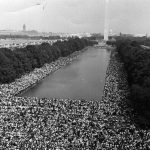
The official rundown of events says guests will start gathering along the Lincoln Memorial Reflecting Pool starting at 7 a.m. A pre-program of performances will begin at 8 a.m., followed by a main program of speakers from 11 a.m. – 1 p.m. The actual march, from 1 p.m. – 3 p.m., will begin at the Lincoln Memorial and end at the Martin Luther King Jr. Memorial.
Tickets are available through registration on NAN’s website, though some walk-up tickets will be available the day of the event. There will be limited, spaced-out seating near the stage at the Lincoln Memorial, available on a first-come-first-serve basis, Washingtonian reports. Some seats will be reserved for people with mobility limitations. The Reflecting Pool area will be divided into socially-distanced “grids” for guests to watch the program from, each with signage displaying COVID-19 safety guidelines.

A National Park Service permit for the event, obtained by DCist, estimates a crowd size of at least 50,000 participants, and includes staging and sound equipment, multiple tents, 200 portable toilets (including wheelchair-accessible ones), and hundreds of containers of hand sanitizer.
Emceed by D.C.-based activist Rev. Mark Thompson, the program features a hefty list of pastors, politicians, musicians, and activists.
The lineup for this year’s commemoration is still being confirmed, the organizers say, but according to a press release, speakers will include the families of George Floyd, Breonna Taylor, Eric Garner, and others who have lost their lives at the hands of law enforcement. A sampling of the program, listed in the permit, includes a performance of the Black National Anthem by Ne-Yo, Robert Glasper, and George Clinton; appearances by Democratic Congress members Brendan Boyle and Sheila Jackson Lee; and speeches by public figures like Michael Eric Dyson and organizers from the D.C. area.
This year’s march will be missing something major — someone, rather — without the presence of the civil rights icon John Lewis. At the 50th anniversary of the March on Washington in 2013, Lewis spoke in front of thousands as the last living speaker from the original rally.
The title of the August march, “Get Off Our Necks,” is a direct reference to the reported 8 minutes and 46 seconds that Minneapolis police officer Derek Chauvin knelt on Floyd’s neck — sparking outrage and demonstrations worldwide.
A number of speakers from labor unions and civil rights organizations will be in attendance, and Martin Luther King III — MLK Jr.’s oldest living child — is co-chairing the event. At Floyd’s funeral, Sharpton directly addressed King III, saying, “We’re going back to Washington, Martin … That’s where your father stood in the shadows of the Lincoln Memorial and said, ‘I have a dream.”
Collaborators for the event include NAACP, the National Urban League, AFSCME, the Lawyer’s Committee for Civil Rights Under Law, the Hispanic Federation, and the National Coalition on Black Civic Participation.
Riley says that “all groups who support the spirit and tradition of Dr. King and his non-violent principles care about voting rights, election poll monitoring, census participation, and the need for comprehensive police reform and accountability [are] welcomed.”
Meanwhile, a list of NPS permit applicants for Aug. 28 features an eclectic mix of smaller groups planning to support the march, including: Black Girls Ride, a motorcycle caravan; members of the Black fraternal order Improved Benevolent and Protective Order of Elks of the World; and Vote Common Good, a left-leaning Christian organization joining a 140-mile pilgrimage from Charlottesville to D.C.
Some have raised concerns that the march will conflict with Mayor Muriel Bowser’s order requiring people coming to D.C. from “high-risk” states to self-quarantine for 14 days. (The list of states was released on July 27, when the order went into effect, and it will be updated every two weeks.) Bowser’s mandate is expected to extend to at least October, the current end date for the city’s public health emergency. Phase Two of the District’s reopening plan currently bans mass gatherings of more than 50 people.
The march’s organizers have said they will no longer be providing buses from the states that remain hotspots the week of the event, but that there will be solidarity rallies in those states for those who can’t participate in D.C.
At a press briefing in July, Bowser said people planning to travel to D.C. for the march should follow the travel order. Responding to a question about whether she would tell visitors to stay away come late August, she said she would consider the city’s coronavirus tracking metrics closer to the date of the march.
“If we have a quarantine order still in effect, I have to emphasize that no one should look at the quarantine order as a punishment. It is guidance from health officials to keep our city safe,” Bowser said. “People who are making personal decisions to travel — or other activity for that matter — have to consider how it impacts other people. And that is the purpose of quarantine guidance. Whether you’re traveling for essential activity or nonessential activity, you have to follow health guidance.”
Bowser later encouraged people to watch the march from home.
For the better part of two months, though, D.C.-area activists have already been weighing the risks of participating in BLM demonstrations during the COVID-19 pandemic.
“We have two pandemics going on: racial injustice and a disease that’s in the air and could possibly kill you,” said one protestor in June. “But there’s no vaccination for white supremacy.”
Riley says NAN is “working to ensure everyone’s safety” and that all participants are required to wear a mask throughout the event. All attendees will receive a temperature check at the 17th Street entrance and will be provided a mask if they don’t have one.
Additionally, the NAACP is hosting an option for those wishing to participate from afar, with a Virtual March on Washington 2020.
“Our 2020 Virtual March on Washington is about asking everyone — from protesters in the streets to elected officials at all levels of government — to commit to pursuing a new agenda that prioritizes equity, justice, and equal opportunity for all,” Derrick Johnson, the president and CEO of NAACP, said in a statement. “As we approach the November elections, we must mobilize to vote like we’ve never done before.”
On the eve of the event, the NAACP will broadcast musical performances and remarks from young activists across television networks and social media — followed by a streaming of the march on Aug. 28, and a night of continued online performances and speeches.
“We must consider the lives we are attempting to forge for our families and communities,” Johnson said. “We must act in our best interest to knock down the walls of injustice and grant future generations access to higher social, economic, and political power. This is what the 2020 Virtual March on Washington is all about.”
This story has been updated with additional information about the march.