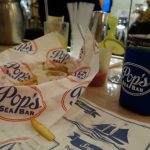
After Mayor Muriel Bowser ordered D.C. restaurants to close in mid-March to mitigate COVID-19, Pop’s SeaBar in Adams Morgan saw an initial 70% drop in revenue, says Dustin Beruta, the seafood restaurant’s general manager. In April, the restaurant received a mid-five-figure Paycheck Protection Program loan from the federal government that allowed it to keep paying its nine employees despite the slower business.
“The PPP was very, very helpful to us once we got it,” Beruta says. “It’s been really nice to take care of everyone who works for us. They are not only our employees, but our friends.”
The COVID-19 pandemic has strained small, locally owned businesses like Pop’s. Since March, at least 20 restaurants, pubs, and clubs in the District have permanently shuttered.
Meanwhile, well-heeled consulting companies, law firms, and nonprofit organizations were some of the D.C.-based recipients of interest-free PPP loans meant to help small businesses withstand the impacts of the crisis, records show. Those firms’ receipt of the loans raises questions about the effectiveness of the $660 billion program, which the Trump administration rolled out with pledges of providing relief to hard-hit businesses and propping up the overall economy. It also furthers discussions about what it means to be a “small business” as the U.S. undergoes a recession that’s anticipated to last for months.
The PPP was billed by the U.S. Treasury Department as a way for small businesses with generally fewer than 500 employees to cover overhead, retain employees, and rehire those who had been laid off as a result of the pandemic. But data released earlier this month by the U.S. Small Business Administration shows large PPP loans were received by District-based companies that have global business interests, pay some of their employees six-figure salaries, and, in certain cases, appear to have other means of raising money. (Precise loan amounts weren’t specified in the data; the SBA reported loan ranges up to $10 million.)
The program has sparked debate about what constitutes a small business and which entities should have been eligible for the aid. About 2,800 D.C. companies received loans of $150,000 or more as of July 6, when the SBA released partial data on the program after originally hesitating to do so despite calls for transparency from good-government advocates and lawmakers. Businesses owned by members of Congress, private equity-backed restaurant chains, elite private schools, and foreign companies also received PPP loans, the Washington Post recently reported.
“When this program was initially stood up, most Americans understood small businesses to be local institutions that may not have access to the global financial system or other sources of capital,” says Derek Martin, the director of Allied Progress at Accountable.US, a government watchdog group based in D.C. “In reality, we’ve seen this program benefit some of the largest hotel and restaurant operators in the country and very politically or economically powerful entities.”
DCist identified multiple loan recipients that are based in the District and have previously brought in tens, if not hundreds, of millions of dollars in annual revenue, according to public records and databases. In addition to major professional-services firms, the companies include a communications firm, a fast-casual restaurant company, a right-wing media outlet, and a philanthropic arm of the Catholic Church. (Nonprofits were eligible for the program, and the loans are forgivable if used within a certain time period.)
The SBA did not return multiple inquiries about how much money it loaned to D.C.-based businesses, why its guidance for the PPP shifted during the application process, and why high-revenue firms — some of which are publicly traded — received loans.
Cava Mezze Grill, headquartered in D.C. and known for offering Mediterranean food at more than 80 U.S. locations, received between $5 million and $10 million through the program. The company is worth $579 million and raised at least $450 million in revenue in 2018, according to the PitchBook financial database and Forbes. Cava, which also owns Zoë’s Kitchen, a fast-casual restaurant that has more than 250 U.S. locations and is based in Plano, Texas, did not respond to a request for comment.
Other District-based firms that received loans according to public data, even as they arguably stretch the conventional definition of small business, include:
- Wiley Rein LLP — a major law firm doing hundreds of millions of dollars in business annually and employing more than 200 attorneys ($5 million to $10 million loan range)
- Albright Stonebridge Group — a global consulting practice chaired by former Secretary of State Madeleine Albright ($2 million to $5 million loan range)
- John I. Haas Inc. — one of the world’s largest suppliers of hops ($2 million to $5 million loan range)
These companies did not respond to requests for comment. Nonprofit organizations like the Congressional Black Caucus Foundation, the Congressional Sportsmen’s Caucus Foundation, and Catholic Charities of the Archdiocese of Washington received PPP loans as well. The foundations both received loans worth between $350,000 and $1 million each, while the charitable religious group received a loan worth between $2 million and $5 million, according to public data.
The Daily Caller, a conservative media outlet co-founded by Fox News host Tucker Carlson, got a loan in the $350,000 to $1 million range. (Carlson sold his stake in the Daily Caller last year, the New York Times reported in June.) The Optical Society of America, which has about 22,000 members in more than 100 countries, scored a loan worth between $2 million and $5 million.
Economic consulting firm Bates White also received a loan in the $5 million to $10 million range. Bates White declined to disclose its recent revenue to DCist, but self-reported 150 employees and $75 million in revenue in 2012.
D.C.-based APCO Worldwide, a public-relations firm that generated $142 million in global revenue in 2019 and has nearly 800 full-time employees, received between $5 million and $10 million in PPP loans, the SBA data show. It’s not immediately clear how APCO got the loan considering its employee count, though it may have to do with the number of employees the company has in the U.S. as compared to its international offices.
The two larger entities that responded to DCist — APCO and Bates White — both say they followed the federal government’s rules in applying for and using the PPP loans to retain employees and pay rent, as the program intended.
“Given the unprecedented uncertainty caused by the global COVID-19 pandemic, we felt that without this support, we might have to take further actions including the reduction of staff,” a spokesperson for APCO says in a statement. “Lacking alternative sources of liquidity, the PPP provided us the only opportunity to receive support, which provided more security during this difficult and turbulent time in the marketplace.”
But Martin, of Accountable.US, says officials did not properly weed out larger businesses and that the program was essentially self-regulated. “Companies had to say on the honor system ‘We’re telling the truth here,’ and after that the SBA didn’t do a ton of vetting,” he says. “The result of that was you had companies that got this money even if they clearly had access to other capital or had other means to survive this crisis, while truly small businesses may not have.”
Although many conventionally defined small businesses in the District did receive PPP loans, they’ve faced changes in demand and coronavirus-related restrictions on economic activity, all while the virus continues to spread and the loan money runs out. Some have reported difficulties in applying for the program as well as other public aid.
D.C. resumed outdoor dining in late May under Phase One of its reopening plan and indoor dining with limited capacity in June under Phase Two. Pop’s revenue is now down about 45% from the usual levels, says Beruta, the general manager. It went back up in part because the restaurant got creative about its sales — adding drink holders, T-shirts, and water bottles — and continued takeout service.
Beruta points out that rent is the restaurant’s biggest expense, and that Pop’s is lucky to have a landlord who’s flexible about payments — something not everyone shares. “As long as we can stay open and pay people at least close to what they used to be making, we are going to keep doing it,” he says.
Beruta credits going to law school with equipping him to navigate the PPP application process. “When PPP first rolled out, it was a mess,” he explains. “I talked to other folks in the neighborhood who just kind of looked at it and said: ‘This is a lot of paperwork we don’t know how to do, we don’t know what the compliance is going to look like, and we don’t want to take the risk.'”
The confusion stemmed largely from numerous updates to the program as it was being implemented. This made it even more challenging for small businesses, especially those without access to attorneys and accountants, to figure out how to apply, says Allied Progress’s Martin. (It didn’t help that the first round of loans were snapped up in just two weeks.)
Minority-owned businesses have also suffered in the pandemic, with D.C. following a national trend of minority-owned businesses getting PPP loans at a lower rate than other companies. According to Accountability.US, only 2.9% of businesses east of the Anacostia River received loans, despite 9% of the city’s small businesses being located in that area, which is predominately Black.
“Businesses owned by people of color are likely to have fewer employees and less revenue than white-owned businesses,” says a recent report from the Center for Responsible Lending, a nonprofit research group based in Durham, North Carolina. “As a result, they were less likely to qualify for larger loans that would yield the higher fees that would make them a priority for lenders at the outset of the program.”
For now, the country is waiting to see if Congress will pass another emergency stimulus bill to keep the economy afloat as coronavirus cases continue to rise.
As for Pop’s SeaBar, Beruta says the business’s PPP loan ran out roughly two weeks ago.
“The temporary fixes are great, but it’s going to take more than that,” he says.