Margaret Barthel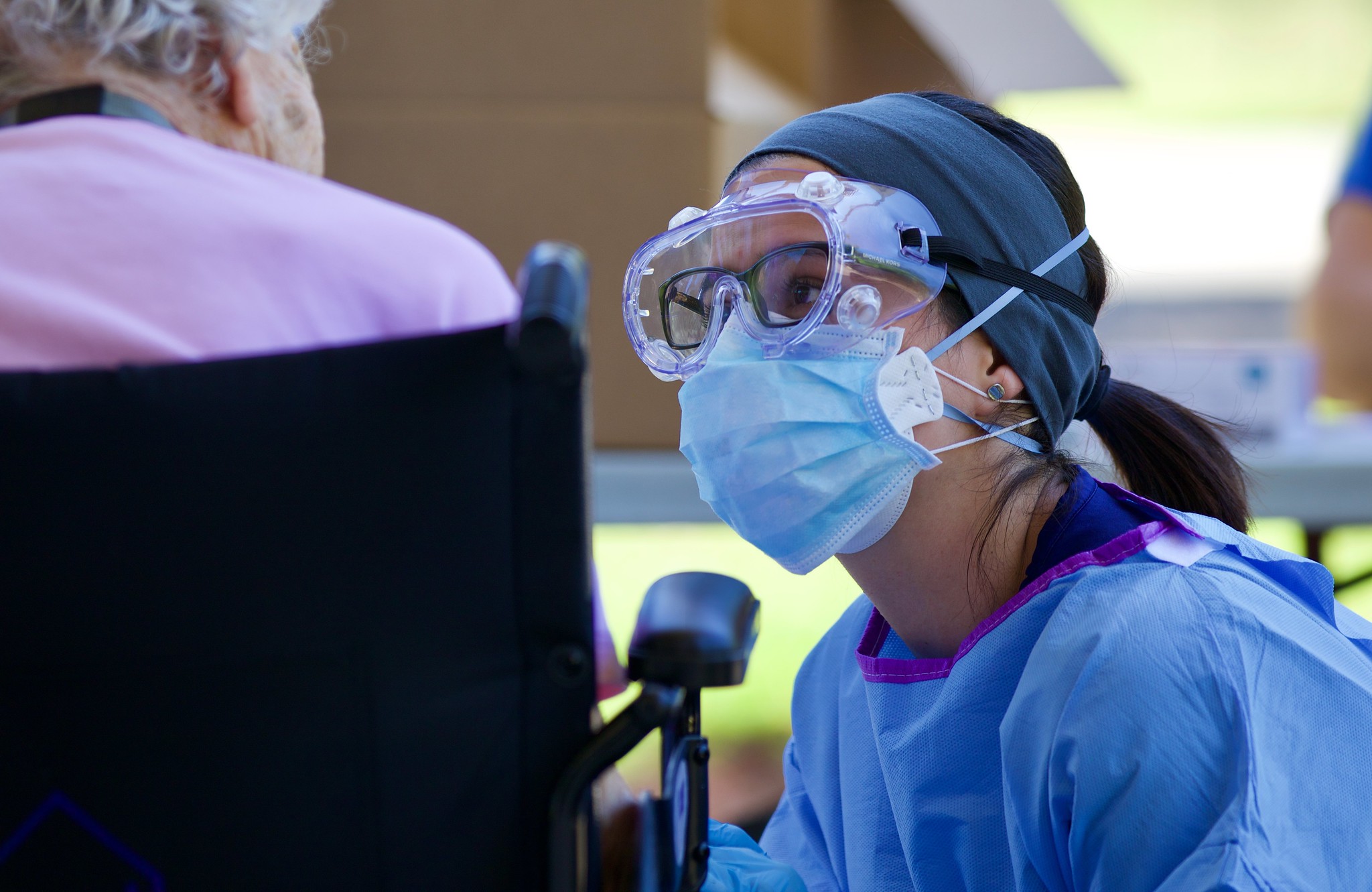
This story was last updated on August 17 at 5:55 p.m.
Maryland requires its nursing homes to test their staff for the coronavirus every week — and up until now, the state was processing the results and paying for the tests, too.
But starting on Saturday, the state’s 227 nursing homes will have to contract with private labs directly to process and pay for the weekly staff tests. Industry experts say that’s set off a race among nursing homes to secure testing contracts, even as labs are stretched to capacity.
Kevin Heffner is the president and CEO of LifeSpan, a mid-Atlantic senior services association with members in Maryland and D.C. He says the situation is giving him flashbacks to the mad dash to find personal protective equipment for nursing homes in March and April.
“There’s sort of that same kind of feel that people or providers are really under a tremendous amount of pressure to be able to do the things that they’re supposed to do, and still provide the care that they need to provide the people who are very frail and very old,” he said.
The state originally said it would stop managing and funding nursing home staff testing at the beginning of August, but pushed the deadline back by two weeks after the state’s long-term care industry associations expressed concerns about logistics and costs.
An expensive mandate
Regular testing of staff at nursing homes is seen as an important tool to catching and containing coronavirus infections, especially in asymptomatic workers. But it’s also costly — and nursing home budgets are already stretched thin as they contend with ongoing costs for protective gear and additional staffing.
Medicare and Medicaid pay a $100 reimbursement rate for each test result. Private labs quote prices as high as $120 per test, according to several industry experts quoted in this story. The next-cheapest testing option on the market is a $75 per test rate negotiated by LifeSpan and LeadingAge, another industry association, with two private labs. And most nursing homes say employee health insurance plans won’t pay for regular staff testing — typically, they’ll only foot the testing bill if an employee is showing symptoms and has a test ordered by a doctor.
Henry Moehring is the senior vice president of health care services and operations at Asbury Communities. He illustrated the testing costs at Wilson Health Care Center, the skilled nursing unit at Asbury Methodist Village in Gaithersburg. (Asbury runs eight facilities in total, including two in Maryland.)
“We’re testing upwards of 320 people a week. And when you look at the cost per test — that times 52 weeks a year, that’s more than a million dollars,” he said.
“I also realize the money that the state is paying for testing has to come from somewhere as well,” Moehring acknowledges. “So I’m mindful of that.”
Allison Ciborowski is the president and CEO of LeadingAge Maryland, an association of elder care providers.
“The way that folks are having to pay for this testing is taking out of operating budgets and other funds,” Ciborowski said. “Some providers are passing this cost onto residents and families because that’s the only way they can make it work to continue to stay in business and stay open.”
State Sen. Delores Kelley (D-Baltimore County), raised the cost issue during testimony this week with Jinlene Chan, the state’s deputy health secretary, during Maryland’s joint COVID-19 Legislative Workgroup.
“We have a real problem with nursing homes and assisted living facilities trying to meet the requirements, and requirements sound reasonable, except it isn’t clear how you can expect them to pay for the additional testing that is needed,” Kelley said. “I know the state’s broke, but these people are even broker.”
Chan said the state will keep talking with the industry to “understand where the challenges are and support where we may be able to,” but noted that the weekly testing requirement has been in place since May — as has the August deadline for the end of state support.
Nursing homes are ‘scrambling for the same service’
With the end of comprehensive state help looming, long-term care facilities are all entering the testing marketplace at once, trying to establish contracts with state-approved private labs whose capacities are already stretched.
“We’re all scrambling for the same service,” said Moehring ofAsbury Communities. “Needless to say, those labs have been busy.”
Moehring said he’d been in touch with four labs, and was able to come to an agreement with one that Asbury had worked with in the past.
Kyle Hreben is the executive director of The Village at Rockville, a continuing care retirement community.
“We are looking at various options, and it has changed throughout the week, in fact, with some of the private labs no longer being able to meet the testing needs of our community,” Hreben said.
On August 3, the Maryland Department of Health announced that it had arranged for nursing home staff testing to be processed by the University of Maryland Pathology Associates at a steep discount: $40 per test.
In the Maryland legislative meeting, Chan pointed to the state’s negotiations with UMPA as evidence that the Department of Health is continuing to support nursing homes in fulfilling the staff testing mandate, even as it takes a step back from managing and funding the entire process.
But the lab deal didn’t go quite as planned. Many nursing home leaders, including Hreben, reached out to UMPA to secure contracts with the state’s negotiated discounted rate. Twenty three nursing homes succeeded in establishing an agreement with the lab — but, according to an UMPA spokeswoman, 49 others received emails indicating the lab didn’t have the capacity to contract with them by the Friday deadline.
An email to nursing homes says UMPA is “working to onboard facilities as quickly as possible to meet the rising demand and will reach out to you in the coming weeks as additional capacity becomes available.”
An UMPA spokeswoman wrote in an emailed statement that the lab plans “to accommodate all COVID-19 testing requests of nursing homes in the state and are working urgently to ramp up our onboarding capacity to meet this important public health goal.”
The spokeswoman noted that UMPA is also conducting testing for state colleges and universities, correctional facilities and state employees.
Hreben says he has not heard back yet from UMPA. In the meantime, he’s secured a contract with another private lab.
Allison Ciborowski of LeadingAge Maryland called the capacity issue at UMPA “incredibly frustrating,” particularly given the existing strain on nursing home budgets.
Ciborowski also said there were flaws in the process for nursing homes getting in touch with UMPA in the first place. She heard from members that the original email address provided for contacting lab didn’t work, and then emails to a dedicated email address went unanswered — at least until UMPA told facilities it couldn’t process their tests.
“We were getting calls from members who were just in limbo because they obviously want to take advantage of the most cost effective option,” Ciborowski said.
And UMPA isn’t the only lab with limited capacity for nursing homes.
“Labs are so stressed at this point that, in addition to the University of Maryland lab saying that they can’t take on any new customers, we’re even hearing from some of the private labs that they’re becoming inundated by the volume,” Heffner said.
Another stumbling block is the state’s requirements for the labs themselves. In Montgomery County, officials negotiated with a local lab for a discounted rate, and agreed to pay for staff and resident tests not covered by insurance. Twenty two facilities signed up, according to the Montgomery County Department of Health, but the effort hit a snag.
“Our testing program through AdvaGenix is on hold while we await further information from the Maryland Dept. of Health about some issues with the AdvaGenix testing process,” said Enrico Lachica, who oversees the county’s long term care facilities, in an email. The county’s public testing is also on hold due to the review of AdvaGenix. It’s now trying to find another way to get tests to the 22 facilities.
Heffner of LifeSpan said there are two encouraging developments that might ease the cost burden and the chaos of nursing home testing in Maryland.
The federal government is expected to begin providing rapid testing devices to nursing homes across the country — which would reduce nursing homes’ dependence on private labs for processing tests. And there is an additional $5.1 billion in federal funding on the horizon, too, though it hasn’t reached nursing homes yet.
Until then, the costs of staff testing “is money directly out of their pockets,” Heffner said.
This story was updated to correct Kyle Hreben’s name and the location of Asbury Methodist Village.