Matt Blitz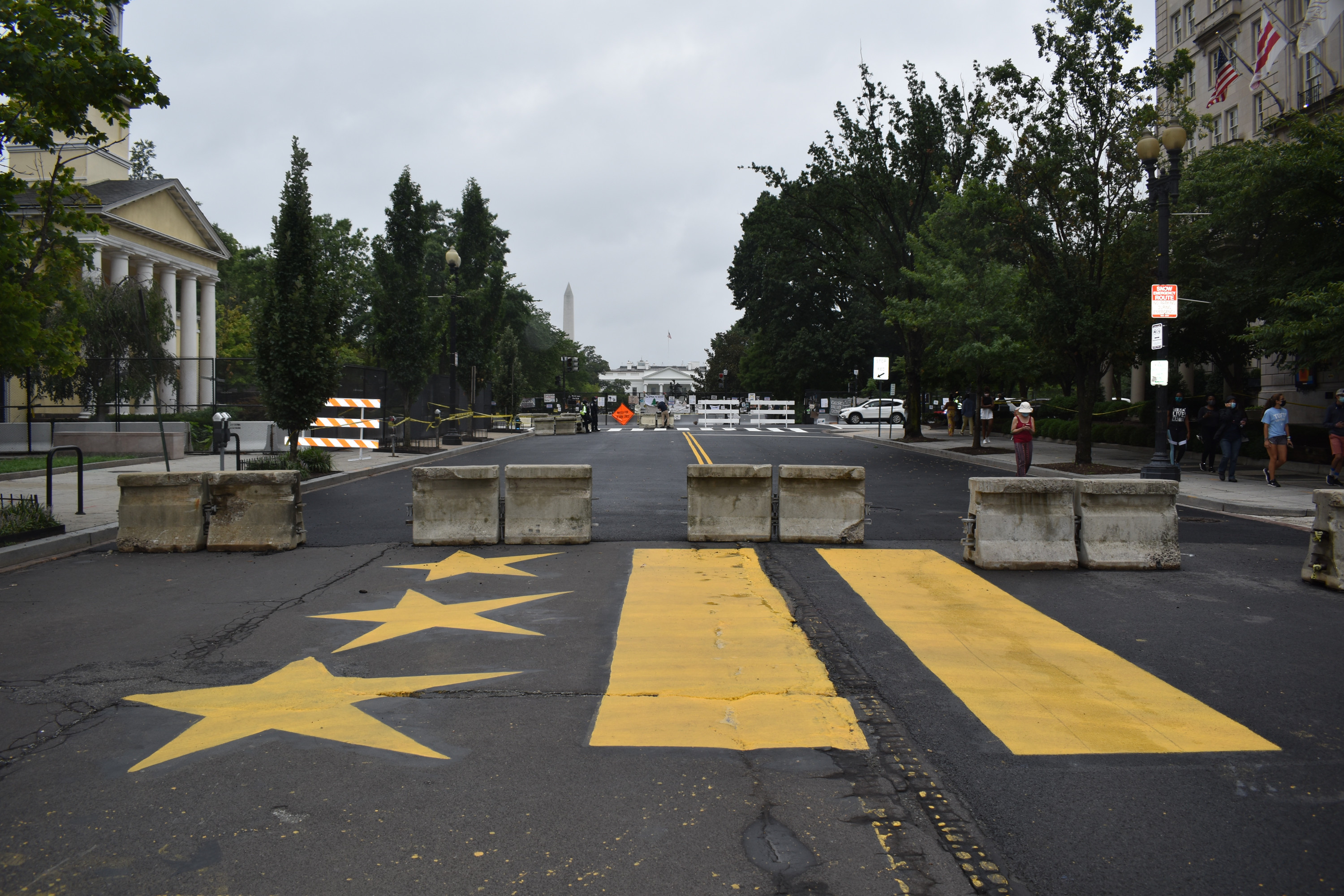
In June, days after D.C. Mayor Muriel Bowser unveiled the massive “Black Lives Matter” mural that attracted international attention, local activists added their own message.
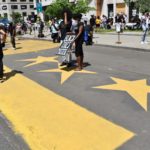
Using the same typography and bold yellow color, they changed the D.C. flag into an equal sign and wrote “Defund The Police.” As a result, the full message read “Black Lives Matter = Defund the Police.”
While D.C. Department of Public Works quickly changed the equal sign back to the D.C. flag, they did not alter the words. When asked about it at the time, Bowser said that the city encouraged expression but hadn’t had a chance to review it.
So for more than two months, the message remained on the pavement as a local addendum to the Mayor’s original national attention-grabbing statement.
But that message is now gone, seemingly paved over in the middle of the afternoon last week.
City officials confirmed to DCist that previously planned road work at 16th Street and H Street NW initially supposed to be completed last year led to the erasing of “Defund The Police” message last week.
“The District Department of Transportation approved a permit from a utility company to perform final construction restoration on 16th Street NW near the intersection with H Street NW,” a DDOT spokesperson wrote in an email. “The decision [to do construction] was made to allow the utility company to close out their work at the location.”
DDOT later said it was Verizon that was doing the restoration and construction at BLM Plaza that led to erasing of “Defund the Police.”
At Black Lives Matter Plaza on Sunday, this erasing of their message did not go over well with activists.
“Everything that is done that is unpopular in this country is done quietly. I feel like Muriel Bowser knew if it was publicized that this was happening, it would look even worse,” said Arianna Evans, who said she was on her 45th day of protesting. “Her paving over this quietly lets us know she’s not really on our side.”
Nearby, the Palm Collective hosted a “reclaiming” of the H Street Art Tunnel, where protesters’ art had also been removed. Bethelehem Yirga, the Palm Collective’s co-founder and a Ward 8 middle school teacher, said the “double blow” of “Defund The Police” being erased and the art being taken down has made the collective and other activist organizations realize they need to act quickly.
“Black Lives Matter equals defunding the police. We wanted to bring attention to that,” Yirga said. “Now, the Black Lives Matter Plaza that’s been out all summer… is changing. And the timing of the narrative is very interesting. It feels like the end of the summer and life is going back to usual. What the hell?”
Protesters have been calling for Bowser to defund the Metropolitan Police Department for months in the wake of nationwide protests over racial injustice and police brutality. Though the mayor’s initial budget proposal called for a 3.3% budget increase for MPD—an increase she publicly defended— the D.C. Council eventually approved an increase of 1.6%, making their new budget $568 million.
Yirga says that Palm Collective stands in solidarity with Black Lives Matter D.C., which is the organization that initially added the statement. When asked if she’s heard of a plan to re-write the message, she laughs. “Those are some good questions. But I don’t know if I have answers.”
Black Lives Matter D.C. has not responded to a request for comment.
The message is also at the heart of a legal battle in D.C. Judicial Watch, a conservative legal advocacy group, claimed in a lawsuit that the “Defund The Police” message allows the group to paint their own slogan on a city street.
Earlier this month, attorneys for the city said that even though the message was not part of the city’s original mural, it still counts as government speech.
Evans believes that the Black Lives Matter mural was largely symbolic and hopes that activists’ message continues to come across, even if it’s no longer painted on asphalt.
“I really feel like … [the city’s] goal was to slow down the protests. And it worked,” says Evans. “But we are going to continue to be out here. We are going to continue to be loud. We’re going to continue to use our voices because black people keep… at the hands of police.”
While she’s angry at the city’s decision to pave over their call to action, Evans — like Yirga — believes that this could be the thing that re energizes the movement.
“We are here to reignite the fire.”
The story was updated with the information that Verizon was the utility company that received a permit from the city to do construction at BLM Plaza.