Matt Blitz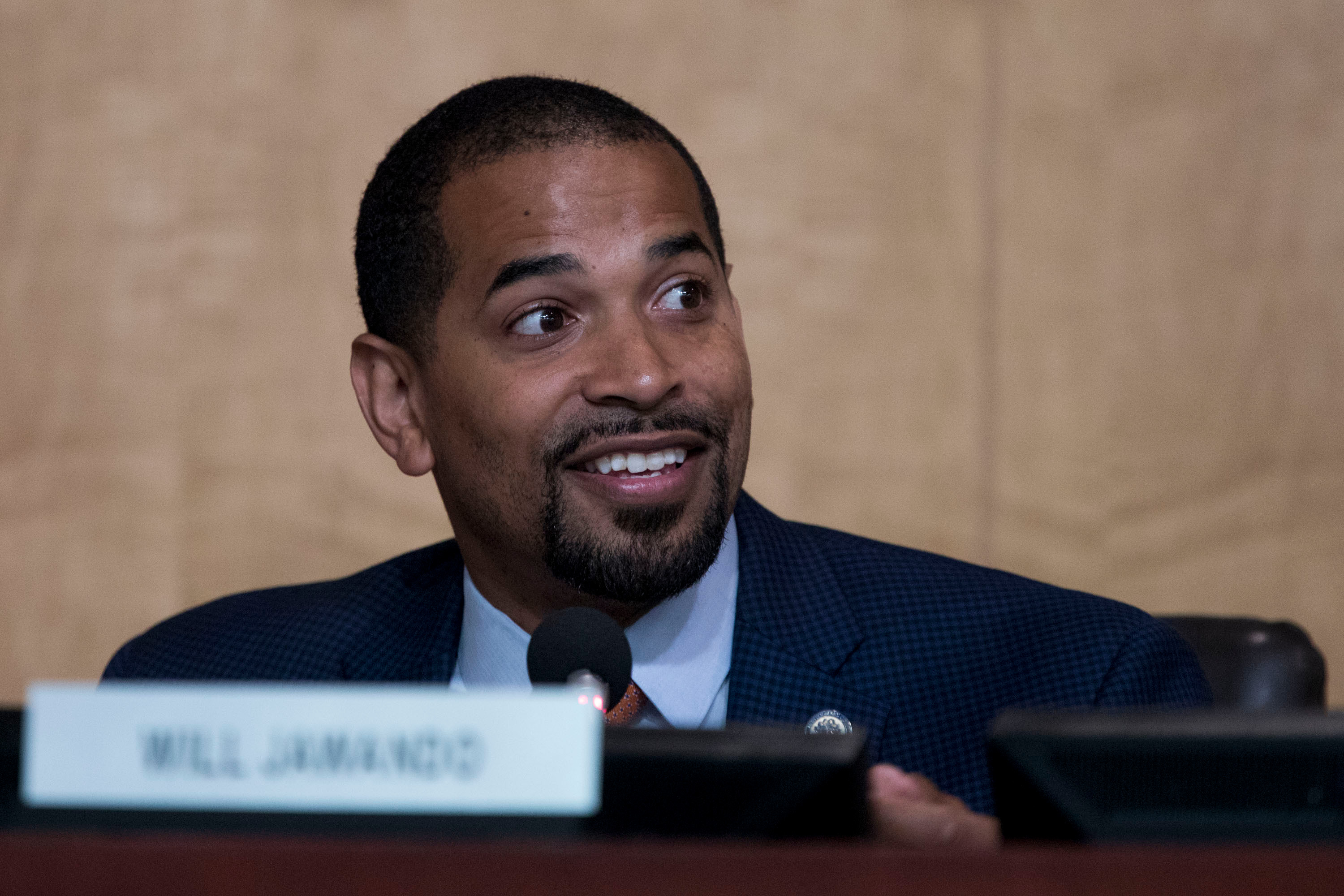
In June 2019, six months into his term on the Montgomery County Council, Will Jawando was stopped by police on his way to play basketball with friends. He had allegedly pulled a little too far up at a stop light. The first thing the officer wanted to know, Jawando wrote on Instagram, was whether the Lexus he was driving was stolen.
Jawando, who is Black, isn’t the first to experience a stop of this nature in the county.
Black drivers were nearly seven times more likely to be stopped in Montgomery County than white drivers in 2018, according to county data released in July. Black male drivers were also three times more likely to get a traffic ticket than white drivers, more than twice as likely to be searched, and more frequently cited as “probable cause.”
Incidents like this, Jawando says, “erode the trust in police and make it harder for everyone to feel safe and feel welcome.”
Personal experience and a life spent in Montgomery County have made the issue of local policing intensely personal for the 37-year-old lawmaker.
“I’ve been here my whole life, raising my family here,” Jawando says “But… we are very segregated, racially, ethnically, and socioeconomically. And we have significant challenges with policing.”
And Jawando, who built a career as a civil rights lawyer and worked in the Obama White House, has been championing police reforms ever since he was first elected to the county council in 2018.
A month before the traffic stop, the council had unanimously enacted a bill Jawando introduced that requires an independent and transparent review whenever a police officer is involved in the death of an individual. It was the first jurisdiction in the D.C.-region to enact such a requirement. Jawando has spoken out about Robert White, an unarmed man who was killed by police in Silver Spring in 2018. Jawando supported a sweeping racial equity bill in November 2019 that passed through the council.
In the months since the killing of George Floyd, Jawando has spoken at rallies and set up town halls about inherent racial equities and the need for police reform. Last month, he was a co-sponsor of a bill that would limit the use of deadly force and no-knock warrants and ban chokeholds.
But, despite it all, he doesn’t completely agree with the phrase “defund the police,” particularly when it applies to Montgomery County.
“To me, it’s really a synonym for reimagining policing and reimagining public safety,” says Jawando. “English is an imprecise language.”
While in D.C., police reform and defunding the police continues to be a weighted topic, in Montgomery County, one of the wealthiest counties in the country, there’s a bit of a different tenor, one that has shaped Jawando’s approach in proposing reforms, but not his resolve.
“I think there is a presumption, unlike D.C or maybe other jurisdictions, that we don’t have some of the same problems of disparities,” Jawando says. “But we do.”
Jawando grew up in a rented apartment in Quebec Terrace in the Piney Branch community located in Silver Spring. “When I was growing up, it was a mostly immigrant, mostly community of color, low-income neighborhood,” says Jawando, who’s the son of a Nigerian immigrant father and a white mother from Kansas.
The neighborhood remains this way. Nearly half of the residents in the 20903 zip code where Quebec Terrace is located are Hispanic. More than a quarter are Black. 60% of residents rent. It’s also one of the hardest hit zip codes in the county for COVID-19.
When Jawando was a teenager, he lost a friend to gun violence. “Hearing gunshots and wanting to feel safe is something I grew up with,” says the first term at-large council member. “It’s actually one of the reasons I was very interested in law enforcement as a young man. It came from wanting to protect my community.” He was an AmeriCorp member in the Montgomery County Police Department for a year after graduating high school before attending Catholic University. He even had an FBI honors internship while in college. But he didn’t go into law enforcement, but rather law school and eventually became a civil rights attorney.
Jawando’s more positive image of the police began to fade away as he grew into being a Black man in America.
In the mid-2000s, while riding in a car with law-school friends, he was arrested when one of them shouted an obscene remark at an undercover female police officer. While the incident was later expunged from his record, Jawando wrote in 2015 about why—despite knowing that he had done little wrong—he thought about running from the police that day.
“I wasn’t having a bad day, I didn’t have an outstanding warrant and I knew I had done nothing wrong,” he wrote. “But I also knew that arrest—not conviction, but a single arrest—could severely imperil my future right then and there. Suddenly, despite my success in life, I could see myself becoming yet another black man swallowed by our elaborate criminal-justice system—another statistic.”
Today, he does count himself as a statistic. “I’m like one of two Black men by the time they’re age 23 in this country who have been arrested,” he says.
Jawando acknowledges there’s a gap in the public’s understanding that can make his calls for police reform feel less urgent to a large portion of the county’s population. Montgomery County remains 60% white, 20% Black, and 20% Hispanic or Latin according to 2019 U.S. Census estimates.
“If you are a white person in Bethesda, you are experiencing policing much differently than a Black person in Briggs Chaney,” he says. “I think people are starting to understand that. On both sides.”
Jawando believes that a majority of officers “want to do the right thing” and this “reimagining” of the police as opposed to defunding is about giving them the resources, the data, and the training that allows them to do just that.
He believes that police should focus mostly on violent crimes, as opposed to crisis intervention.
This would include shifting some responsibility of the police to the county’s Health and Human Services Department. “Police shouldn’t be responding to… individuals who are experiencing homelessness or to individuals who are dealing with a mental health crisis,” Jawando says. “We are exploring here in the county [having] social workers, medics or nurses – folks who deal with crisis intervention – respond instead of or alongside law enforcement.”
Jawando also cites the incentive structure around traffic stops that needs to be looked at.
These proposals are not defunding the police, in fact they may require increased funding, but Jawando credits the phrase for starting an important dialogue. “It’s been successful in creating the conversation and also being an urgent call for action.”
He knows that some on both sides of the debate don’t necessarily fully agree with him.
“Whether you agree or disagree, it makes people dig into…what [defunding the police] means and what it doesn’t mean.”
What he truly worries about is that the community he grew up in and is raising his family in is susceptible to a violent police incident similar to the killing of George Floyd.
“If you think we can’t be Minneapolis, you only need to look at the case of Mr. Pesoa.”
In July 2019, a Montgomery County police officer, after arresting 19-year-old Arnaldo Pesoa on a drug charge outside of an Aspen Hill McDonald’s, can be seen in a video very aggressively shoving a knee into the back of Pesoa’s head. The officer was later found guilty for assault while in office.
“The way that knee came down and his head hit the ground and started bleeding right away, he could have broken his neck… and could have been killed,” Jawando says. “And officers are standing right around watching, just like with George Floyd, and did nothing to intervene.”
“A lot of times, people think it couldn’t be us.”