 Dominique Maria Bonessi
 Jeffrey Katz
 Tamika Smith
 Colleen Grablick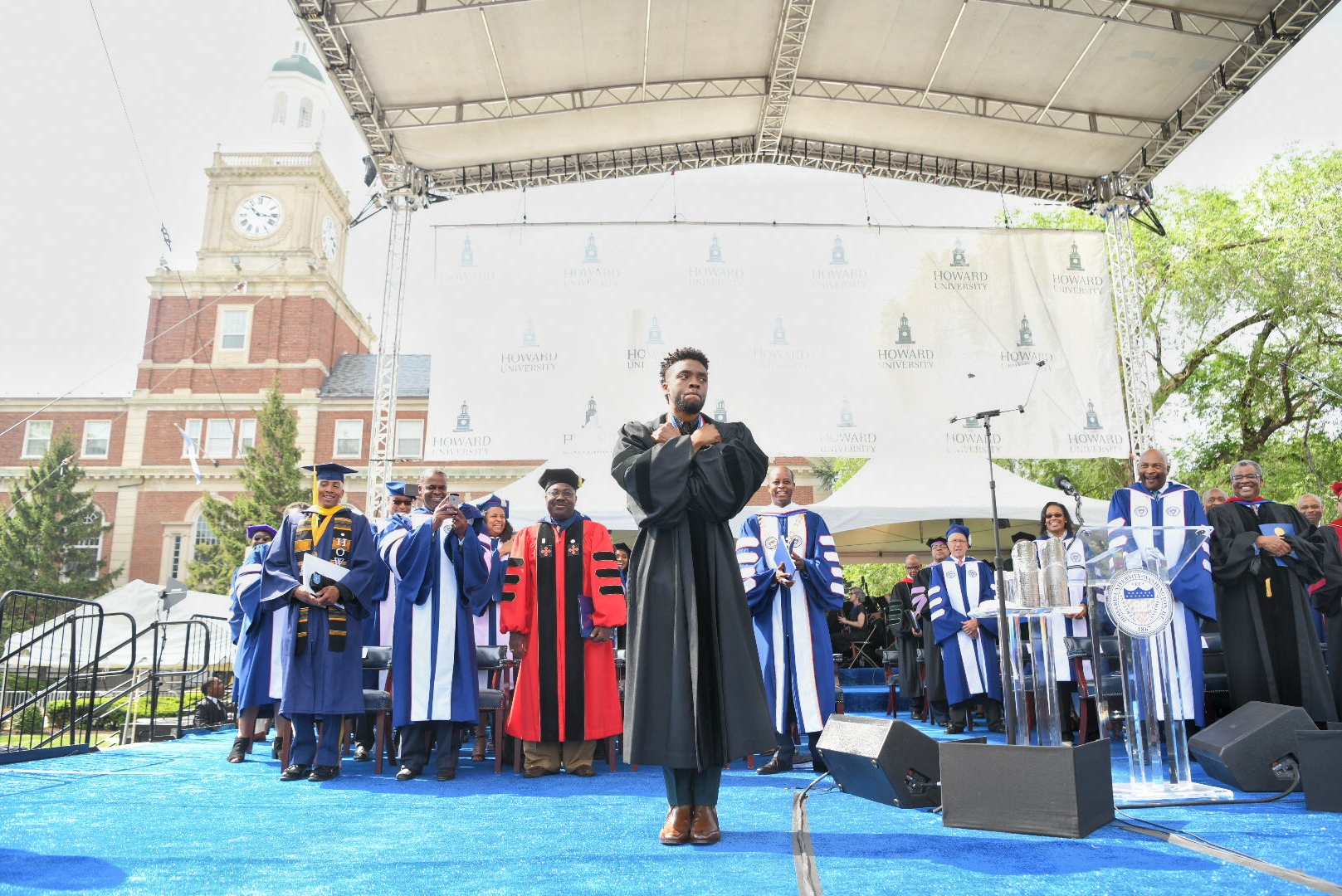
This post was updated at 11:58 a.m. Monday.
Actor Chadwick Boseman’s shocking death at age 43 hit close to home for many Washingtonians, especially at his alma mater, Howard University.
Boseman told graduates in a commencement speech two years ago they should be motivated by a sense of purpose, and face life’s challenges without fear. Though it was not publicly known at the time, Boseman had colon cancer. He succumbed to the illness Friday night, after a four-year battle.
His death prompted mourning and words of appreciation for an acting career notable for excellence and dignity. He was known for his strong portrayals of Black heroes, including Jackie Robinson, Thurgood Marshall and fictional African leader T’Challa from Black Panther.
Locally, those on-screen portrayals made news of Boseman’s passing a particular blow among Black families — as well as to the extended Howard University family.
In a 2013 appearance on WAMU’s Kojo Nnamdi Show, Boseman explained why he chose to attend Howard.
“I knew there were a lot of great actors that came from there and artists that came from there,” Boseman told host Kojo Nnamdi. “So it just seemed like the greatest place to pursue, you know, acting, directing, writing, to be around Black theater.”
Shortly after his death, Howard University tweeted, “His incredible talent will forever be immortalized through his characters and through his own personal journey from student to superhero! Rest in Power!”
Democratic vice presidential nominee — and Howard alumnus — Kamala Harris was among those expressing condolences. Harris tweeted that she was heartbroken and described Boseman as “brilliant, kind, learned, and humble.” Boseman was among many Howard alumni who cheered Harris’ nomination just a couple of weeks ago.
Boseman had compared Howard University in an interview to Wakanda, the fictional country in Black Panther, where Black people “from all over the diaspora” gather and experience “an influx of culture.”
Vera Katz, Boseman’s acting professor at Howard, tells WAMU/DCist that as a student he was “a champion for his people early on in the class, he was a thinker, he would ponder” what was said in class.
“He was always fighting for justice,” she says.
Katz says he was often on the school’s Harriet Tubman Quadrangle, a meeting and activism space for students. On one such occasion in his senior year during the school’s Charter Day, Boseman and two other students got up on stage and took over the microphone while then-University President Patrick Swygert was making a speech.
“They disrupted the event,” Katz says. “Chadwick said, ‘Do not close the college of fine arts.”
Katz recalls Boseman and his friends were “ejected from the ceremony.”
“We were trying to keep it open because it was the only Black college of fine arts in the country,” she says, an effort that later failed.
Howard University’s fine arts program produced such artists as Phylicia Rashad, Debbie Allen, Isaiah Washington, Richard Wesley, Donny Hathaway, Roberta Flack, Anthony Anderson and Taraji P. Henson.
Boseman graduated in 2000 with a bachelor’s degree in fine arts. When he returned in 2018 to give his commencement speech and receive an honorary degree, he referred to student activists who had taken over a university building in a protest over a financial aid scandal shortly before. Katz says he continued to push the university to reopen the college of fine arts and even offered to donate to its rebirth.
In his interview with Nnamdi, Boseman recalled being active in the D.C. theater scene while a student here. “I was an intern at Woolly Mammoth Theatre, Arena Stage, I was all around, you know, Studio Theatre, everywhere,” he said.
With the financial help of other celebrity alumni like Rashad and Washington, Boseman made his way to Oxford University to study for a summer at a prestigious theater program. He started his acting career on Broadway and then on television, experiencing racism and adversity along the way.
For Black residents and their families, seeing Boseman’s portrayals of the Black community on screen was empowering.
Ada Anagho Brown, president of Roots To Glory Tours in Stevenson, Maryland, tells WAMU/DCist that Boseman had a genuine interest in researching and knowing his characters.
“It’s not just about that person, it’s about the community,” says Brown, whose company conducts tours for people who want to connect with their roots in Africa.
Brown, a Cameroonian American, says Boseman represented his community, whether it was portraying a baseball player trying to break the color barrier, a lawyer fighting for equal rights, or the fictional African leader of Wakanda.
“Without being a continental African, he was able to portray Africa in a way that nobody had any issues with,” Brown said. “We felt like he gave us justice, he served us so well … He was the perfect person to bring that style, that class.”
Brown has two college-aged students and says watching Black Panther helped them understand their African heritage.
“Before the movie they were like, ‘yeah, my mom is African,’” Brown says. “And after the movie they were like, ‘And I’m African too.’”
Takoma Park resident Tameka Montgomery tells WAMU/DCist that she and her three sons — ages 10, 12, and 14 — loved watching Boseman on screen in Black Panther, 42, Marshall, and Da 5 Bloods.
“One thing I really admire about Chadwick Boseman is that he used his craft as an actor in a way that gave a very positive representation of the Black community,” Montgomery says. “I felt like the roles that he took, it was very intentional about being uplifting and empowering. Jackie Robinson, Thurgood Marshall, Black Panther — even though that’s a fictional character — it really was very empowering.”
Montgomery’s oldest son, Silas, says he rarely can watch a movie twice. But Black Panther was one of the few films he could watch over and over again, noting how “strong” he thought Chadwick looked in the role.
He says he and his family will likely re-watch the movie again this weekend.
“There’s certain people who just can’t play a certain role, and he was the kind of person that was made for that role,” Silas says.
He also admired Boseman’s work in Da 5 Bloods, describing his character in the film as an “activist soldier.”
For Montgomery, Boseman’s death is yet another devastating loss of 2020, and she says that her thoughts are with his family.
“I think about his family and what they’ve been going through with him, on top of everything we’ve all been going through with COVID, and with the issues with all of the police brutality and the protesting that’s going on, and we’re in the midst of an election,” Montgomery says. “It’s just a lot.
This story was updated to include comments from Tameka and Silas Montgomery. It was also updated to note that Denzel Washington was not an alumnus of the Howard University program, though he did contribute to it financially.