 Eliza Tebo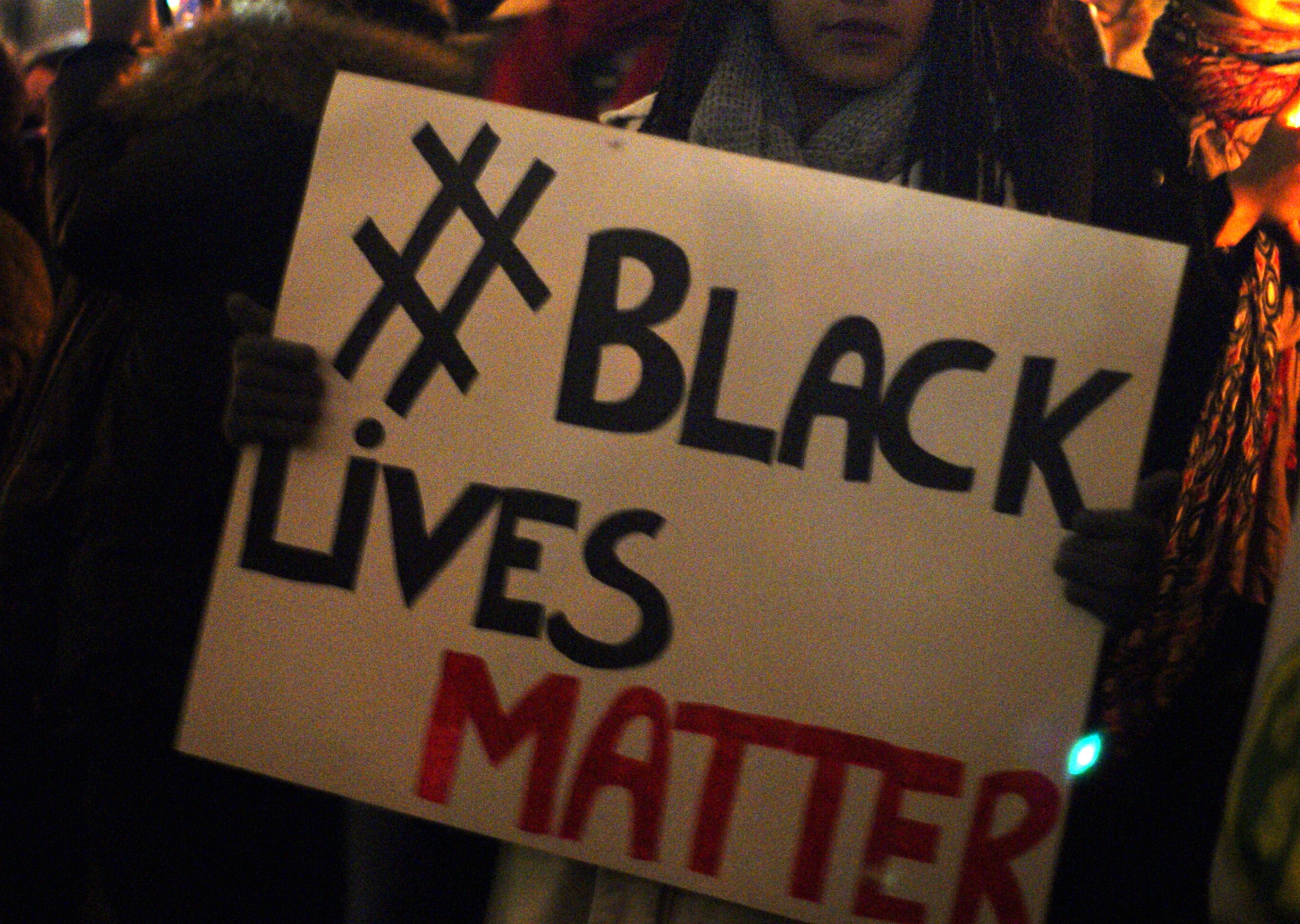
This story was last updated at 7:56 p.m.
For a second consecutive night, a demonstration in downtown D.C. turned violent, as police and activists collided near Black Lives Matter Plaza.
Just after midnight on Monday morning, D.C. police officers used forceful tactics, including chemical irritants, to disperse a crowd that D.C. Police Chief Peter Newsham said had grown “increasingly aggressive.” At a press conference Monday, both Newsham and D.C. Mayor Muriel Bowser pointed to “outside agitators” for spurring conflicts over the weekend between protesters and law enforcement. This isn’t the first time D.C. officials have made that claim — Newsham insisted in early June that “outside agitators” were to blame for violent clashes, but arrest and prosecution records from mid-June showed otherwise.
“They appear to be folks who are coming into our peaceful city with the intent of destroying property and hurting folks,” Newsham said.
https://twitter.com/nu1wcf/status/1300288980433469440
Officers on bicycles tackled some protesters early Monday, threw some against parked cars and held others against the sidewalk, according to the Washington Post. Some protesters also said they saw demonstrators throw water bottles at police officers moments before they moved in on the crowd.
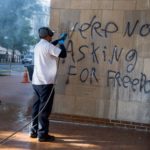
Protesters used smoke bombs, fireworks, and “other munitions” against nearby police officers on Sunday night, Newsham said. They also defaced property using spray paint, he said. Just before midnight, Newsham said they “became increasingly aggressive,” throwing urine-filled balloons and bricks at officers, as well as spitting at them. MPD arrested 14 individuals, who were charged with felony rioting. Five MPD officers were injured, and two MPD vehicles were damaged, Newsham said.
More than 70% of those arrested Thursday thru Monday at protests in the District are not D.C. residents, Newsham said.
“We welcome peaceful demonstrations like we had on Friday,” Newsham said, referencing Friday’s largely peaceful March on Washington. “If you come to the city with the intent on destroying property or hurting people, we have a responsibility to take you into custody.”
The MPD will release a breakdown of the home states of those arrested, which Bowser says will likely include residents of Maryland; Virginia; Portland, Ore.; and Minneapolis. Of those arrested during demonstrations in D.C. from May through August, 83% are from D.C., Maryland or Virginia.
D.C. Mayor Muriel Bowser said Monday that brutality in all forms has no home in the District.
“We will not tolerate violence of any kind in Washington D.C.,” she said at the conference. “We don’t tolerate it if it’s on the streets between rival crews and we won’t tolerate it against our police officers, the men and women who are charged with keeping our community safe. And we certainly won’t tolerate it against our residents and visitors.”
Bowser appeared to place much of the onus for recent flare-ups between activists and police on “outside agitators,” whom she says took to D.C. streets on the heels of the Republican National Convention and may have remained throughout the weekend. These visitors, she said, came “armed for battle,” with baseball bats, laser pointers and fireworks.
“Our collective attention in the District of Columbia is reducing violence of all kinds and of all forms and in all places,” she said. “What we’re certainly not going to do is stand by and allow outside agitators to come to our city to distract us from the work of D.C. residents.”
While Bowser said D.C. police haven’t connected non-D.C. residents with a particular group or funding source, she said it wouldn’t be “a big leap” to say these individuals are backed by an organization.
The MPD has intelligence linking a van present at Saturday night’s protests to activity in Kenosha, Wis., and Portland, Newsham says. The van, whose driver was arrested for reckless driving, is registered in Washington state and matches images of a van used at protests in those two cities, Newsham says. Both are recent sites of violent and sometimes fatal clashes among demonstrators, counter-demonstrators and law enforcement.
The FBI is working with the MPD on an investigation into any potential outside groups that may be behind the weekend’s violence, Newsham said.
“There’s a potential that could be the case, that it could be domestic terrorism,” Newsham said. “This isn’t just Washington, D.C.; we’ve seen violence in other cities, and to the extent that that is coordinated, us in law enforcement, we have a responsibility to find out if it is.”
The MPD made no arrests during Friday’s March on Washington, which brought large crowds to the city to protest police brutality and systemic racism. Newsham said that day of protests sat in stark contrast to the events of this weekend.
“Police officers are human beings too,” he said. “When you throw bricks and rocks and bottles and urine, and you set fires, there is going to a police reaction. So folks who want to suggest or paint the picture that this was somehow peaceful, and the police indiscriminately used munitions against them, they’re not being honest.”
https://twitter.com/aletweetsnews/status/1300286542100000768
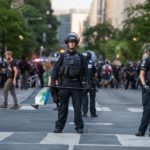
About a hundred people gathered in downtown Washington Sunday night for a march that wrapped up around midnight near St. John’s Episcopal Church. D.C. police officers hoisting shields lined the perimeter. Shortly thereafter, clouds of smoke from what appear to be flash bangs filled the intersection as an activist yelled, “Fight back!”
Sunday night’s protests marked a second successive night that D.C. police engaged with activists using a show of force. On Saturday evening, police used flash bangs, chemical sprays and nonlethal bullets to disperse crowds in downtown D.C. The MPD used OC spray, a type of pepper spray, as well as sting balls to disperse crowds, Newsham said. Six officers were injured and five individuals were arrested, he said.
Bowser signed both temporary and emergency legislation banning D.C. police from using chemical irritants to “disperse a First Amendment assembly” earlier this summer. But it remains unclear how the law applies to this weekend’s events.
On Monday, President Donald Trump tweeted that mayors leading sites of “crazy violence” have “lost control of their ‘movement.'” Bowser said she’s been in touch with the Trump administration and would continue to communicate with officials who “can impact safety” in D.C.
Some question whether tougher police tactics, which have been embraced by Trump, might only intensify existing tensions at future protests.
“What I’m worried about is this country descending into a race war,” Bowser said. “And I’m worried about the continued incitement of violence from leadership who should be focused on bringing our communities together. … Our police and peaceful protesters will be safer when we come together as a community and tamp down this black versus white rhetoric.”
https://twitter.com/realDonaldTrump/status/1300428128309907457
Tension With Federal Prosecutor’s Office
In one tweet, Trump specifically told Bowser she should arrest “agitators and thugs! Clean up D.C. or the Federal Government will do it for you.”
On Monday, however, Bowser also criticized the U.S. Attorney’s Office for D.C., saying it has failed to prosecute people for alleged acts of violence at this summer’s protests.
“When we arrest people with felony charges, we need the U.S. Attorney for the District, who is a federal appointee of the president, to prosecute them,” Bowser said at a press conference Monday.
“Right now there’s no accountability for people who came to these protests and attacked our police. And we haven’t seen a willingness from the U.S. Attorney to prosecute them.”
The Attorney’s Office pushed back, stating that Bowser’s assertion is “patently false and serves no purpose other than to pass blame and foster innuendo.”
“Since the protests began, this Office has never turned down a single case for prosecution in which there was sufficient evidence to support probable cause,” the office said in a statement Monday evening.
In D.C., the U.S. Attorney’s Office oversees prosecution for local crimes in addition to federal cases.
The office says it has “aggressively charged 121 criminal cases” between late May and the beginning of August, including charges of assault on police officers and federal agents; arson cases; and destruction of property. This weekend, the office brought criminal charges against five people.
Bowser, however, said that MPD has submitted 63 affidavits to the Attorney’s Office in support of arrest and search warrants related to protests, but that the federal prosecutor declined 28 of those petitions, while another 24 are still pending review.
She also specifically called out protests on Aug. 13, when MPD arrested 41 people for offenses related to “felony rioting” and “assault on a police officer.”
Bowser said the U.S. Attorney’s Office declined to prosecute 40 of those people.
Prior to making those arrests, police had corralled (or “kettled”) a group of protesters in Adams Morgan.
The tension between Bowser and the U.S. Attorney’s Office over prosecutions could stem in part from the sometimes violent protests at President Trump’s inauguration in 2017, when hundreds of protesters were arrested and charged with felony rioting. But when the cases were taken to trial — based on evidence gathered by MPD — most ended in not-guilty verdicts and dozens more were ultimately dismissed by the U.S. Attorney’s Office.
This story was updated with additional details on the protests and comments from Bowser, Newsham, and the U.S. Attorney’s Office.