Margaret Barthel
As the region heads in to another holiday weekend and the end of an unprecedented summer, progress at containing the coronavirus outbreak in the D.C. region is still mixed. But much of the region is still forging ahead with reopening.
Maryland is moving into Phase Three of reopening on Friday — Montgomery County isn’t following suit. D.C. is reporting an “increasing trend” in community spread and remains in Phase Two. And Virginia Gov. Ralph Northam said Tuesday that the state will not make changes to its reopening status — currently in Phase Three — before Labor Day, citing a spike in cases after Memorial Day.
“We need to think back to Memorial Day and July the Fourth,” Northam said in the press conference. “We saw surges in the week to two weeks following those holidays.”
And there are still questions about how jurisdictions are approaching handling some of the data.
Here’s what we know about the trajectory of the coronavirus in D.C., Maryland and Virginia.
D.C.
D.C. reported 47 new coronavirus cases for August 20, the latest date on which it released data, bringing D.C.’s total case count to 14,135.
The District says it’s meeting the majority of its coronavirus benchmarks: the positivity rate for test results is below 5%, the transmission rate is low, hospitals have unused capacity, and progress is being made with contact tracing.
But there are two big stumbling blocks. The percentage of new cases from quarantined contacts, a measure of how many people who get sick who D.C. contact tracers have already connected to a coronavirus-infected person, is at 7%. That’s far below the District’s 60% goal.
And D.C. also says it’s seeing “an increasing trend” in community spread.
If you glance at D.C.’s visual for community spread data, the most recent dots on the trend line mostly trend downwards. So how can community spread be increasing?
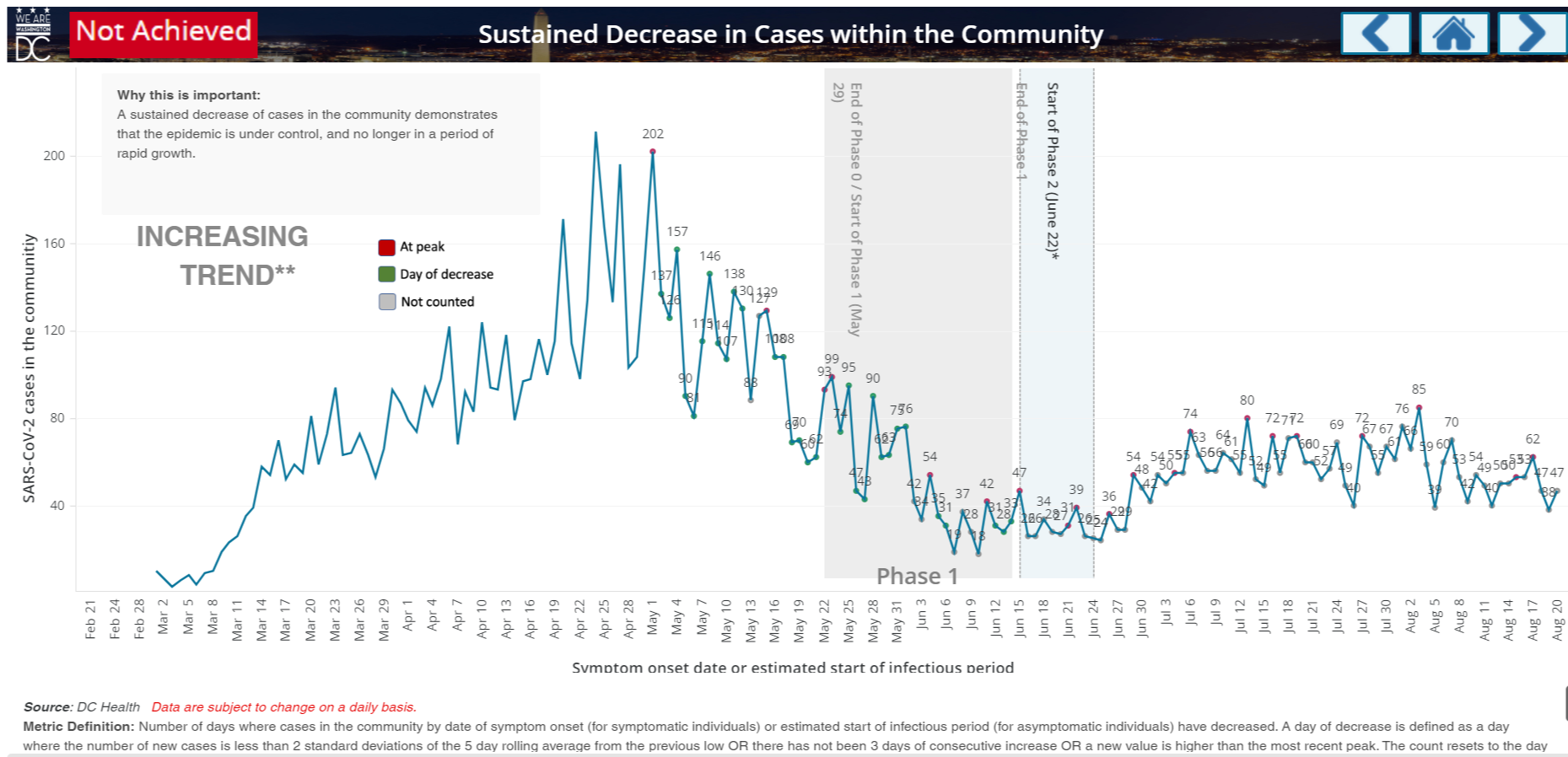
That’s because D.C. isn’t just relying on the change in new case numbers from day-over-day to establish a trend in the data. Instead, an “increasing trend” happens when “new peaks have values exceeding previous peaks.” So, even though the last few data points represented on the graph show a decline, the trend is still considered to be going up because the last peak of cases was larger than the peak before it.
Another confusing thing about D.C.’s community spread data: The latest data point reported is weeks ago — August 20.
That’s for a few reasons: The District counts COVID-19 cases based on the estimated date of symptom onset (when the person started having symptoms, or when an asymptomatic person started being infectious) instead of the date the positive test result came back. That helps to get rid of irregularities in the data that might come up because of lab processing, like fewer cases being reported over the weekend because testing sites aren’t open or labs aren’t processing tests on those days.
D.C. also delays releasing day-by-day case numbers by almost two weeks (that’s why the latest entry is August 20, not September 2) — a lag time that officials say is to “reduce volatility in the data” due to nationwide delays in test processing.
That lag time between the dates D.C. releases information and the symptom onset days increased from 7 to 11 days in late August, and now stands at 13 days. DC Health says this way it shows “the most complete data.”
All this may sound like a very confusing way of going about representing numbers of new coronavirus cases, but it underscores one important piece of context: whether case numbers are up, down or flat each day, they can only ever provide a snapshot into what already happened weeks in the past.
Maryland
Maryland reported 693 new COVID-19 cases on September 3, bringing its total to 110,012.
Gov. Larry Hogan announced Tuesday that Maryland will enter a Phase Three of reopening starting Friday. Movie theaters and entertainment venues will be allowed to reopen at half capacity, and retail shops and houses of worship will be allowed to increase their capacity — all happening just as the holiday weekend arrives.
Among other things, Hogan touted the state’s “continued and sustained drop in cases per 100,000 [people],” noting that over the month of August that metric dropped by 45%.
But August’s declining rate was still noticeably higher than the rate of cases in mid-June.
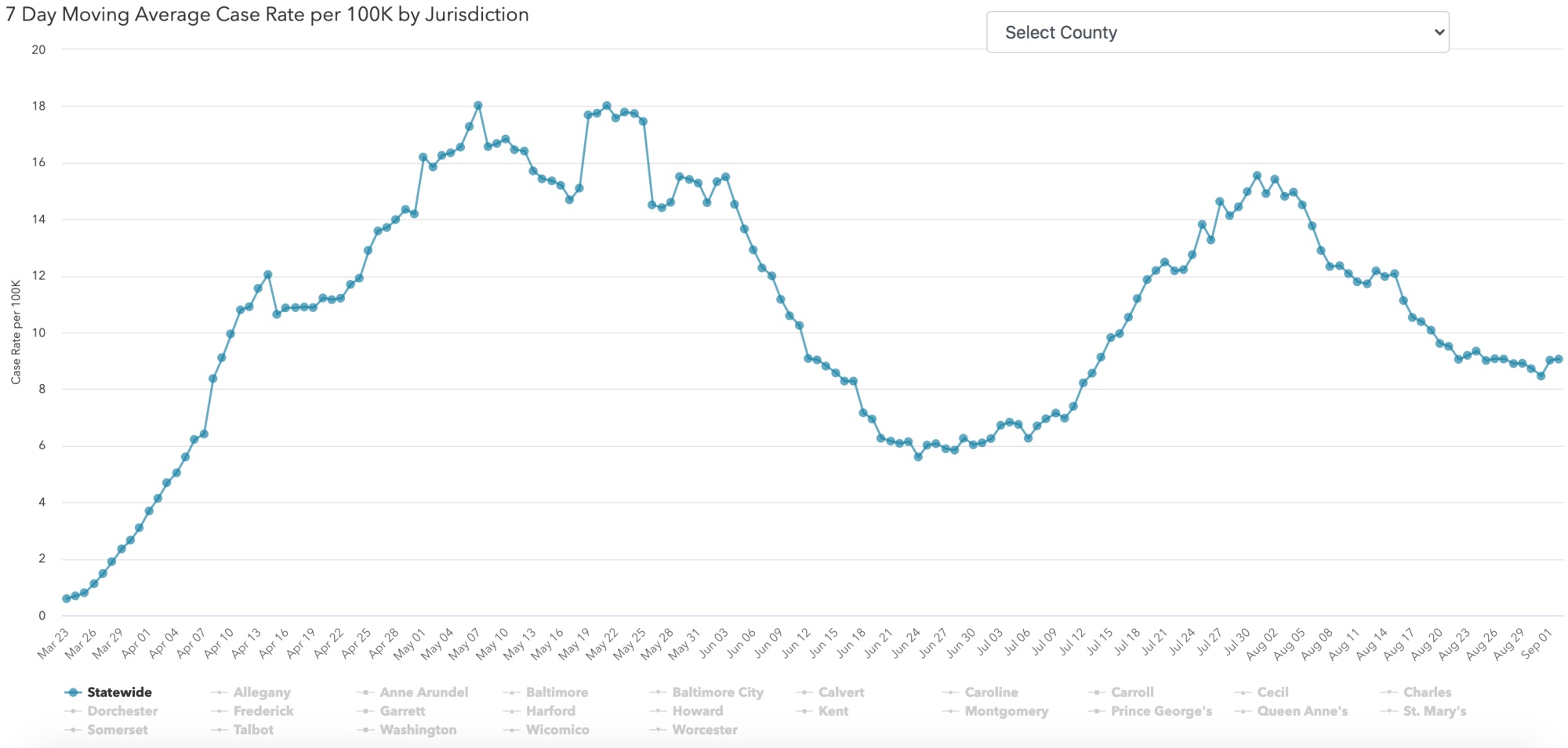
Montgomery County officials announced on Wednesday that it will not move ahead with the rest of the state in the full Phase Three reopening, though it may announce changes to some of its Phase Two restrictions later this week.
“I am disappointed because none of the elected officials in the state got consulted on this,” County Executive Marc Elrich said at the briefing. “Nobody asked us what we know. What do we think? What are you hearing? What are you experiencing?”
Elrich also pointed to a worrying spike in the positivity rate — which measures what percentage of the tests conducted for a specific location come back positive, and can give clues about how widely the virus may be circulating undetected in a particular location — in Worcester County, home to Ocean City and its popular beaches.
“One of the things I’d love to know is how many people who got COVID had a vacation in Ocean City,” Elrich said. “We don’t exist in a vacuum. There’s no wall around Montgomery County.”
Virginia
Virginia typically averages out the number of new coronavirus cases over the course of a week. From August 21 to August 27, Virginia averaged a total of 843 new positive cases. Northern Virginia’s 7-day average is roughly 182 cases for the same time period. The state reports 123,668 total positive coronavirus cases.
Virginia’s case numbers are also in decline, though like Maryland, the commonwealth has also not returned to the case levels it had in June.
“Overall, the coronavirus is moderately contained in Virginia,” Gov. Ralph Northam said in a press conference on Tuesday.
But Northam said Virginia would not make changes in its reopening status before the holiday weekend, instead holding steady in Phase Three. He also cautioned that Virginia — along with the rest of the nation — saw spikes in cases following Memorial Day and July Fourth weekend.
“This virus is still alive and well around the Commonwealth of Virginia,” he said.
As in D.C. and Maryland, there are some complexities worth noting in Virginia’s case numbers. Unlike D.C., the Virginia Department of Health adds positive cases to its graph as they come in, instead of waiting to post the numbers for a single day in one batch. That means that the current graph — in particular, the most recent days — could change as more test results arrive and are added to the corresponding date of symptom onset.
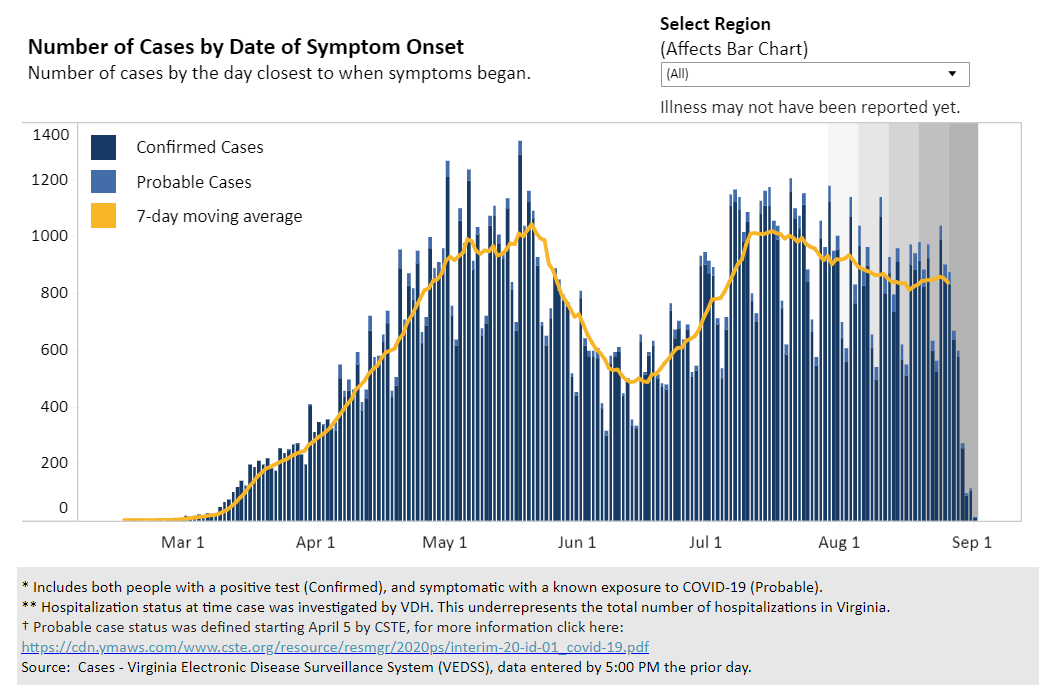
Processing times for tests can vary, a VDH spokeswoman told WAMU/DCist in an email.
“Since mid July, we have been seeing both in the Commonwealth of Virginia and nationwide, very lengthy times for residents to receive their COVID19 test results,” the spokeswoman wrote. “We investigated these turnaround times further and found within our hospital settings the turnaround times are now 1-2 days, in cases of public health investigations generally 2-4 days, but for those seeking results through their private healthcare provider, a community testing site, or others where a commercial vendor is used, those tests were taking in excess of a week.”
In the press briefing, Northam also noted one area where Virginia could be doing better: the state’s positivity rate continues to hover around 7%, above the 5% benchmark experts recommend before reopening.
“We’d like to see it lower than seven, but we haven’t seen sharp spikes statewide, which is a good thing,” Northam said.
Northam also said that the number of “testing encounters” — the number of people getting tested — has declined from earlier in the summer. (It peaked in late July at over 17,000 tests over a 7-day rolling average; the same average now stands at just over 13,000.)
Northam implored residents to be mindful of the outbreak, as summer ends and schools and universities return to virtual and in-person classes.
“We have to continue the guidelines, and be vigilant,” he said.