Colleen Grablick
The top federal prosecutor for D.C. has walked back on his earlier claims that D.C. police had arrested protesters without sufficient evidence during this summer’s demonstrations — the latest in a series of back-and-forths between local leaders and federal lawmakers.
The dialogue started with a letter from D.C. Mayor Muriel Bowser on Monday, which accused the U.S. Attorney for D.C., Michael Sherwin, of lacking the “willingness” to prosecute protesters who allegedly attack police. Sherwin initially penned a response on Tuesday refuting the claim.
In that first letter, Sherwin wrote that D.C.’s police department failed to provide evidence in the arrests of several protesters over the course of the summer.
“As I’m sure you are aware, without some evidence to establish probable cause of a particular arrestee’s criminal conduct … we cannot bring federal charges,” his letter reads. “Surely, by your comments, you are not suggesting that this Office skirt constitutional protections and due process.”
Sherwin appeared to retreat on those remarks after a conversation with D.C. police chief Peter Newsham on Wednesday, writing in a letter that “[Newsham] should not take my letter as of September 1, 2020 as suggesting there had been no probable cause for the arrests.”
Sherwin went on to write that his office would be “charging a number of arrestees today,” following further review of the evidence presented by D.C. police. According to a Washington Post report about the meeting, a Justice Department official said those charges involve some in a group of more than 40 people who were taken into custody in mid-August, following a protest in Adams Morgan.
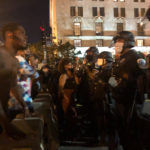
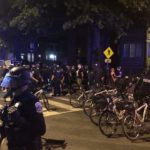
Witnesses on the scene said that protesters were kettled during the incident, and some who spoke to DCist said police deployed pepper spray — a claim later confirmed by the former Deputy Mayor for Public Safety and Justice Kevin Donahue.
In his first letter, Sherwin wrote that MPD’s “arresting documents lacked sufficient probable cause to support any criminal charge” linked to 41 of the 42 “rioters” arrested by D.C. police that night.
“The ’42 rioters’ were arrested as a collective by MPD and presented to the Office without any articulable facts linking criminal conduct to each individual arrested,” Sherwin wrote on Tuesday. “Simply put, we cannot charge crimes on the basis of mere presence or guilt by association.”
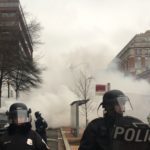
According to MPD, 541 people have been arrested and processed for demonstration activity during this summer’s wave of protests that began in the wake of George Floyd’s killing in Minneapolis. Sixteen percent of the charges filed against those people were for felony rioting.
D.C. police and Sherwin’s office did not immediately return DCist’s requests for comment on this meeting.
During an appearance on the Kojo Nnamdi Show on Friday, Newsham said that Sherwin had written his first letter in a “moment of anger,” and that Shewin has agreed to “move forward” with prosecutions. When pressed on the recent arrests of protesters the weekend following the March on Washington (Sherwin noted in his original letter that 18 of those 19 arrests lacked sufficient evidence) Newsham repeated earlier claims that the violence was instigated by non-local visitors.
“Nobody is being hard on any protesters,” Newsham said, arguing for a distinction between protesters and those allegedly causing violence. “People who come to the city and violate the law are going to be arrested.”
Sherwin’s apparent about-face follows a week of escalating tensions between local D.C. lawmakers and conservative federal leaders (many of whom have taken to portraying cities run by Democratic politicians as essentially lawless or “destroyed” after recent protests.)
On Wednesday, the ranking Republicans of two House committees wrote a letter to Bowser, accusing her of handing over the streets of D.C. to “violent left-wing extremists and agitators.” That same day, President Trump penned a memo threatening to withhold federal funding from a number of U.S. cities, including D.C., where large-scale protests have occurred over the last few months.
Earlier on Tuesday, the mayor came under fire when a working group she commissioned recommended more than 50 public sites in D.C. (including federal monuments) be renamed, removed, or contextualized due to their ties to slavery and racism. The Bowser administration later removed the federal monuments from the report amid the backlash.