Martin Austermuhle
This is expected to be an election season like none other in D.C.’s history. With the COVID-19 pandemic still a reality, D.C. is changing how it hopes residents will vote. There will be fewer (but bigger) polling places on Election Day. But the city will join a handful of states across the country in directly mailing a ballot to every registered voter. And as in elections past, early voting will again be offered.
City officials are encouraging residents to think of it as a “voting season” this year instead of the usual Election Day, and strongly urging voters not to wait until Nov. 3 to go vote. We’ve compiled and answered some of the basic questions you may have about casting your ballot this fall. And if you live in Maryland or Virginia, see our voting guides here and here.
What dates should I put on my calendar?
- First week of October: Mail ballots start arriving. All registered voters will be sent one.
- Oct. 5: Ballot drop boxes open.
- Oct. 13: Deadline to register to vote. If you miss this, fear not: D.C. does have same-day voter registration during early voting and on Election Day. (You’ll need to bring proof of residence.)
- Oct. 21: Haven’t received your mail ballot yet? You should expect to vote in person.
- Oct. 27: Early voting starts.
- Nov. 3: Election Day! Mailing in a ballot? It has to be postmarked or dropped off at a special drop box by the end of the day.
What’s on the ballot?
All D.C. voters will be choosing a U.S. president and vice president, a delegate to Congress, two At-Large members of the D.C. Council, a shadow senator and shadow representative, an At-Large member of the State Board of Education, and Advisory Neighborhood Commissioners. Voters living in wards 2, 4, 7, and 8 will also be choosing their members of the council and of the board of education. All voters will also be asked to approve or reject Initiative 81, which if passed would make enforcement of laws against magic mushrooms and psychedelic plants a lower police priority.
How do I register to vote or change my address?
You can print and fill out a voter registration form here, either to register for the first time or to change your address. When you’re done, you can either drop it in the mail or take a picture or scan it and email it to DCRegistrations@dcboe.org.
As of early September, D.C. officials say they have started testing digital signature technology on voter registration forms to avoid forcing voters to print out their forms. (This technology is meant as a stop-gap replacement for the Vote4DC app that used to allow online voter registration, but was killed off over the summer because of complaints that it was unreliable.) That new system is available here.
If you want to register in person, the D.C. Board of Elections is hosting a number of outreach events; check the calendar here.
The deadline to register to vote is Oct. 13, though D.C. offers same-day voter registration during early voting and on Election Day. But if you opt to register to vote the same day you vote, remember you need to bring proof of residence. (If you don’t, you’ll still be allowed to vote — albeit on a provisional ballot, and you’ll have to prove your residence after the fact.)
How can I vote?
D.C. will offer in-person voting on Election Day, a week of early voting, and voting by mail. Here’s a handy map of all the early voting sites, ballot drop boxes, and vote centers for Nov. 3.
Can I vote in person before Election Day?
Yes! D.C. will have early voting from Oct. 27 to Nov. 2 at 32 locations across the city — four per ward. (That will include the Capital One Arena and Nationals Park, if you’re looking for a novel voting experience.) Anyone can vote at any of the early voting sites; there is no rule that you have to cast a ballot at a site in the ward where you reside. Early voting sites will be open from 8:30 a.m. to 7 p.m.
Can I vote by mail?
Absolutely — and D.C. is trying to make it easy for you.
Election officials say that every registered voter will be sent a ballot to the address where they registered to vote. (If you need to check that your information is up to date, look here.) So unlike during the June primary, there’s no need to request an absentee ballot. D.C. will start mailing out ballots the first week of October, with two mailings thereafter for anyone who is late to register or has changed their address. If you don’t receive a mail ballot by Oct. 21, officials say you should expect to vote in person.
If you need to update your address, though, you can send in an application for an absentee ballot. It has to be received no later than a week before Election Day.
OK, I voted using my mail ballot! Now what?
Once you’ve filled out your ballot, you have a few options to return it. You can drop it in the mail — postage on the ballot’s return envelope has been prepaid. The ballot envelope has to be postmarked by Election Day, and received by the elections board no later than 10 days after the election to be counted.
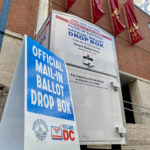
If you don’t want to depend on the Postal Service, you can drop off your ballot at any early voting site or polling place on Election Day, or any of the dozens of ballot drop boxes that will be placed across the city. (They opened on Oct. 5.) Those drop-off options run through 8 p.m. on Election Day. Ballots left at drop boxes or vote centers will be picked up on a daily basis.
What if I receive a ballot at my address that’s for someone else?
There’s a chance you may get a ballot for a former resident or tenant of your current home, especially if they haven’t updated their own address. If that happens, election officials ask that you return the ballot to the sender. Do not open it, and certainly do not vote with it.
I sent my ballot back in. How will I know it has been received?
Given some of the concerns around the U.S. Postal Service that came up over the summer, voters may be nervous about their ballot being received on time to be counted. And given many voters’ experience during D.C.’s June primary — when the online ballot tracking worked inconsistently — it’s also logical for people to want to know if things will be different this time around.
D.C. officials say they will. They’ve outsourced the mailing of ballots to a mail house — K&H Integrated Print Solutions, if you’re really curious — that offers ballot-tracking so voters can see where exactly their ballot is and when it has been received. This is what Alice Miller, director of the elections board, told the D.C. Council in early September, :
As each envelope travels through the USPS system it is scanned many times. Every two hours, K&H receives an upload of informed visibility data from the USPS for all scans. K&H then shares that data with the BOE and a software service that the BOE will use for ballot tracking.
The [ballot barcode] will allow the BOE to track a specific voter’s ballot and provide a current status via the BOE’s web portal. The voters will also be able to track their ballot via the ballot tracking service imbedded into the BOE’s website.
If you opt to leave your ballot at a drop box or vote center, Miller says you’ll still be able to track it — but you’ll have to wait two days from when you dropped it off before the system registers it. Here’s the online system to track your ballot.
If I vote by mail, can I vote in person?
It should go without saying: Voting twice is a big no-no. It’s also a felony punishable by five years in prison and a $10,000 fine. And D.C.’s system is built to prevent it. Say you choose to vote by mail, and send your ballot back in. Once it’s scanned as part of the ballot-tracking process, the city’s voter registration system is notified and electronic poll books used at vote centers will flag you as having voted already. The same goes in reverse: if you vote in person and then try to mail a ballot in, the system will register that you cast an in-person ballot and nullify your mail ballot.
But seriously, don’t try to prove you can beat the system by voting twice.
If I want to vote on Election Day, what’s that going to be like?
Very different from a normal election in the District’s 144 neighborhood-based voting precincts. D.C. instead will be opening 95 “vote centers” across the city on Nov. 3.
In some cases, these will look like normal polling places, but in other cases, they will be larger facilities to accommodate more voters — known as “super vote centers.” And unlike a traditional polling place, which is linked to your address, anyone can vote at any of the vote centers across D.C. (The vote centers will include the 32 early voting sites.) All vote centers will be open from 7 a.m. to 8 p.m.
Election officials are cautioning that anyone opting to vote on Election Day should expect a line. Though there are more vote centers than during the primary, social distancing and cleaning protocols will slow down the process, leading to some waits. Officials are strongly encouraging residents to vote by mail or at least vote early. But if you are stuck in line as the end of Election Day approaches, know this: As long as you got in line before polls closed, you will be allowed to vote.
What if I’m a senior citizen or voter with a disability?
Any voter with a disability or voters over the age of 65 who votes in person can take advantage of curbside voting at their vote center. Election officials also say that seniors who choose to vote by mail will be able to take advantage of designated ballot drop boxes at 16 senior housing facilities across D.C.
Voters with certain disabilities or who are elderly can also take advantage of an email version of a ballot, if they choose. All the information is here, or you can call the D.C. Board of Elections and request to speak with the ADA Coordinator at 202-727-2525. You can also reach out to University Legal Services’ Disability Rights D.C. initiative.
Do I need an ID to vote in D.C.?
If you’re a registered voter, no, you don’t need to bring a form of ID with you to the polling place. If you’re doing same-day voter registration, though, you’ll need to bring proof of residence. That can include a D.C.-issued ID, or a government check or paycheck, a bank statement, a current utility bill, a lease, or any official document that includes your name and current D.C. address.
Can I take a selfie inside the voting booth?
For years this was something of a contested legal question, but it’s now clear in D.C.: You’re free to take a selfie of yourself doing your civic duty. But don’t be that person doing a voting booth dance routine to post to TikTok.
When do votes start getting counted?
D.C. will process mail ballots as they arrive, but they won’t release any results until after polls close on Election Day. At that point, you can expect vote tallies from most mail ballots received until Election Day, in-person votes cast on that day, and early votes. But for any race that’s close, D.C. officials warn that final tallies could take as long as 10 days after the election — that’s how long the city will wait to receive a mail ballot, provided it was postmarked on Election Day.
Have other questions? Seeing issues we should be aware of? Get in touch.