Matt Blitz



The city’s newest memorial honoring the presidential and military legacy of Dwight D. Eisenhower is filled with sounds of jackhammers, pounding concrete, and idling bulldozers. It’s a Friday afternoon, less than a week before it is set to open to the public.
The noise is coming from the National Air and Space Museum, which remains closed but currently in the midst of massive renovation.
Victoria Tigwell, deputy executive director of the Eisenhower Memorial Commission, talks over the din and gestures towards bronze likenesses of the 34th president.
“What do memorials and monuments do? They are another way we tell history,” says Tigwell. “What we hope is people look at what these moments in time mean today.”
The $150 million (most of which came from federal funds) Dwight D. Eisenhower Memorial sits along one of D.C.’s busiest avenues and is jammed in between buildings that were once occupied by thousands of government employees. It also fills up a stretch of Maryland Avenue that was once a road cut thru and used for short-term parking.
It was also supposed to open back in May, in a ceremony that was delayed until this past Thursday due to the pandemic.
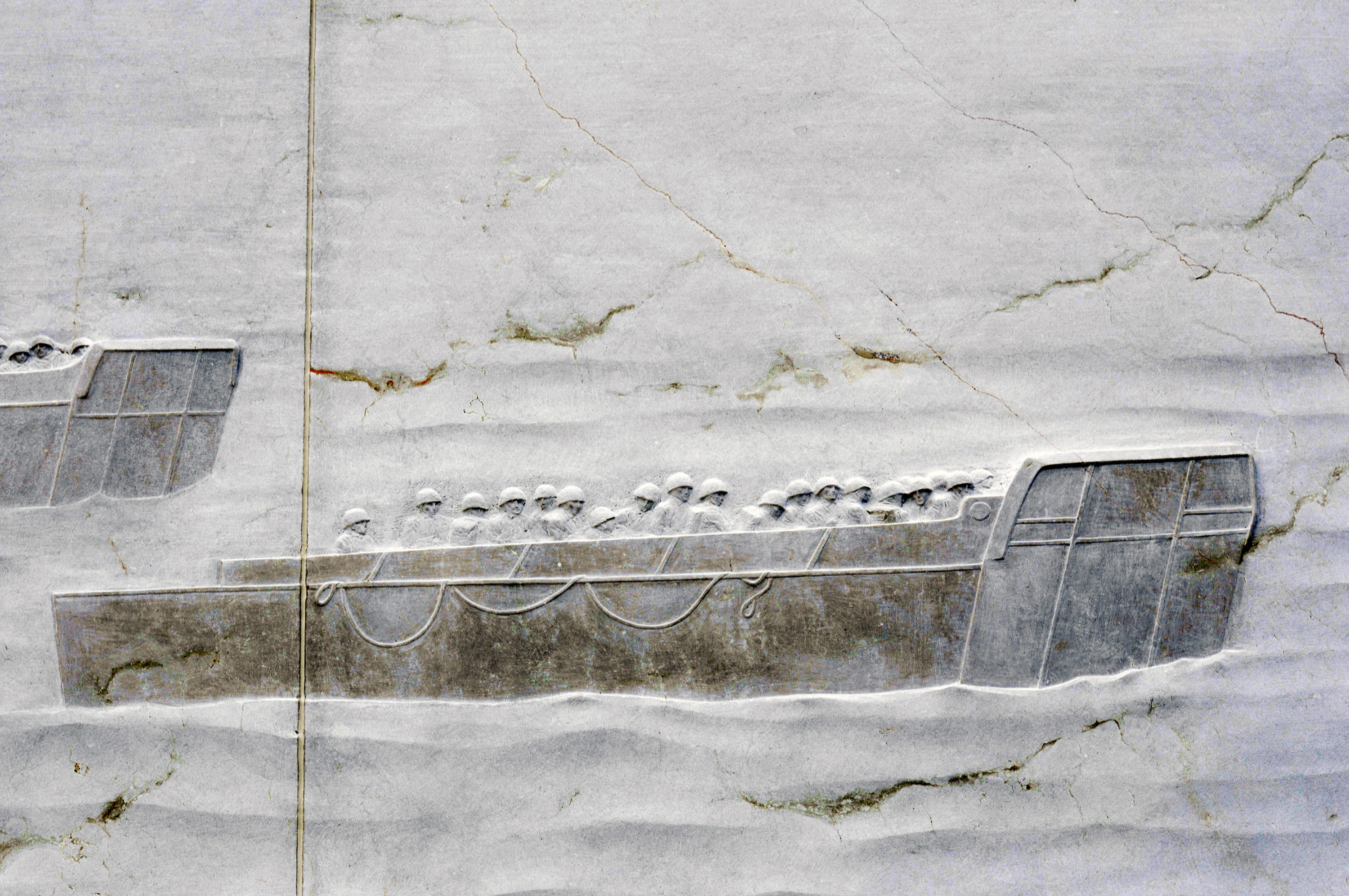
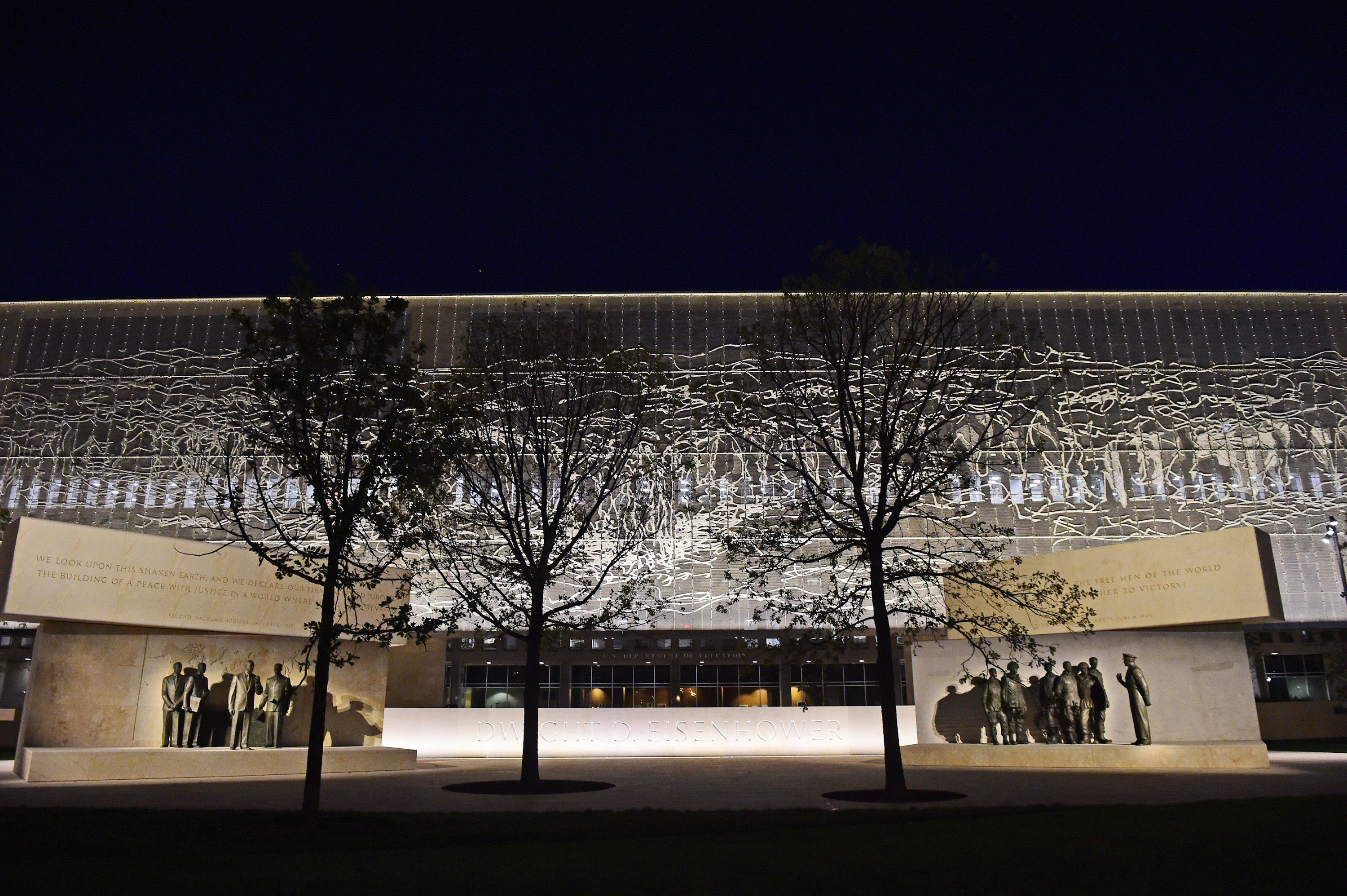
It features two limestone and bronze scenes — one of Eisenhower as president and one of him as a general. To the side are two silo-looking towers and a figure of a pensive young Eisenhower sitting with his knees up.
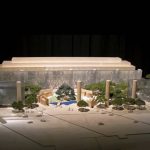
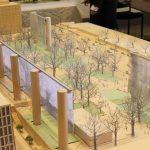
Above and spanning nearly the length of the Department of Education building that sits behind the memorial is a giant stainless steel tapestry nearly 450 feet wide and 60 feet tall made up of 600 panels that depicts, in squiggly lines, the Pointe de Hoc cliff on the Normandy coast that American soldiers famously climbed up during the D-Day invasion.
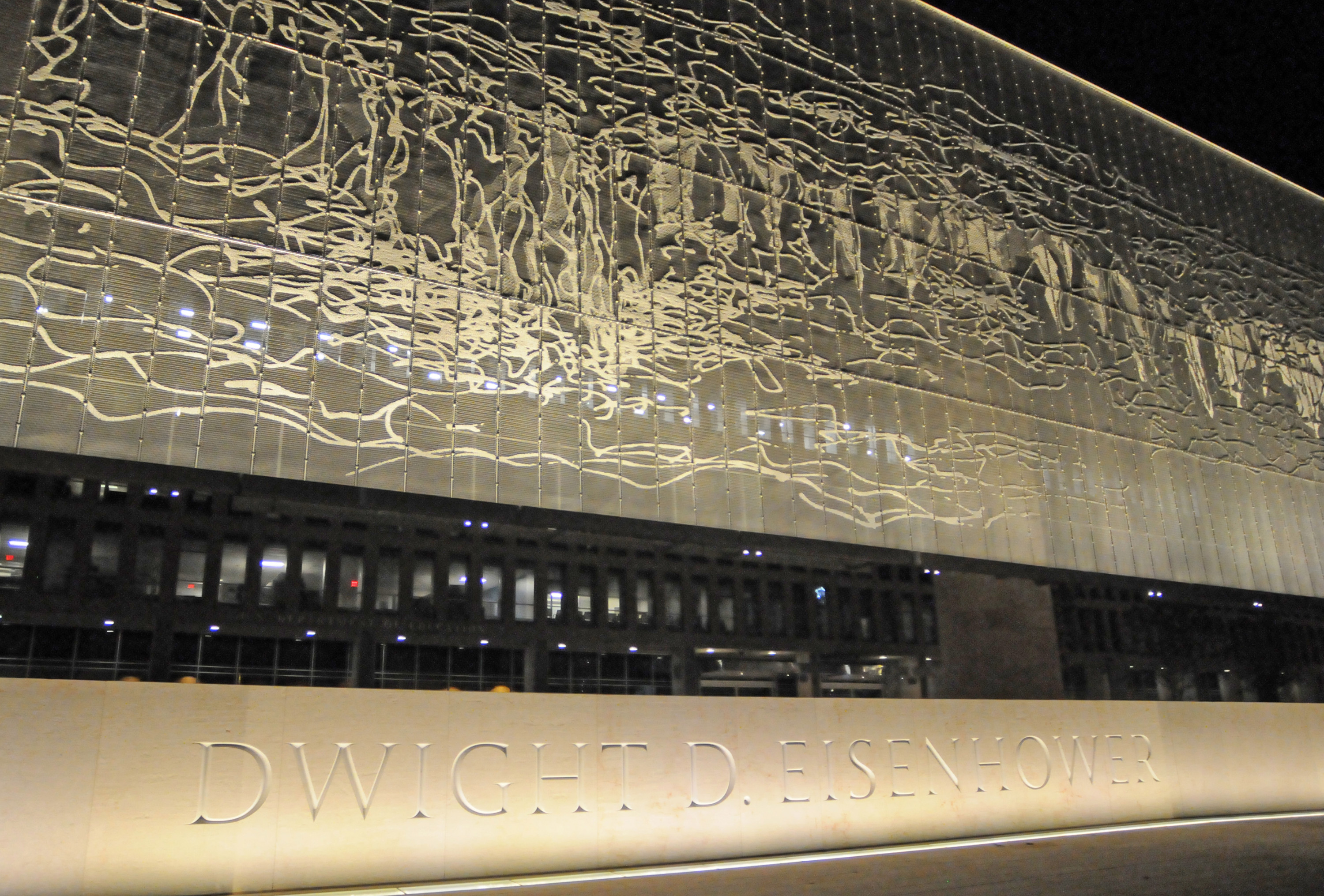
The drawing on the tapestry is the handiwork of the memorial’s 91-year-old designer Frank Gehry. “That’s actually his hand drawings,” says Tigwell. “Originally, it was a landscape in Kansas. But the [Eisenhower] family objected to that. So, a compromise was reached … and, one day I guess, Frank sat down … and sketched.”
First authorized more than two decades ago, it’s been a long and very bumpy path to this monument’s moment. It took 10 years for a designer to actually be selected. The commission finally landed on then-81-year-old Frank Gehry, despite him not being the first choice of some in the Eisenhower family and no minority-owned firms being among the nearly 50 finalists.
Immediately, the family took issue with the famed architect’s design, thinking that elements invoked images of missile silos, Nazi concentration camps, and 9/11. It was the subject of a 2012 Congressional hearing and it was nearly halted. But the commission approved the design in 2013 and in turn, Gehry agreed to several significant design changes.
Susan Eisenhower, the president and general’s granddaughter, was one of the most vocal in opposition to the initial design. She’s a longtime D.C. resident and today says she supports the memorial.
For her, it needed to show Eisenhower “in the context of his times.” There was initially too much emphasis on her grandfather as a young boy growing up in Kansas, she says.
“A young boy looking at its future, that’s one of the great themes of American life … you can grow up to be anything,” Eisenhower tells DCist/WAMU. “But, as a young boy, you don’t look forward to seeing yourself as the guy who liberated concentration camps and seeking peace in Europe. You can’t look forward to that … that’s something you do out of duty.”
She also hopes Washingtonians consider what he did for their city. It’s well known that Eisenhower sent federal troops to Central High School in Arkansas to enforce desegregation. But five years earlier, in 1952, Eisenhower declared in his first State of the Union address of his intentions to desegregate the District of Columbia. Months later, that’s exactly what happened thanks to a Supreme Court ruling that was brought by D.C. resident Mary Church Terrell (who has a school named after her in Southeast).
“My grandfather was a … pivotal force for civil rights in the city of Washington D.C.,” says Eisenhower, who is also author of a new book about her grandfather. “I’m so proud of that as a D.C. resident … my grandfather actually worked to change things in D.C.” Following the Supreme Court ruling, Eisenhower did tell D.C. public schools in 1954 to desegregate.
She also notes the memorial’s green space would also be something Eisenhower would appreciate if he were alive today. “He did appreciate the enjoyment of things,” she says.
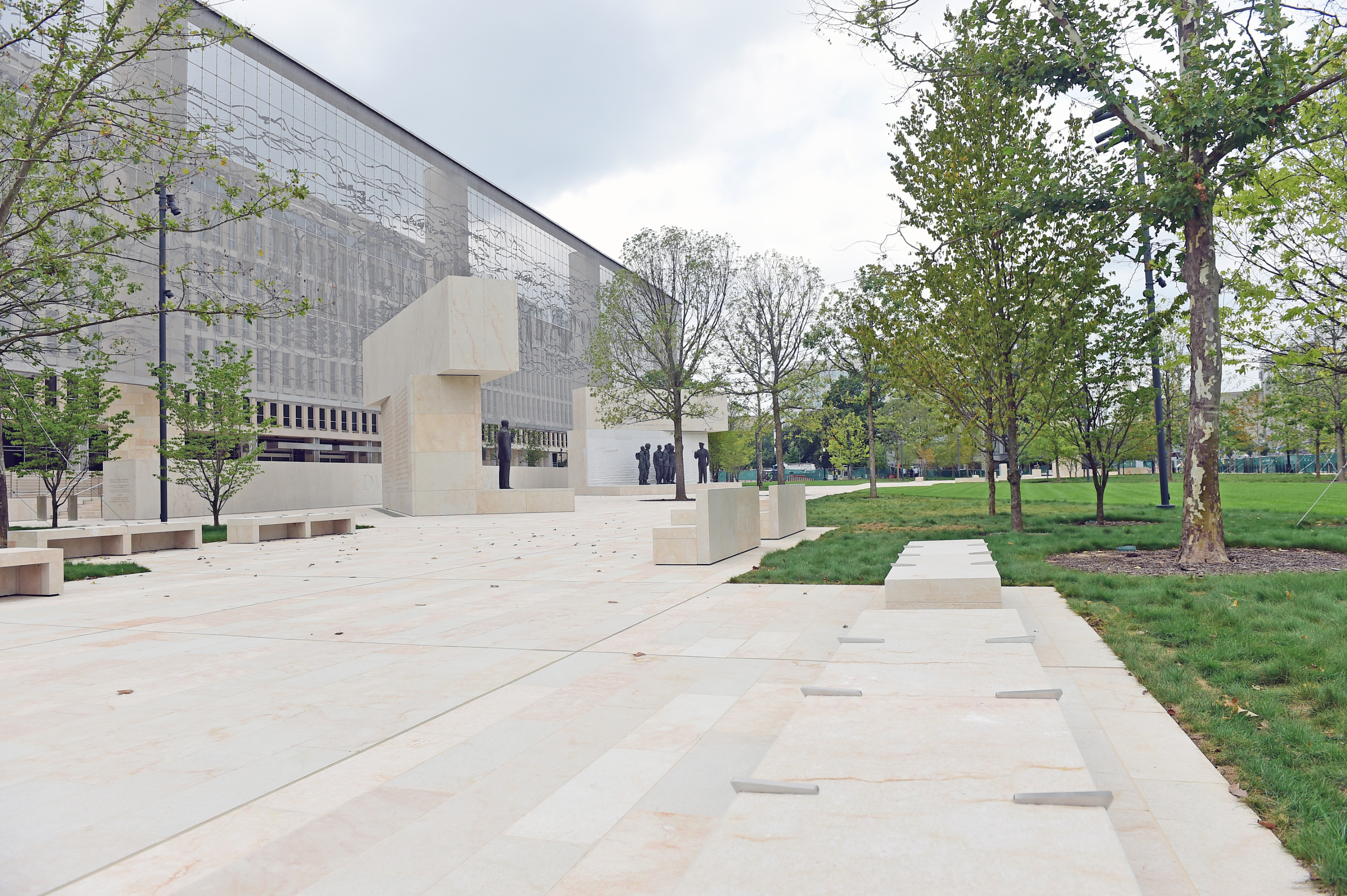
The four-acre park was built for outdoor workday lunches, quick strolls, and close conversations on benches. It was anticipated that its location between two federal buildings — Department of Education and Federal Aviation Administration — would fill this park on weekdays.
But now, in the midst of a pandemic, it’s very unclear when those federal employees will actually return to their offices. And despite its location across the street from one of the most popular museums in the country, there may not be a whole lot of visitors here for the foreseeable future. The commission expected a million visitors a year to the monument, but those numbers are unlikely to be reached with D.C. tourism way down in 2020 and unlikely to rebound until 2024.
The memorial to Eisenhower is also opening after a summer that saw national and local conversations about monuments to historical figures. In D.C., protesters toppled a statue of Confederate Gen. Albert Pike, and nearly did the same to a statue of former president Andrew Jackson. Meanwhile, a statue of Abraham Lincoln is facing calls for removal over “degrading racial undertones,” and has been a fulcrum of debate over historical monuments.
Though historians have generally regarded Eisenhower as an effective president who brought the country into prosperity and who, despite his background, spoke out against the “military industrial complex,” this memorial to him joins a citywide portfolio of statues that is almost entirely made of white men. Of the more than 100 statues in D.C., only about a half-dozen are of American women, and only one is a woman of color (Mary McLeod Bethune).
When asked about this, Tigwell focuses on the image of Eisenhower as a forward-looking president. She says that his civil rights legislation, his ability to bring peace, and his unheeded warning against the expansion of the military all make him worthy of memorializing today.
“He led America in one of its formative decades when it was learning its new place in the world,” says Tigwell. “I mean, we were never going to go back and be that isolated country.”

The monument is also integrated into the city tapestry more than the other notable memorials. Its placement along a main thoroughfare and surrounded by office buildings was both a challenge and an opportunity, according to those involved in the development. In an email to DCist/WAMU, Gehry says that the biggest task for him “was to give the site gravitas.”
Tigwell says it provided a chance to create a more welcoming setting in a space that was once all concrete and asphalt. “Here’s an opportunity to bring green space to a not very green part of the city,” says Tigwell. “That’s a big deal.”
There are unique details for keen eyed visitors to look for as well. At night, the statues are lit by 35 foot poles that create shadows and angles of light that can leave visitors thinking their eyes are playing tricks on them. “When the sun is down and the darkness settles in… it projects [the statues’] shadows on the bar relief behind,” says Tigwell. “It’s almost like they’re sort of ghosts there in the Normandy landing. It’s really beautiful.”
Another thing to look out for is the memorial’s font: It was created specifically for this project by the John Stevens Shop out of Rhode Island, founded in 1705 and now one of the oldest continuously operated businesses in the United States. Every speech and the 21-inch tall inscription of Eisenhower’s name is written with it.
“It’s not going to be one of the selections on your laptop,” says Tigwell. “At night, when it’s lit, it plays an optical illusion on you.”
Despite the challenges and the decades-long efforts, all involved are saying that the effort was worth it.
Gehry notes the former president’s calm and steady hand through difficult times. “He brought people together, he worked hard, and he cared deeply about making life better for more people,” Gehry writes of Eisenhower. “He was not a chest pounder.”
Susan Eisenhower, too, is happy with the results. She says it represents what her grandfather always strived for which was to make “the kind of progress that this country has committed itself to doing since its founding.”
Says Eisenhower, “In the end, it’s exactly as it should be.”