 Jordan Pascale
This story was updated on Oct. 6.
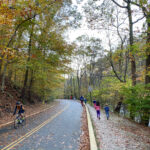
For more than six months of the pandemic, the upper part of Beach Drive in Rock Creek Park has been transformed from a commuter pipeline to a recreational oasis.
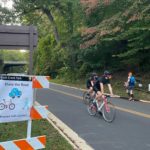
Shortly after stay-at-home orders limited people’s gym habits and other activities, the National Park Service and D.C. Mayor Muriel Bowser decided to close most of the street to traffic to allow more space for recreation and exercise. Since then, the 4.5-mile stretch from Broad Branch Road to the Maryland state line has been busy with runners, cyclists, walkers and skaters nearly every day.
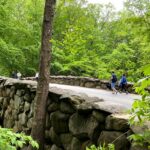
The changes created opportunity for lower-stress, traffic-free excursions like a 20-minute bike ride, an hour-long run, or an hour and a half walk. The road follows the creek and it features a tree canopy that’s about to change colors. You can hear the crickets in the evening.
Users describe it as one of the few quiet, scenic places in D.C. to do all sorts of activities without fearing for your life in traffic. They say while the road is busy, it’s not crowded because of how wide it is.
Alex Appah, a 39-year-old who was roller skating down Beach Drive on a recent weeknight, put it this way.
“It’s just been really nice to be able to have a place to go outside,” she said. She picked up her new hobby recently. “It’s safe, it’s really long and it’s pretty smooth.
“Obviously, some of the pavement, D.C. is not so great. I would skate on the roads, but I don’t want to compete with cars. So this is great. I hope that they keep this forever.”
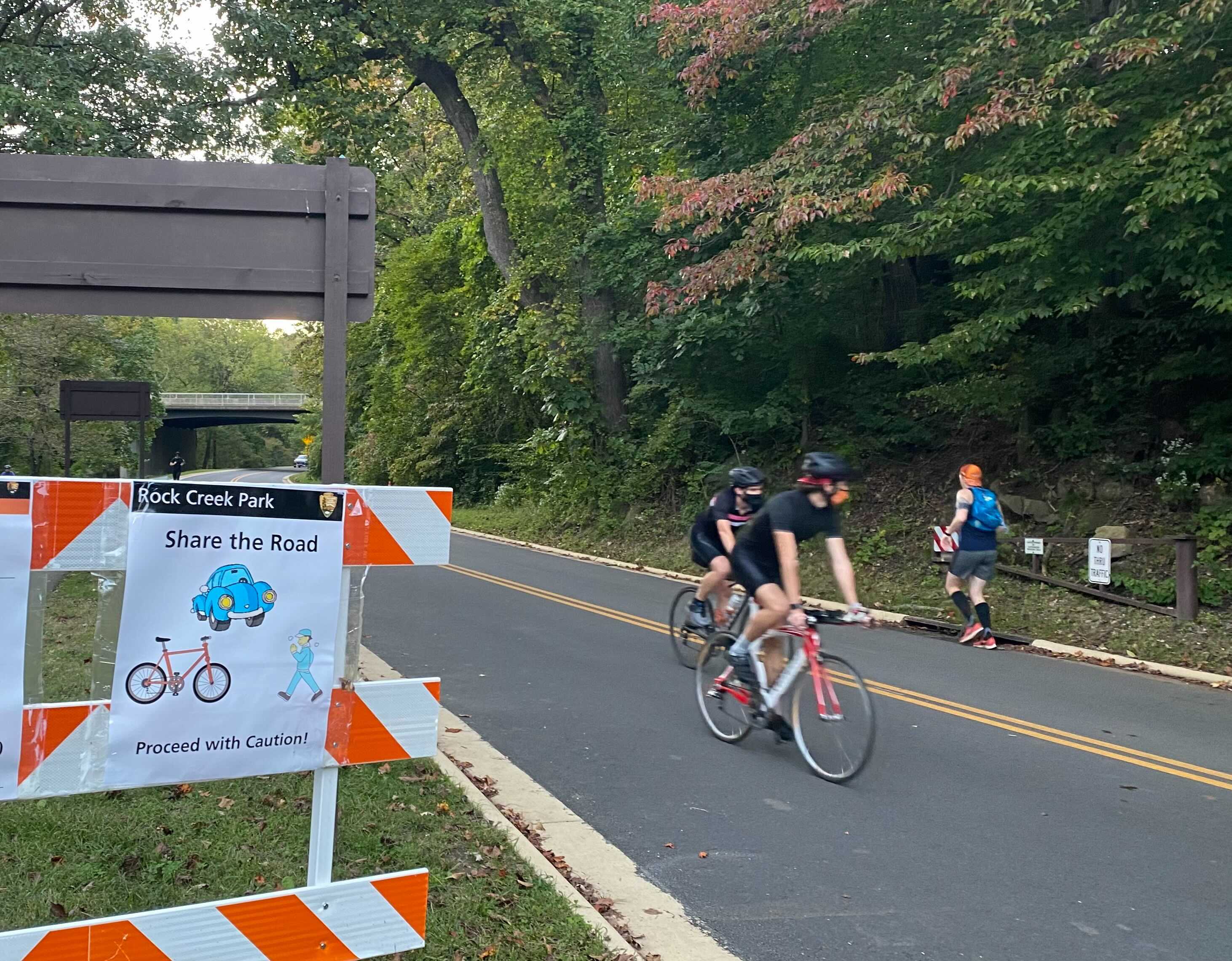
Others were walking, running and biking. Kids tottered along on scooters and on the backs of bikes. Couples walked dogs.
More than 70 volunteers with the People’s Association for Rock Creek Park and other organizations did a recent count of users over multiple days in August and September. About 17,000 people were biking, 5,000 walking, 5,000 running and 700 walking dogs, according to Peter Harnik, a long-time environmentalist who has been working on the issue for decades.
“There was also one cat on a leash, one bird on someone’s shoulder, children on shoulders, bike trailers, wheelchairs, a unicycle, skateboards, and electric single-wheel vehicles,” he said.
Beach Drive has closed to traffic on Saturdays and Sundays from 7 a.m. to 7 p.m. since the 1980s, but the change to all-week traffic closure during the pandemic has left some people asking, “why can’t it be like this all the time?”
The National Park Service says don’t get used it — Beach Drive will revert back to traffic after the pandemic. Nearly 5,000 vehicles a weekday used the road in 2017, but traffic hit a historic low during the pandemic.
“On typical workdays, thousands of people use Beach Drive to travel throughout Washington D.C., and the total rehabilitation project we finished last year improved conditions for everyone on the road,” wrote NPS spokesperson Jonathan Shafer in an email. “Rock Creek Park will continue to offer a variety of recreational opportunities, and, over the long-term, that includes allowing visitors to walk and bike on part of Beach Drive on weekends.”
It will remain closed to traffic until at least October 9, according to the park’s website, but NPS has also said it will keep the road open to recreation until the state of emergency is over. Bowser has the authorization to extend the emergency until the end of the year.
Advocates who want to keep the road closed to traffic are meeting with park officials Friday to present the case to keep it that way.
“We have our work cut out for us,” Harnik says. “We’ve had our work cut out for 40 years.
“Changing things is difficult and we’re not deluding ourselves that this will fall into place… we’ve made progress over the last 40 years and intend to make more progress.”
The Fight Over Beach Drive
The first official road through Rock Creek Park dates back to 1897. Captain Lansing H. Beach, whose name was later attached to Beach Drive, couldn’t get funds to build the road, so he used chain gangs and other means to improve the roads in the parks. Two years later, Congress approved $15,000 to build what’s now known as Beach Drive from near Pierce Mill to Military Road.
Around 1915, in the early days of motorized vehicles, the American Automobile Association pushed to allow time for cars to enter national parks as a way to open them up to new visitors. Opponents feared the new option would spook horses, so they agreed on use at different times — usually about three hours in both the morning and afternoon. And even then, vehicles were the outsiders.
“All of the early driving regulations required automobiles to pull over to the outside of the roadway regardless of direction of travel when teams passed,” a national park history says. “The speed limit on park roads was 6 miles per hour except on straight stretches where no teams were in sight. In those areas drivers were allowed to increase their speed to no greater than 15 miles per hour.”
Joyrides through nature on parkways soon became popular.
But car backlash in parks arose in the 1970s as New York’s Central Park placed more restrictions placed on vehicles. Now it’s car-free.
Meanwhile, Rock Creek has seen incremental change over the years starting in 1963 when the Park Service designated a mile of Ross Drive to be closed to cars from 6 a.m. to noon on Sundays.
By 1981, recreationists did win a victory of full weekend closures on portions of Beach Drive.
In the early 2000s, parks officials released ideas to manage traffic in the park, including one idea advocates really wanted: closing Beach Drive to traffic during non-commuter hours. Greater Greater Washington reports many politicians, including Maryland’s congressional delegation, put the finger on the scale to protect commuters.
“Some commuters have extra political muscle,” Harnik said. “Those coming from Maryland have Congress members, real voting Congress members. The other reality is that some of the people driving through the park are congresspeople themselves and other important people.
“It’s a high stakes situation.”
Looking Forward
AAA spokesperson John Townsend says it’s untenable to keep Beach Drive closed to traffic after the pandemic.
“(It) will mean longer commute for commuters and District residents, and cause a spillover effect, resulting in more congestion on many District streets,” he said. “If, and that is a big if, and when things return to normalcy, and Lord knows when that will occur, such closures will spawn major rush-hour delays.”
The opposition says that is not true. Three portions of Beach Drive have been closed over the past three years for rehabilitation, and advocates argue the closure didn’t create unreasonably bad traffic on the detours near the park.
Harnik and others also say a park is inherently about being outside in nature.
“This is a park,” he said. “It shouldn’t be dominated by cars.”
Plus, he says, the calculus has changed with the pandemic. Harnik predicts more telework and less commuting when this is over.
Jeanne Braha, executive director of the non-profit Rock Creek Conservancy, says the group would like to see Beach Drive close to traffic after the pandemic, too.
“We look forward to working with community and park staff to find a way to extend this popular option past phase 4 [of reopening], as well continuing to find additional ways to make Rock Creek more equitably accessible to all people,” Braha said in an email.
Greg Billing, director of the Washington Area Bicyclist Association, agrees for both recreational and environmental reasons.
“Having a road in the middle of a natural area does have an impact,” he said. “On runoff and chemicals in the watershed. Cars can disrupt wildlife behavior and access to the watershed.
“It impacts the entire ecosystem.”
This story was updated to correct the number of vehicles a day that use Beach Drive.