Martin Austermuhle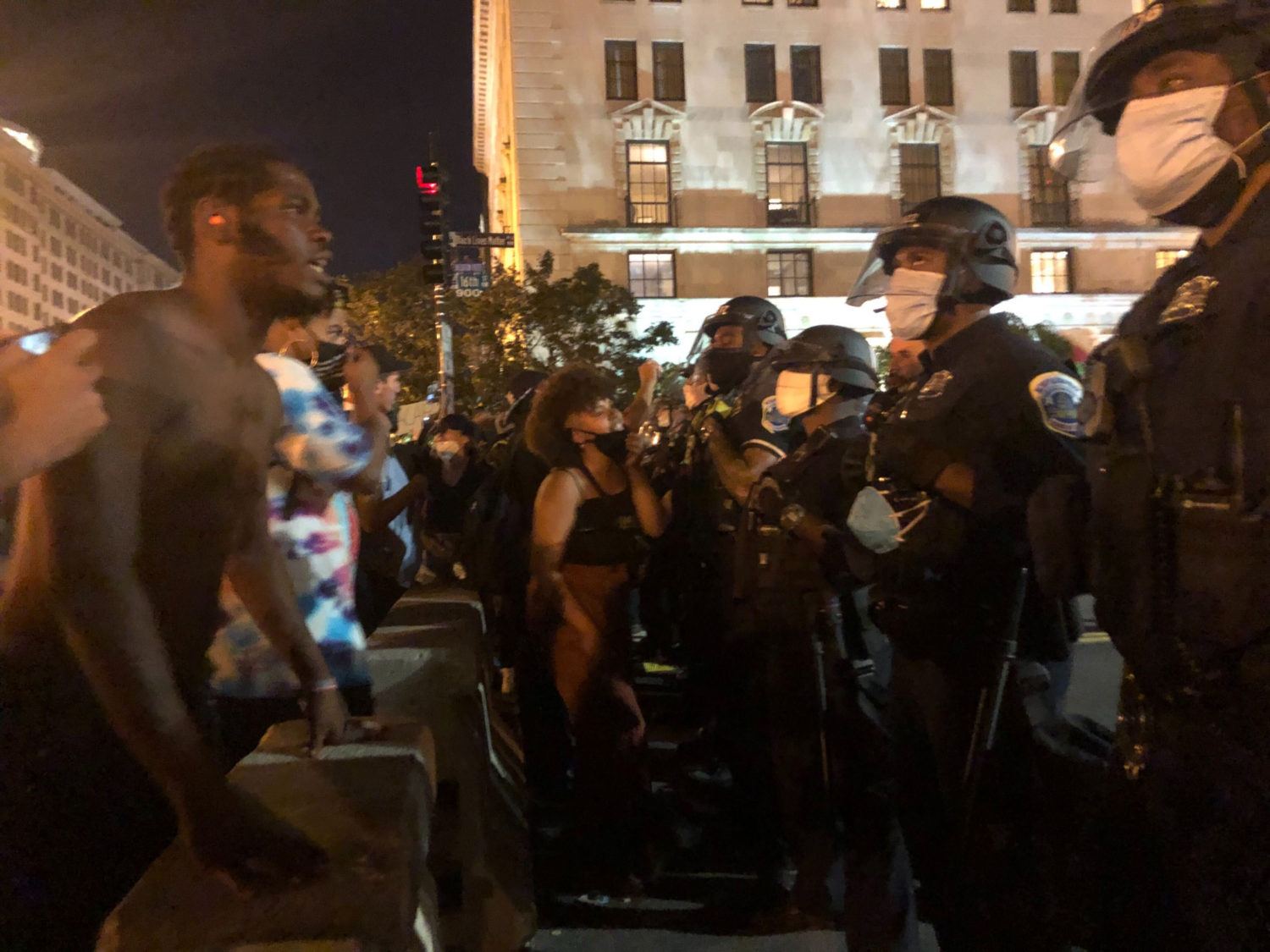
When the D.C. Council’s judiciary committee meets for a hearing on Thursday morning, it will take public testimony on two high-profile policing bills: one that would ban the use of tear gas and other chemical irritants during peaceful protests, and another sweeping measure that would make permanent a range of reforms first adopted on an emergency basis over the summer.
But civil liberties advocates say that just as important will be a third bill with an unassuming name: the Rioting Modernization Amendment Act of 2020. The bill seeks to change the D.C. law that prohibits rioting, clarifying when a disturbance rises to the level of a riot and what types of punishments people can face for participating in a riot.
Advocates say the changes are needed more than ever, especially after a summer of protests against police violence that saw D.C. police arrest more than 100 people for felony rioting — a charge that can bring with it a 10-year prison sentence. But it also follows the demonstrations at President Trump’s 2017 inauguration, when 234 protesters were arrested for allegedly rioting — but none were ever convicted of the crime.
“It is both incredibly vague and harsh,” says Ward 6 Councilmember Charles Allen, who chairs the judiciary committee and co-introduced the bill along with five of his colleagues to update the city’s rioting statute.
Under existing law, which was written by Congress and dates back to at least the 1960s, a riot in D.C. is defined as a “public disturbance involving an assemblage of 5 or more persons which by tumultuous and violent conduct or the threat thereof creates grave danger of damage or injury to property or persons.” Participating or inciting a riot can fetch a six-month jail sentence, while the punishment jumps to a 10-year maximum sentence if someone is injured or there’s property damage in excess of $5,000 during a riot.
But Bobbi Strang, the president of the Gay and Lesbian Activists Alliance and a board member at the D.C. Office of Police Complaints, says the law’s terms are poorly defined, allowing police to arrest people who may not actually be rioting — but are standing near someone who might be. Strang says she saw this when she served as a police observer for OPC during the 2017 inauguration protests, and worries that it will continue.
“Say that you’re on a street where there’s restaurants. Someone’s eating a meal, finishes up, pays, and walks out into that crowd of people that are being arrested for rioting. They now have proximity to what the police have determined to be a riot and can be arrested under the current court interpretation for felony rioting,” she says.
In the 2009 case she is referencing, a majority on the U.S. Court of Appeals for D.C. found that a mass arrest of D.C. protesters during President George W. Bush’s second inauguration was justified under the city’s riot law because “police witnesses must only be able to form a reasonable belief that the entire crowd is acting as a unit and therefore all members of the crowd violated the law.”
One judge, though, did dissent: “That the Fourth Amendment bars police from arresting a person solely because he or she is part of a group that includes others who have committed crimes should be undisputed.”
The council’s bill would increase the number of people to nine (up from the current five) who have to be involved for a disturbance to be declared a riot, and each of those people would have to be engaged in some other criminal offense, like destruction of property or bodily injury. The bill would also do away with the current offense of inciting a riot, which advocates also say is poorly defined and could even ensnare someone doing little more than chanting. (The city’s independent Criminal Code Reform Commission is also considering proposing new language for the anti-rioting law.)
Over the summer, D.C. Mayor Muriel Bowser and Police Chief Peter Newsham repeatedly said they supported peaceful protests — but said police would intervene to stop violence and property destruction when it happened. In a statement on the council’s bill, D.C. police spokesman Dustin Sternbeck repeated that distinction.
“The Metropolitan Police Department frequently provides public safety support for First Amendment assemblies in the District of Columbia and remains committed to preserving individual rights to peacefully protest,” he said. “In the event that individuals are engaged in behavior that causes harm to others or destroys property, we have an obligation to intervene and ensure that the District is equipped to respond to such events.”
But Mara Verheyden-Hilliard, co-founder of the Partnership for Civil Justice Fund and a longtime critic of Newsham’s approach to policing protests, says D.C. police shouldn’t be able to arrest someone based on association or proximity alone.
“It is critical that police act with precision,” she says. “You can’t arrest someone and deprive them of their liberty without probable cause to do so. And if people are out together chanting and marching in unison and one person or a small number of people engage in activity that the police assert is illegal, then it is their obligation, if they believe that that is arrestable and they wish to arrest people for that activity, to act with precision.”
Verheyden-Hilliard adds that to see the problems in how police are currently enforcing D.C.’s anti-rioting law, one need look no further than the U.S. Attorney for D.C., which prosecutes the offenses. After the mass arrests at the 2017 inauguration, the prosecutions largely fell apart, with juries returning not-guilty verdicts for many of the protesters and prosecutors deciding to dismiss the cases of others.
Much the same has happened this summer. In June, the U.S. Attorney for D.C. dropped rioting charges against dozens of protesters. In August, after D.C. police arrested dozens of people for rioting at two separate protests, the U.S. Attorney’s office chose not to prosecute most of those cases. That prompted Bowser and Newsham to accuse U.S. Attorney Michael Sherwin of lacking the “willingness” to prosecute protesters; Sherwin fired back in a letter saying that D.C. police failed to provide evidence in the arrests of several protesters over the course of the summer.
Sherwin eventually retreated from that claim, announcing charges in mid-September against three people for rioting offenses. But before the end of the month, the cases against two of the three protesters were dismissed. (The New York Times reported in late September that Sherwin’s retreat had in part been spurred by an intervention from U.S. Attorney General Bill Barr, who has echoed President Trump’s calls for law and order.)
In its own statement to WAMU/DCist, Sherwin’s office says it looks forward to “collaborating further with the Council and other stakeholders to ensure that any changes to the law are conducted in a thoughtful and considered manner and result in a fair and just law that ensures public safety.”
Allen says the goal is clarify what rioting is, when police can arrest someone for it, and to ensure that prosecutors are more successful in taking those cases when someone does participate in a riot in D.C.
“I want to be very clear. Rioting is illegal and it will remain illegal under the legislation we’re considering,” he says. “The question is around how do we make sure that we modernize the crime of rioting, to make sure that we have this set up in a way that when or if rioting does take place, we’re able to have the accurate charge, to have a prosecution move forward and have the accountability.”