Margaret Barthel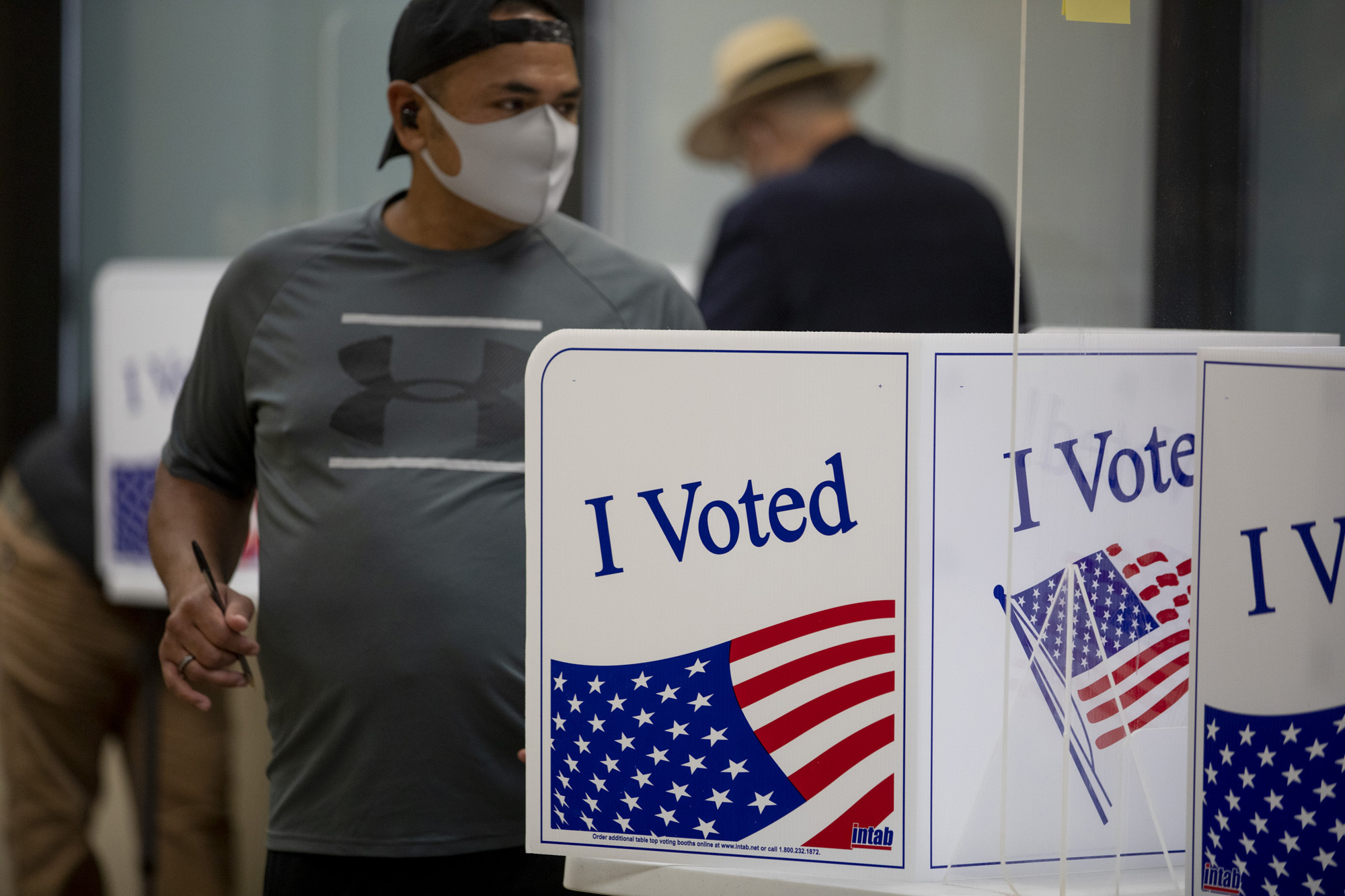
The last full week before the election approaches, and with it comes more opportunities for early, in-person voting in the Washington region.
Maryland and D.C. will begin in-person voting during the week, as interest remains high in the Nov. 3 election.
Virginians have been going to polling place to cast early ballots since Sept. 18. They’ll have more choices in Alexandria: two new Saturday-only centers opened this weekend and will be available again next weekend.
In Maryland, early voting centers will open on Monday and remain open 7 a.m. – 8 p.m. daily through Nov. 2. A full list of early voting locations is available here. Voters can cast ballots at any center within their local jurisdiction.
Marylanders who need to register to vote will be able to do so at centers in their local jurisdiction, provided they bring an official document with them to an early voting location. Authorized documents include a driver’s license, change of address form, paycheck, bank statement or utility bill.
In D.C., early voting will open on Tuesday and remain open 8:30 a.m. – 7 p.m. daily through Nov. 2. A full list of early voting locations in the District is available here. Voters can cast ballots in any of the centers, not just the ones in the ward in which they reside.
Six of the District’s 32 early voting centers are so-called super vote centers, large spaces like the Entertainment and Sports Arena and Capitol One Arena that will be able to accommodate a high volume of voters while maintaining social distancing.
Alexandria, Va., will open two additional early voting centers this Saturday, at Minnie Howard School and George Washington School. The two locations will only be available this Saturday and next Saturday, Oct. 31. More than 21,000 people have voted in-person in Alexandria already, and the city has already received more than half as many ballots as it received in the entire 2016 election season, according to a report from WJLA.
Requests for mail-in or drop-off absentee ballots closed last week in Maryland and Virginia. In D.C., the Board of Elections mailed every registered voter a ballot.
If Virginia is any indication, the new early voting centers will be busy. Many voters in the commonwealth have faced long lines at early voting locations in the past month, as local boards of elections manage unprecedented voter turnout and the need to maintain social distancing procedures at polling places.
Maryland Gov. Larry Hogan is already asking state residents who want to cast ballots in person to go to early voting centers at odd hours.
“We strongly encourage voting early and at off-peak times to prevent large crowds and long lines,” Hogan tweeted.
Large crowds and long lines have been an issue in Fairfax County, Virginia’s most populous jurisdiction, since the beginning of early in-person voting in September. That continued even after the county opened up 14 satellite voting locations on Oct. 14.
I’m currently at a polling site in Fairfax County, VA, where voters say they’ve waited nearly two hours to place their ballot. The line is wrapped around the building. pic.twitter.com/SoFoSeQ56V
— Alicia Diaz (@Alicia_Diaz23) October 22, 2020
Visited 4 early voting stations in Fairfax county VA for a consult job and ALL of them had LONG lines today. Good to see America voting
— DavKind 🧢 (@DavKind76) October 23, 2020
How long it took to wait in line and early vote this afternoon in Fairfax County, VA. Lots of folks voting! pic.twitter.com/54afWWvD7J
— Andrew Holland (@TheAndyHolland) October 23, 2020
The situation prompted the Fairfax NAACP to write a letter to the county’s Board of Supervisors last week, calling for changes to the in-person early voting process to reduce wait times. The recommendations include hiring more staff, increasing voting location hours, re-examining traffic flow and space utilization at satellite voting centers, and implementing IT and hardware fixes.
“Although [the Electoral] Board explains that it devoted many resources to mail-in ballots, which have gone well, its failure to have anticipated and effectively planned for unprecedented in-person turnout is inexcusable,” the letter from the Fairfax NAACP said. “We would like a full audit of the Board’s protocols that may have resulted in voter disenfranchisement in Fairfax County.”
The letter raises concerns that long lines for in-person voting now could lead to much longer lines on Election Day— a health risk as well as a hassle to voters.
“Those whose health and access to the polls will be most impacted by Election Day voting are likely to come from marginalized communities,” the letter said. “Likewise, those most likely to be disenfranchised will be marginalized communities.”
The Fairfax Electoral Board reported on Saturday that it has received more than 264,000 ballots already— more than half the number of ballots cast in the 2016 presidential election.