 Daniella Cheslow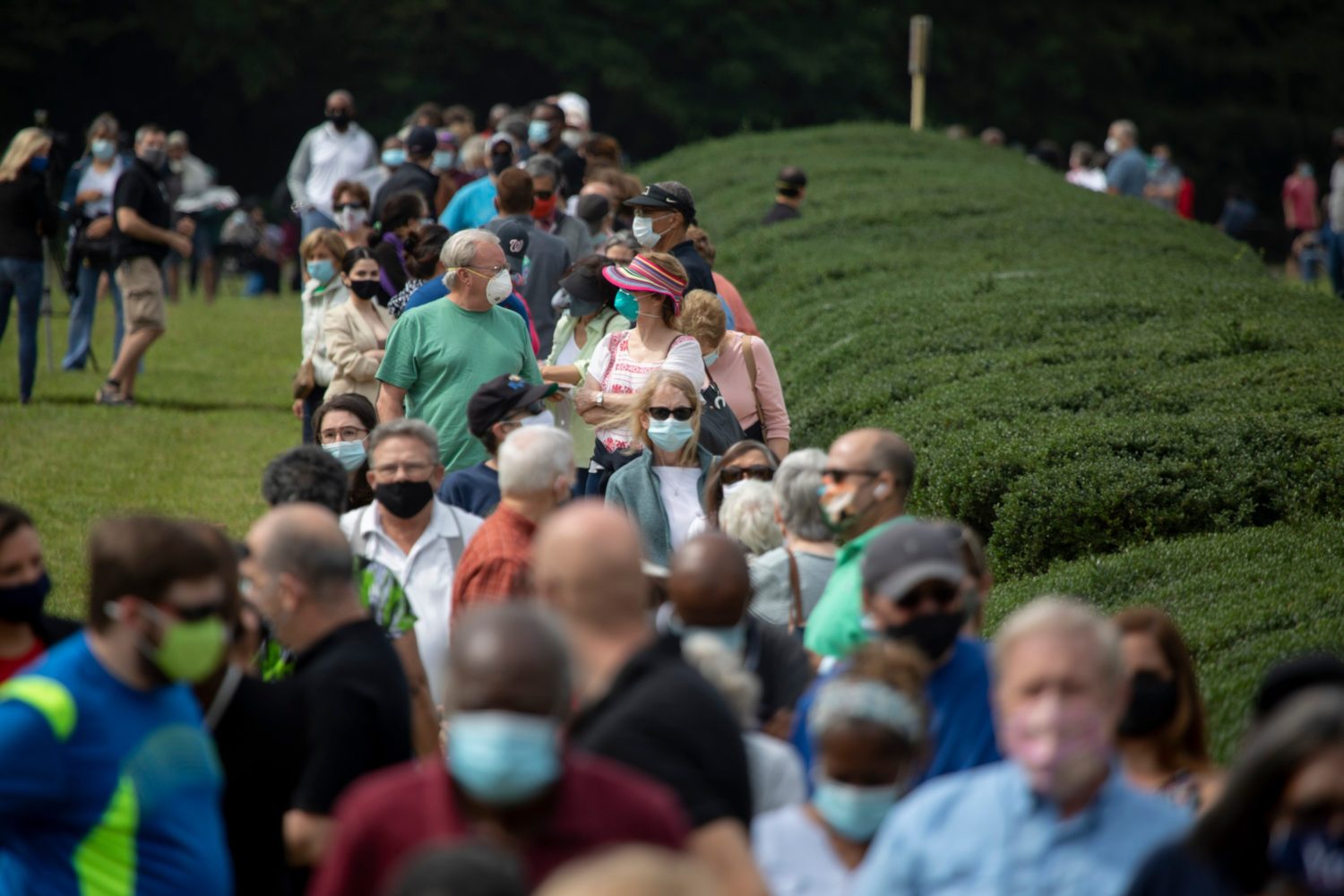
Joe Biden swept Virginia on Tuesday with a comfortable nine-point margin, exceeding the performance of Democratic contenders before him.
Despite that win, some Democrats in Virginia now worry that narrow congressional victories and a failed attempt to flip a House seat reveal the “blue wave” that gave their party power during the Trump era could possibly have stalled. Republicans, on the other hand, say they are seeing flickers of promise.
“Tuesday, from a congressional standpoint, it was a failure, it was not a success,” said Rep. Abigail Spanberger (D-Virginia) during a conference call with fellow congressional Democrats earlier this week, the audio of which was obtained by The Washington Post.
Spanberger flipped her seat in 2018 and eked out an unofficial re-election victory with just 5,000 votes more than Republican Nick Freitas in Virginia’s 7th District, which includes the Richmond suburbs and the outer reaches of Charlottesville.
Two other first-term Democrats, Rep. Jennifer Wexton and Rep. Elaine Luria, kept their seats, but the party failed to flip the 5th District, where African American physician Cameron Webb lost to Republican Bob Good, a former Liberty University fundraiser.
Now, Republicans see a possible path away from four years of stinging defeats.
“I do see hope for the Republican Party,” said Jill Cook, secretary of the Republican Party of Virginia’s state central committee.
Virginia was once a key swing state, but in the Trump era, Democrats have increasingly taken control. In 2016, voters picked Hillary Clinton by a five-point margin. The following year, Democrat Ralph Northam was elected governor. The congressional flips came a year after that, allowing Democrats to take control of the House of Representatives, and last year Democrats claimed the General Assembly for the first time in 26 years.
Renzo Olivari, communications director for the Biden campaign in Virginia, says this year’s election continued that winning streak, notching a wider lead for the Democratic candidate than in 2016, an achievement all the more noteworthy during a pandemic.
In particular, he noted Biden won in multiple counties that had not picked a Democratic presidential candidate in decades, including Stafford County in Northern Virginia and Lynchburg, home of the evangelical Liberty University.
Rebecca Bromley-Trujillo, a researcher at Christopher Newport University, painted a more sobering picture.
“Overall Democrats should probably be pretty happy, but there were some losses that might sting a little bit,” she said.
Several factors account for the Democrats’ tempered success. First, new voters came out in droves for both parties, taking advantage of new laws that allowed for 45 days of early voting. Some 2.3 million voters chose Biden, compared to about 2 million who voted for Clinton four years earlier. Among Republicans, votes for Trump rose from 1.8 million last presidential election to 1.9 million this year.
“I think that what happened in Virginia is the same thing that happened nationally,” said Ben Tribbett, a Democratic strategist based in Northern Virginia. “The polling didn’t pick up on a number of non-college educated, white working-class voters that were going to participate in this election even though they didn’t before.”
Spanberger, in her call with the House Democratic caucus, pointed to another problem: messaging she said was too far to the left. She said millions of dollars were spent on attack ads that falsely said she hoped to defund the police.
“The number one concern that people brought to me was… defund the police,” Spanberger told her colleagues. “We need to not ever use the word socialist or socialism ever again.”
Julius D. Spain, Sr., the president of the Arlington NAACP and the regional vice president for the group’s Northern Virginia area, said he listened to Spanberger’s comments twice — and he agreed with the congresswoman.
“When we look at police reform and we look at how police have been treating our communities of color for decades, and how we need to revamp the system, I agree,” he said. “But there is something to say about messaging and how you go about doing that.”
Indeed, charges of wanting to defund the police haunted Spanberger, a former CIA officer, and Webb, the son of a Drug Enforcement Administration employee. They both denied they wanted to take money away from law enforcement.
Melissa Beaudoin, chair of the 11th Congressional District Republican Committee, said that nevertheless, the national conversation around defunding the police trickled into Virginia races and alienated voters. “Do I think that issue played a role in this cycle? Absolutely,” she said.
Some Democrats also wondered if their coronavirus protocols might have cut down on invaluable in-person conversations that might have swayed voters. While Republicans candidates canvassed, held rallies, hosted meet-and-greets, and often flouted masks and social distancing, Democrats initially conducted almost all-virtual events, only later adding limited door-knocking to their outreach efforts.
“We still think it was the responsible thing to do,” said Larry Jackson, co-chair of the Fauquier County Democratic Committee.
Still he said the party would analyze that choice amid a broader review of the campaign. “If the pandemic is over by 2021, we’ll go back to business as usual. Otherwise, we’ll change our game plan,” he said.
Former Republican delegate David Ramadan, now an adjunct professor at the Schar School of Policy and Government at George Mason University, agrees that Democrats lost votes because of their hands-off approach. “Knocking on a door shows a candidate cares,” he said. “One can go door to door and be safe.”
Despite the challenges, certain bedrocks kept Democrats in power in Virginia. According to exit polls, African Americans supported Biden by 89%, the strongest blue vote among any demographic group. Women favored Biden by large margins, too, with 60% picking the former vice president. Ramadan said that for this reason, Republicans should still be chastened, especially by Trump losing in Lynchburg, traditionally a GOP stronghold.
“The party that lost Lynchburg is a party that has lost its message,” Ramadan said. “It’s been a long journey of walking away from walking away from what Virginians want.”
Beaudoin said her party was making strides in appealing to suburban voters, many of whom are immigrants in Northern Virginia. As an example, she pointed to Manga Anantatmula, an Indian immigrant who challenged Democratic Rep. Gerry Connolly in the district that includes parts of Fairfax and Prince William counties. Connolly prevailed with 71% of the vote, but Beaudoin said Anantatmula’s candidacy was evidence of a party that was evolving.
“We are making progress in this area. We are actively reaching out to these communities that share our values but don’t realize it,” she said.
That outreach has set off alarms among some immigrant political action groups in Virginia. Luis Aguilar, Virginia director of the immigrant electoral mobilization group CASA in Action, said that the strong Latino vote for Trump in Florida has echoes in Virginia as well.
“I’d really urge the Democratic Party to take the lessons of the national arena seriously,” he said.
Spain, of the NAACP, said he, too, saw a warning in Virginia and the national numbers.
“Don’t take anything for granted,” he said. “A nine-point spread, roughly in the presidential race — we have a lot of red in Virginia. We just need to be cautious.”
This story has been corrected to state that Luis Aguilar is Virginia director of CASA in Action, and not CASA Virginia as previously written.