Margaret Barthel
 Eliza Tebo
Coronavirus cases in D.C., Maryland, and Virginia are hitting new highs — and, in some places, surpassing this past spring’s surge. Cases are increasing here as they are throughout the country as people become more lax about guidelines on social distancing and gatherings.
Public health officials say the region is at a turning point. If the number of cases continues its rapid rise, the local health care system could be completely overwhelmed by the pandemic.
Infections are soaring throughout the region. The 3,219 cases reported on Friday in D.C., Maryland, and Virginia were the largest daily tally for the area since the 3,120 reported May 1, according to the Washington Post. Nationally, cases are skyrocketing, with a million new cases reported in just 10 days, the New York Times reports.
“The curves demonstrate that we’re going to have, no question about it, an increased number of cases,” said Dr. David Marcozzi, an associate professor of emergency medicine at the University of Maryland School of Medicine. “The only factor that is the thing that can change that is individual behaviors.”
That’s significant, Marcozzi said, because the region’s health system could be overwhelmed if cases continue to rise unchecked.
“Our medical system is ready to absorb the lower curve of that surge that the models project out,” said Marcozzi, who also leads the University of Maryland Medical System’s COVID-19 response. “But let me be honest with you. If you start getting into the moderate or highest level of those models, then we will have significant challenges to be able to treat everyone coming through the front doors of all the hospitals.”
Alexandria Public Health Director Dr. Stephen Haering said that doctors and nurses can only be stretched so thin.
“We do not have an unlimited supply of health care workers,” he said. “If they get ill, then they can’t work. Or if they get exposed, then they can’t work because they have to quarantine.
“We’ve seen increases of hospitalizations, increases in ventilator use, and increases percent positivity across the region,” Haering continued. “This has also been reflected here in Alexandria and quite frankly, we’re concerned about it.”
‘A critical turning point’
Individual jurisdictions are also climbing closer to records they set in the spring. Virginia’s 7-day rolling average of cases is now at 1,437 — the highest on record. The number stood at 1,195 on May 31, making the current figure several hundred cases higher than even the peak of the first wave of the outbreak. Public health experts in all three jurisdictions use seven-day rolling averages of case numbers to understand the broader trend of the case count, beyond daily irregularities in case reporting.
Cases in Northern Virginia exceeded 400 per day for 3 consecutive days, which hasn’t occurred since late May, according to the Virginia Department of Health. In Arlington, the 7-day average in the past week reached 40 cases per day for the first time since May, according to ARLnow. Average daily cases in Alexandria are lower — around 22 per day, mirroring rates seen this summer — and the hospitalization rate has also increased in the past week.
The picture is similar in Maryland, where the 7-day rolling average of the case rate — 18.55 cases per 100,000 people — is now higher than it was in the spring when it peaked at 18.03. Montgomery County (16.7) and Prince George’s County (17.85) are hovering below the case rate for the entire state, but both jurisdictions have seen infections increasing noticeably since late September.

Gov. Larry Hogan tweeted on Monday that Maryland had “reached a critical turning point in our fight against” the virus.
“While our state has been preparing for this fall surge for the past eight months, we cannot afford to let our guard down,” Hogan said in the tweet thread. “Wear a mask, wash your hands, and watch your distance. We will continue to keep Marylanders informed in the days ahead.”
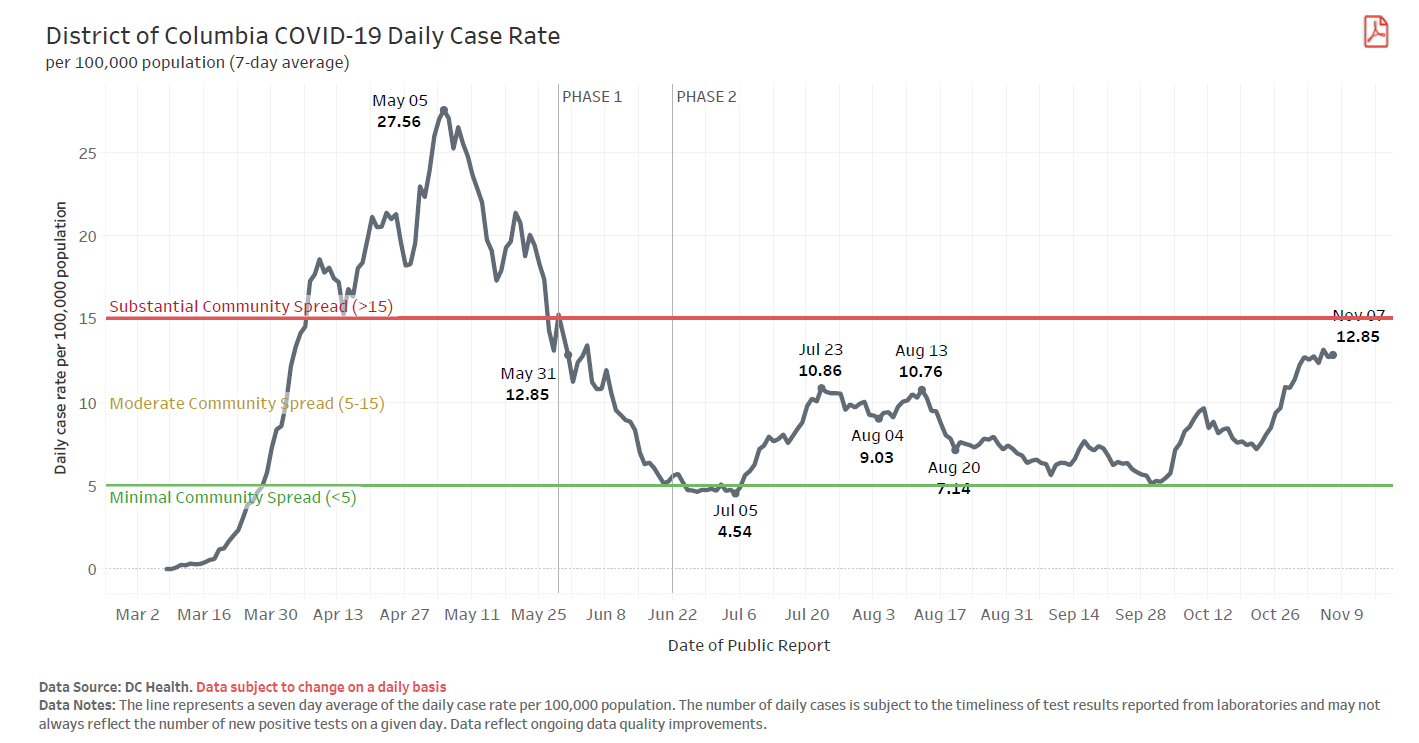
Cases are also ticking back up in D.C., though they’re still below what they were in the spring. The case rate — again, the 7-day rolling average of new cases per 100,000 people— was 12.85 on Saturday, down from a high on May 5 of 27.56. Even so, the District’s case numbers have been creeping up steadily since Oct. 22.
Concerns over fatigue, small social gatherings
So, what exactly is causing the surge in COVID-19 infections? It’s hard to say definitively, but public health experts have some ideas.
One of them is general fatigue with COVID-19 guidelines, like social distancing from friends and family and wearing a mask. That can mean more relaxed attitudes and riskier behaviors.
“This is very exhausting for everybody,” said Haering, the Alexandria public health director. “The thing is, when we let our guard down, that actually lets the virus spread.”
Fatigue makes continued social distancing and mask-wearing an increasingly tough sell, Maryland’s Marcozzi told WAMU/DCist.
“My biggest concern is that at a time when we’re all tired is the exact same time that we have to double our efforts,” he said.
The latest surge is more concentrated among younger people than the outbreak in the spring, which disproportionately hit nursing homes and other congregate facilities, Marcozzi and Haering said. That’s one explanation for why hospitalizations and death rates have not jumped up yet — the virus is circulating among people who are generally at less risk for a severe case.
“What I’ve seen is a smaller social gathering leading to increased cases — so smaller social gatherings, sometimes indoors, sometimes with people not being masked, feeling that they’re safe because they’re in a smaller environment and not in a big crowd, but not following guidelines like social distancing and masking,” said Dr. Anne Monroe, an epidemiologist at the George Washington University Milken School of Public Health.
Marcozzi noted that the familiarity of family and friends can lull people into a false sense of security.
“Folks aren’t thinking that their friends or family members are potentially carrying the virus when in fact they are,” he said.
In Maryland, a plurality — 28% — of the people who reported attending a social gathering of more than 10 people in the days leading up to contracting COVID-19 said they had attended a family gathering. That data is for Oct. 25 through Oct. 31, the most recent week of contact tracing data.
In D.C., officials also expressed concerns about small social gatherings driving new cases. D.C. Health Director LaQuandra Nesbitt was asked about the potential for heightened spread in the District due to the dense crowds gathered near the White House over the weekend as presidential election results were announced. She said the department would monitor the effects of the post-election celebrations, but that officials remained concerned about smaller groups.
“Prior to the election on Tuesday, we made people aware of the number of activities that are happening in our country, including people continuing to have small gatherings in their homes and not wear masks,” Nesbitt said at Mayor Muriel Bowser’s press conference on Monday. “So while we will continue to monitor what the impact of people’s response on Saturday to the president-elect and vice president-elect will have long term, there will be a host of things that we will also continue to monitor that contributes to our increased rates of transmission.”
Transmission in family and friend social gatherings could be heightened in the future, as colder temperatures and the holiday season drive more people inside to socialize for extended periods of time. Monroe said she’s worried about the effect Thanksgiving could have on the coronavirus surge.
“Particularly if people are traveling from state to state or bringing together households that haven’t been together over the past months, I think we could potentially see another inflection point then,” she said.
A worsening picture could mean more restrictions, said Haering, and an end to long-hoped-for school reopenings.
“We don’t want to get to the point where the policy makers are saying, ‘Oh, my gosh, the hospital beds are filled up or the ventilators or the ICU beds are filled up, we have to clamp down and tighten the faucet,'” he said. “So what we’re really stressing is the more that we can do on a voluntary basis, the less likely we’ll get to a point where policy makers will have to make some really tough decisions about staying open.”
But slowing spread at family gatherings presents a particular challenge, experts said, because hosting or attending such private events comes down to individual decisions. It’s harder for public health guidelines or emergency policy orders to dictate behaviors in someone’s living room than in a restaurant, Monroe suggested.
“The harder thing is having people follow guidelines in their private spaces, and that is what we’re seeing that’s driving the cases right now,” Monroe said. “I don’t know right now that shutdowns of non-essential retail, for example, would make a difference in terms of the number of new cases in our region.”
At least one area jurisdiction, Montgomery County, is considering re-imposing some restrictions in light of climbing coronavirus cases. County Executive Marc Elrich proposed last week limiting gatherings to 25 people, down from 50 people, reducing the capacity of stores and restaurants to 25% instead of 50%, and requiring restaurants to collect contact tracing information from diners. The County Council will vote on the proposals on Tuesday.
For now, experts like Marcozzi, Haering, and Monroe are doubling down on messaging about individual public health practices — and hoping that residents across the region take heed.
“With COVID, we know how to prevent it,” Monroe said. “We have the tools that we need for social distancing and masks and hand washing and not touching your face and all the basics, and yet, here we are. So it’s a bit frustrating.”