Colleen Grablick
As the nation sees record-breaking counts of new coronavirus cases with each passing day, infections in the D.C. region continue to hit marks not seen in each jurisdiction since the spring.
On Tuesday, the District reported 245 new cases — the highest number of daily infections since the city recorded that same number on May 8. D.C. has only seen a daily case count this high on one other occasion — May 1 — when the city recorded 335 new cases. Less than one week ago on Nov. 11, D.C. reported 206 infections — a significant jump from the daily case counts reported throughout September and October, when cases occasionally topped 100.
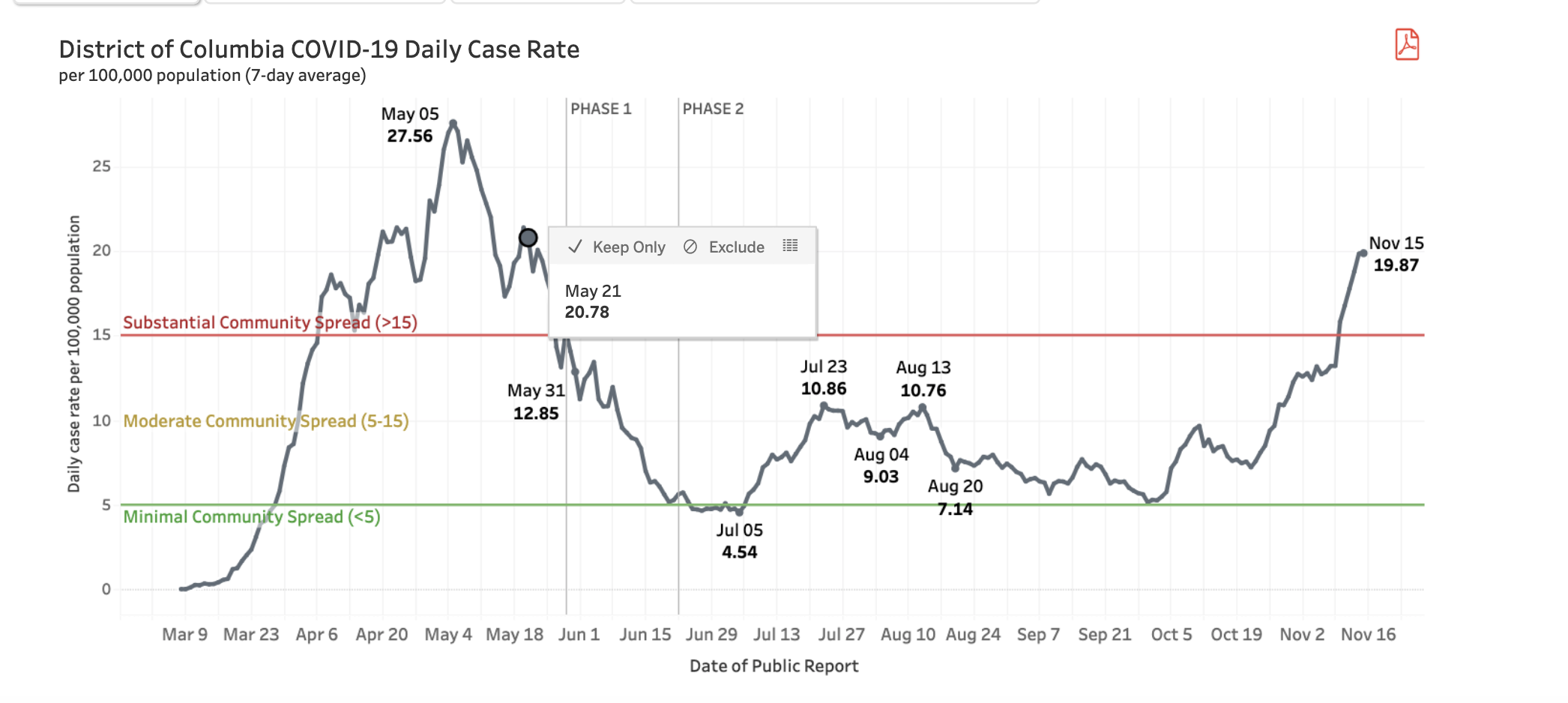
D.C.’s average daily case rate per 100,000 residents is now 19.9 — another high that the District hasn’t seen since May, when the stay-at-home order was still in effect and officials had not yet moved into Phase One of reopening. During the spring surge, the daily case rate per 100,000 residents — a measure of community spread — peaked at 27.56 on May 5, and dropped as low as 4.54 in early July. Per the city’s health department dashboard, D.C.’s community spread has been “substantial,” since Nov. 10.
D.C.’s transmission rate, which estimates the number of people who will be infected by each positive case (and is a key indicator for measuring the spread of a pandemic in a community) was 1.21 as of Nov. 5. The last time D.C. reported a transmission rate this high was July 5. And the city’s average percent positivity rate, which measures the number of positive cases out of all tests administered, is 4.6% as of Nov. 16. The last time that metric hit 4.6% was five months ago, on June 16.
D.C.’s acute care bed capacity has also reached concerning numbers in recent days: the metric surpassed 90% last week, a level which is considered insufficient, according to the city’s reopening metrics. The metric (which fluctuates frequently) indicates how the local hospital system is able to care for all patients, including those with COVID-19, without needing to employ emergency surge resources. The District’s bed capacity dropped to 81.8% as of Monday, which is considered “moderate” capacity; the goal is to bring that number below 80%.
Regionally, D.C.’s daily cases per capita top its neighbors, Maryland and Virginia, where infections are similarly spiking. According to the Washington Post’s regional coronavirus tracker, D.C. holds a seven-day average of 2,821 new cases per 100,000 residents — slightly higher than Maryland’s 2,793, and more than Virginia’s 2,457.
On Tuesday, Virginia recorded 2,125 new cases after seeing a record high of 2,677 cases on Monday. While Monday’s count was caused in part by a backlog in recording, the commonwealth’s seven-day average of new cases is now more than 1,500 for the first time in the course of the pandemic. (One month ago, that metric was less than 1,000.) The state’s positivity rate is now 7.4% — well above the World Health Organization’s recommended 5% for reopening.
Following the trend over the past several weeks, hospitalizations in the state continue to increase and are now at the highest they’ve been since late May. As of Tuesday, 1,392 COVID-19 patients were hospitalized, but the state’s bed capacity remains fairly steady.
While the Southwestern portion of the commonwealth had been a hotspot of infections in recent weeks, Northern Virginia — the state’s most populous region — surpassed Southwest’s seven-day average of daily new cases, reporting an average of 468.3 new cases compared to Southwest’s 420 on Tuesday.
Last week, Virginia Gov. Ralph Northam announced a slew of new COVID-19 restrictions: limiting public and private gatherings, both indoors or outdoors, from 250 to 25 people, prohibiting alcohol sales past 10 p.m., and expanding the mask mandate to include children over the age of five.
Maryland’s daily case count also spiked on Tuesday, with 2,149 new cases added in the last 24 hours. This is the second-highest daily count over the course of the pandemic, behind the 2,321 new cases recorded on Nov. 14.
Tuesday’s positivity rate in Maryland was 8.7% percent, the highest single-day positivity rate recorded since late May. The seven-day average positivity rate is now 6.85%, almost double the rate the state recorded throughout the second half of September.
As cases continued to spike last week, Gov. Larry Hogan set new restrictions on restaurants, limiting indoor dining capacity from 75% to 50%. The state’s health department also activated its plans for hospital surge capacity as the number of patients hospitalized with the virus hit June-level metrics. On Tuesday, Hogan took additional actions, mandating that restaurants close at 10 p.m. and limiting capacity in all retail businesses (including grocery stores) and religious institutions to 50%, down from 75%.
Tuesday’s return to levels not seen for months across the region comes after several days of continuously spiking infections, and as health officials sound the alarm on fatigue and frustration, eight months into the pandemic and just days before locals will decide how to celebrate Thanksgiving.
While some jurisdictions have rolled back their phased reopening plans to limit the surge in infections (like hard-hit Montgomery and Prince George’s County), D.C. has yet to dial back any of its Phase Two measures. At a press conference on Nov. 12, D.C. Mayor Muriel Bowser suggested that the city “may” need to reimpose new coronavirus restrictions as the pandemic surges on through winter. On Monday, Bowser said the District will “continue to monitor our metrics very closely,” but did not offer further detail on any new possible restrictions.
This story was updated with updated information about new Maryland restrictions mandated by Gov. Larry Hogan.