Debbie Truong
The Washington Teachers’ Union has rejected an agreement with D.C. Public Schools over reopening campuses, creating another setback for the school system as it tries to bring students back to physical classrooms.
The union and school system reached a tentative agreement last week that outlined conditions for returning to in-person learning. The proposal covered protections for teachers who are exposed to the coronavirus and safety conditions inside buildings.
Elizabeth Davis, president of the Washington Teachers’ Union, said she wanted to seek input from teachers before formally approving the pact with D.C. Public Schools Chancellor Lewis D. Ferebee. On Wednesday, Davis said signing the agreement is not in the best interest of students and school workers.
“Teachers recognized that many individual students, especially those furthest from opportunity, need additional supports,” Davis said in a statement. “We hope to return to our schools in a smart, data-driven manner that protects our students, teachers and communities from COVID-19.”
D.C. Public Schools did not immediately respond to a request for comment.
The union has lobbied for a provision that would allow teachers to opt out of in-person teaching, which the school system has resisted.
Under the proposal, teachers would have had the ability to opt-out of teaching in person during the second quarter, which is underway. But the school system could have required teachers to return to physical classrooms starting the third quarter, which begins in February. Davis said that was the main reason teachers did not want the union to accept the reopening proposal.
“We cannot move forward with an agreement that could force anyone, regardless of preexisting conditions or their living situations, back into an in-person classroom,” she said, adding the union will continue to negotiate terms for reopening with the school system this week.
She also said Mayor Muriel Bowser has not provided clear guidelines for if and when the school system would close campuses, if COVID-19 cases continue to rise in the region.
Bowser criticized Davis for rejecting the accord after indicating early support of it.
“I can’t say I’m surprised. She’s backed away from other tentative agreements,” Bowser said during a press conference. “It should be apparent that the goal posts, unfortunately, continued to move.”
Ferebee has previously said he has the authority to move forward with reopening schools without the union’s approval. But lack of union support stymied plans to bring thousands of students back to school buildings this month.
The union filed a complaint with the city’s Public Employee Relations Board, arguing the school system refused to negotiate with the teachers group, as required by law. The board, which mediates disputes between city employers and workers, sided with the union, leaving DCPS unable to staff classrooms.
Instead, the school system has started reopening buildings under a much more modest plan. About 400 students at 25 elementary schools returned to physical classrooms Wednesday to what the school system is calling CARE classrooms. More are scheduled to open in the coming weeks.
In those classrooms, class sizes are restricted to 11 students or fewer. Classes are not staffed with teachers but other school workers or employees with organizations the school system partners with. Students are continuing to log on to virtual classes.
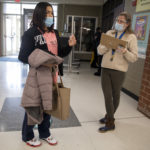
Students at Bancroft Elementary School in Mt. Pleasant were among the first to return. Outside the school Wednesday morning, a crossing guard greeted families, directing them to an entrance where students’ temperatures were taken. A mother rushed her fourth-grade daughter to class, before hustling home to her other child.
D.C. schools identified the students for in-person learning, prioritizing children who have high needs, including those enrolled in special education or English language learner services.
Principal Jessica Morales said some children at Bancroft, an English and Spanish dual-language school that educates a large number of students from low-income families, have had a hard time maneuvering technology for distance learning. Many families have struggled with childcare, relying on family members to help during the day.
Morales said having a place for parents to bring their children helps alleviate some of the burden.
“Unfortunately, a lot of our families have received eviction notices,” Morales said. “And they need to go back to work.”