Growing up in D.C., Nayion Perkins says he used to pick up a copy of Express, the Washington Post’s free daily commuter paper, on his way to school. He got to know the folks handing them out, and turned to the publication “for information and entertainment.”
Then the paper shut down in 2019. Perkins, who at 25 is the director of design and strategy for content and local experience company The Pack, says, “sometimes you don’t realize how important something was to you until it’s gone.”
The Pack, comprised of five native Washingtonians, tells “the stories of Washington, D.C.,” through hosting events, producing clothing, and more, Perkins says. Now, the company is launching its own version of Express.
“We saw [the launch] as a great way to spread information but also pay homage to what was an important part of the city, a specific part of the city,” says Perkins, who serves as the layout and design editor of the new Express.
In the spirit of the original Express, which repackaged reporting from the Post and the Associated Press as well as featured its own original coverage of local food, arts, and news, The Pack’s version covers a mix of subjects.
For the first — and perhaps only — issue of Express, which is available online now, The Pack sought out nine outside volunteer contributors, from writers and subject matter experts to photographers, all of whom were native Washingtonians or have spent significant time in the District. (Perkins has a journalism background, but says not everyone involved with the project does.)
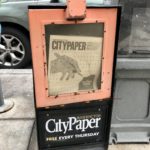
The Pack printed 500 copies of the paper, though the team plans on setting some aside to mail out, and will release a sign-up sheet for readers who would like a copy. This Saturday, they will distribute copies of the paper throughout the city, and will bring a replica of the newspaper box to set up at each distribution site while they’re there.
“We’re in a digital age and physical print materials are not as heralded anymore, but we thought a newspaper was still an effective medium to get these messages out,” says Perkins.
There are not currently plans to print a second issue, though Perkins says they are open to it.
Perkins, who lives in Northeast, says the team started thinking about relaunching the paper as a way to celebrate “the general culture” of D.C. after the original paper closed.
But as COVID-19 hit the District, it threw a wrench those plans, and when protests against police violence and racial injustice swept the city this summer, staff changed the focus of the project to highlight peers who work in activism.
Their first issue, which is available online now, features headlines like “Hail to Change: After years of debate, The Washington Football Team adopts a new name,” and “What is Police Abolition?” as well as a fall arts guide, a “fun + games” section, and more.
The layout is modeled after the original Express, which Perkins says he still has a few copies of. He notes that the Sudoku puzzle is his favorite part because it reminds him of the original Express’ games section, which he used to fill out on his own.
The original Express began publishing in 2003. A post on WaPo’s public relations blog published at the time of its closure blamed the shutdown partly on increased WiFi availability in Metro stations, which led to more users reading the news on their phones rather than in print. A Post article announcing its closure cited a drop in circulation from a high of 190,000 daily readers in 2007 to 130,000 in 2019.
Dan Caccavaro, the executive editor of Express, told DCist at the time, “It’s been a rough half a year for us,” pointing to Metro’s partial shutdown and the government shutdown before it. “I don’t know that our performance recently necessarily reflected what it would be going forward.”
Express employed 20 journalists, per the Post, as well as around 75 people who distributed the paper at Metro stations and in newspaper boxes. They were not part of a union, unlike Post employees. Caccavaro told DCist that all 20 journalists lost their jobs, but didn’t know what the closure would mean for the “hawkers” who distributed the papers.
The Washington Post Newspaper Guild, the union that represents many Post employees, condemned the closure and called on the Post to hire Express staffers.
The Post did not immediately respond to DCist’s request for comment on The Pack’s relaunch of Express, whether any original Express were hired by the Post after its closure, and whether the Post hired any “hawkers” in another capacity.
Perkins says The Pack has not had any contact with the Post about its version of Express. The paper is free for readers; Perkins says the project is not being monetized and those involved are not making any money from it.
Perkins says for a generation of people in D.C., Express was in many cases their earliest reference point for print newspapers. “So, we wanted to provide the nostalgia of that, along with actually giving people information they could use and share,” he says.
Copies of the paper will be available at Soufside Market on Pennsylvania Avenue SE from 11 a.m. to noon, 1240 U Street NW from 12:30 to 1:30 p.m., and the Brookland-CUA Metro station from 2 to 3 p.m.