Matt Blitz
In the first minute of his first game as a Howard Bison, Makur Maker caught an out of bounds pass near the rim, leapt above his defender, and softly bounced the ball in the hoop for two points.
It was a rather unremarkable act for the nearly 7-foot, 20-year-old college basketball phenom, but it’s one that will go down in Howard University history for what it represented –– even if few were there to witness in person due to COVID-19 restrictions.
In July, Maker’s decision to attend and play at Howard University over college basketball powerhouses like the University of California-Los Angeles and the University of Kentucky sent shockwaves across the college basketball landscape. Maker is the first five-star recruit to commit to a Historically Black College and University, and likely the most hyped basketball player ever to attend the D.C. university.
Maker at the time said that making the decision to attend Howard wasn’t solely based on its basketball program, but knowing that he had the ability to influence others to follow in his very large footsteps.
“I need to make the HBCU movement real so that others will follow,” he wrote on Twitter in July. He also mentions that he hoped to “inspire” another potential top recruit, 16-year-old Mikey Williams. In an as-told-to essay for the Undefeated a few days later, Maker cites alumni Thurgood Marshall, Toni Morrison, Elijah Cummings, Kamala Harris, and Chadwick Boseman as his own inspiration for the decision.
All of this also happened in the midst a summer of Black Lives Matter protests regionally and nationwide.
But after months of anticipation for the season, one where onlookers are dreaming of an NCAA tournament bid and individual accolades, fans may not see much of him actually on the court.
Though he dropped 11 points in his debut, Howard lost that game 95-78 to Belmont. The next night, Maker scored 12 points in a game against Division II team Queens University of Charlotte, but Howard lost again. Maker didn’t play even 20 minutes, making it clear something was wrong. The next game, he never got off the bench.
By November 28, only two games deep into the season, Maker was benched “indefinitely” due to a “nagging” groin injury.
“Quite honestly, he’s really banged up and we’re going to shut him down until he gets healthy because right now he’s just not,” Howard men’s basketball coach Kenneth Blakeney told the Washington Post. “He’s not able to move, and I don’t want him to be counterproductive right now.”
A Howard spokesperson tells DCist/WAMU that the university does “expect to see Maker back on the court in the near future.” They declined to make him available for an interview even prior to the injury.
In reality, that basket Maker scored in the first minute of his first game could be one of only a few he scores donning the Bison blue and red.
But while the potential ending of Maker’s season at Howard is no doubt a disappointment for his coaches and fans, his performance on the court is almost beside the point. That’s because, contrary to the immense pressure that mounted on Maker when he joined the team, his decision to attend Howard was never just supposed to be about the outcome of this season.
Instead, Marker seemed to understand, like more and more athletes of his generation do, that symbols and representation matter.
Coaches tell DCist/WAMU that Maker will have helped reshape the team simply by committing to and showing up on the D.C. campus, highlighting that Howard’s legacy, history, and future goes way beyond one 20-year’s decision to play basketball there.
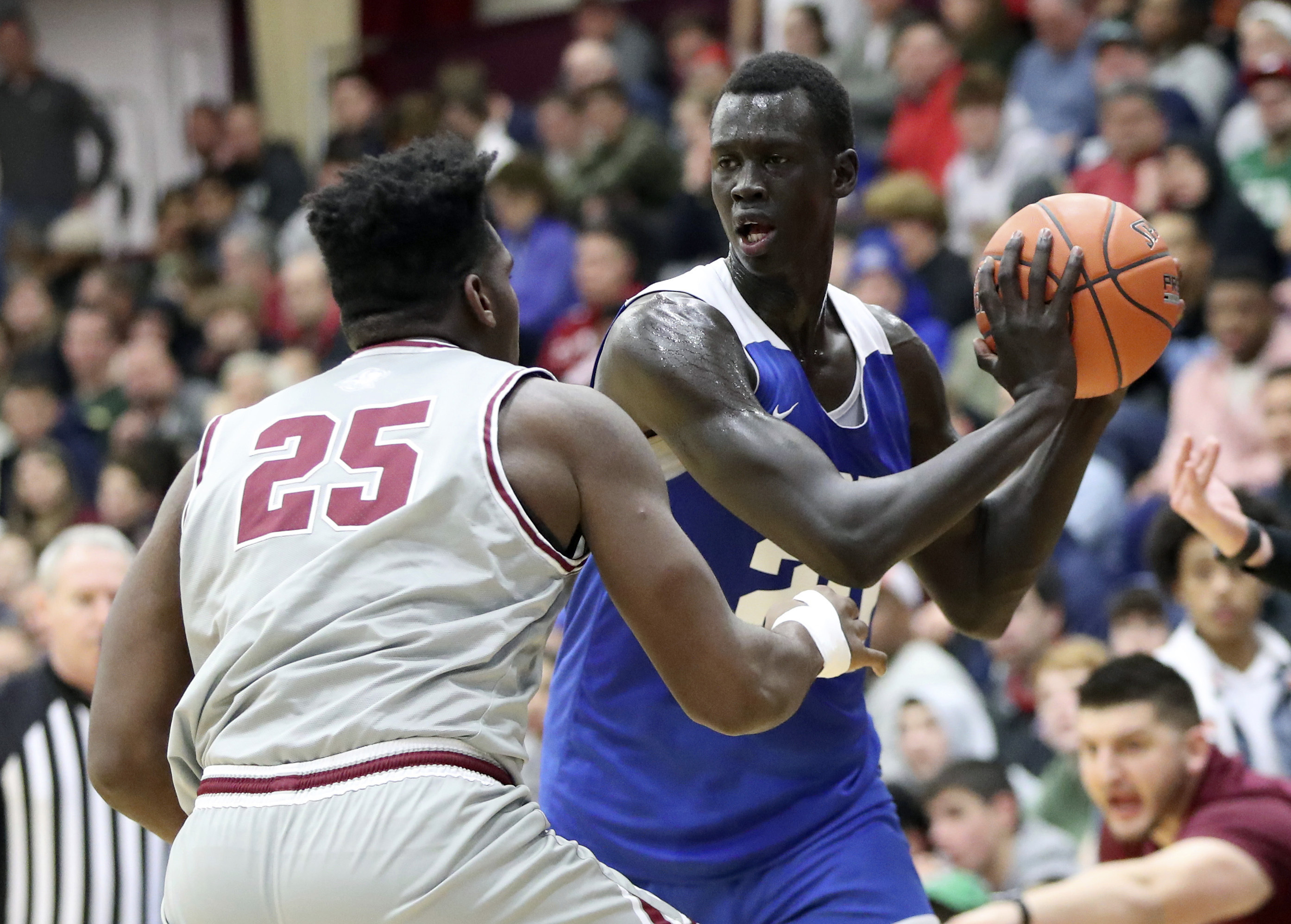
Makur was born in Kenya to Sudanese parents. At a young age, he and his family immigrated to Perth, Australia, where he grew up.
Even at the age of 14, he was considered a prime basketball prospect. He was essentially recruited to move to Southern California to enroll in a private prep school in 2015. Maker bounced around between several schools over the next few years, at one point joining his cousin (and future NBA player) Thon Maker in Ontario.
Coming out of high school, he was so good and considered such a tantalizing prospect that he declared for the NBA Draft in April and was considered a potential first round pick.
But, in July, he did what few thought he would do — not only committed going to college, but to Howard University. He also made a point to note it was South Sudan Independence Day.
Howard’s men basketball coaches tell DCist/WAMU that highlighting Howard’s history was a major part of their recruiting pitch to Maker.
“The university basically sold itself,” says Blakeney. “[There’s] a list of people that have paved the way. Our presentation to Makur and his family was just that… ‘Here are all the wonderful people that have come to [Howard]. It’s a place where you and your brand can really, I think, help ignite it in a way that it hasn’t been ignited before.’”
“A lot of information we gave him was about Kamala Harris and we spoke in future tense that Kamala will be the vice-president of the United States,” says assistant coach Jake Brown, who works closely with Maker. “And it came true.”
Upon arriving on campus, Maker was met by a team that was primarily like him — young. 75% of the roster are freshmen or sophomores. It was also a team that had only won four times last year, against 29 losses, and hadn’t gone to the NCAA tournament in nearly three decades.
It’s a team that needed talent and maturity. The coaching staff believes it got both in Maker.
However, they are realistic about on-the-court expectations. Even with Maker in the line-up, they acknowledge the chances of them making the NCAA tournament this year are not great. (That is, if the tournament even happens). “At the end of the day, it’s about being able to compete and build that culture,” Brown says.
With Maker likely to miss a substantial amount of time due to his injury, wins may continue to be elusive for the currently winless Howard Bison.
“I know the expectations from the outside have gotten higher,” Blakeney says. “I get that, but I don’t think that’s fair.”
At the end of the day, it’s possible that Maker’s biggest legacy at Howard won’t be for his athleticism, but for helping his coaches and school administrators build the kind of program they want.
Associate Provost of Enrollment Anthony Jones says Maker is at the forefront of this wave of highly-recruited athletes considering HBCUs across the country –– and it’s not just basketball, either. “It’s tied to the position that society is giving our young people that HBCUs are okay. Not only okay, but they can produce,” Jones says.
Blakeney is noticing this shift as well. “It’s showing up on the recruiting trail too,” he says. “It’s already translated to four and five star athletes looking at Howard.”
Blakeney himself is a D.C. native and was once a highly-regarded basketball star at famed DeMatha Catholic High School in Hyattsville, Maryland. He played at Duke in the 1990s, where he won two national championships.
He says he’s made it a priority to recruit more from the region, which he notes has produced more NBA players than nearly every other region in the country.
While Maker is not from D.C., coming to Howard sets up the program to follow the model of Georgetown in the 1980s, says Blakeney, when the private university won a national championship, produced a number of NBA stars, and became a D.C. icon along with coach John Thompson Jr., who died in August.
“[They did] it with local DMV kids. It’s kinda the blueprint I’m following right now,” says Blakeney.
But all of that is a future that Maker is likely not going to be a part of. The coaches acknowledge that they are probably going to only have him this season, like other “one-and-done” players at major basketball programs. At this point, they might have him for only a few games.
It’s probable that Maker will declare for the NBA draft and end his collegiate career this spring.
“Yeah, I do definitely think that’s the case for him. I think it’s definitely our plan to get him drafted next year,” says Brown. “One person making a decision does [bring] a lot of attention to HBCUs, but it’s going to take two, three … years to bring sustained change.”
That change to Howard’s program won’t come with wins, but rather who Maker is as a player and person, Blakeney says.
“He’s a guy that has a lot of world and life experience. He’s kind of like an old wise soul a little bit,” Blakeney says. “He’ll sit, be quiet, and he’ll absorb everything. He’ll make his opinions and judgments after… kind of surveying the situation. And he plays that way also.”
Coaches note that Makur leads by action rather than talk. Brown says that off the court, he’s also done a good job of being a role model –– and that includes just hanging out with his teammates and building camaraderie.
Like a lot of 20-year-old student-athletes in the midst of a pandemic, Maker is playing video games to pass the time. Blakeney says he often catches snippets of conversations between Maker and his teammates about playing Call of Duty.
“He’s not treating it as if he’s a higher, higher recruit than anyone else. He’s really easy to work with and done a good job of kind of mentoring some of… the other freshmen,” he says.
The true mark of him committing to Howard University in July 2020 to play basketball, even if only for a few games, may not be known until years or, even, decades down the line.
“I think he’s definitely left a legacy,” Brown says. “And he’ll continue to leave a legacy here, even if he’s here for only one year.”