Debbie Truong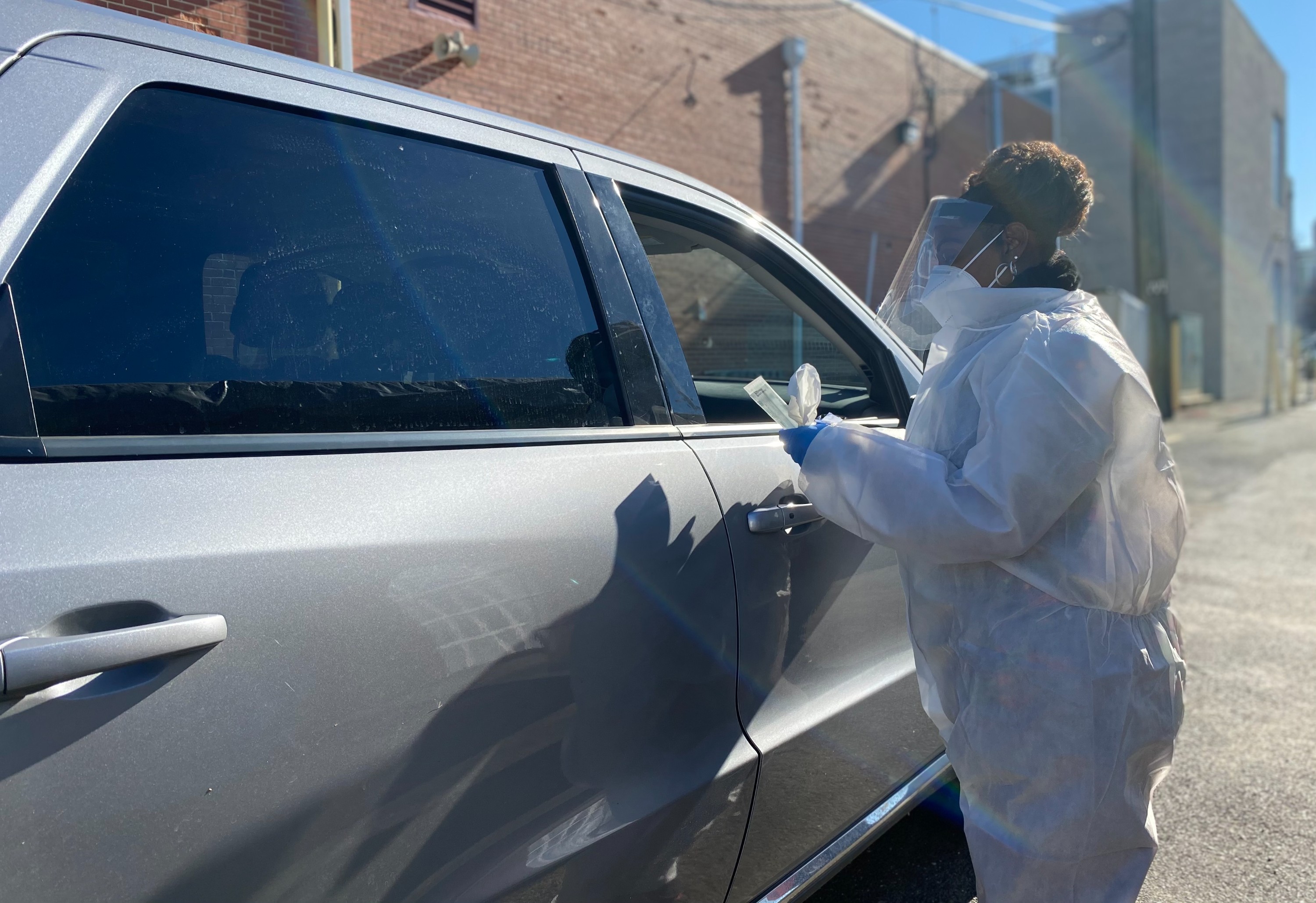
Once a week, staff working in-person at Rocketship Public Schools receive a coronavirus testing kit from the company Curative. School workers swab the inside of their own mouths, sealing the sample in a tube and biohazard bag.
The school ships the samples to a lab, which provides results in 48 hours, said Josh Pacos, Rocketship’s director of schools. Any employee who chooses to return to school buildings must complete the weekly ritual.
“We cannot, with 100% confidence say, ‘You are not at risk for any level of transmission of COVID,’” Pacos said. “What we can do is make sure that the layers of protection we provide are of the highest possible quality.”
As campuses across the Washington region gradually reopen for face-to-face learning, schools have adopted a range of approaches to coronavirus testing for students and staff.
At Rocketship and other D.C. charter schools, testing is mandated for every school worker who returns for face to face instruction. D.C. Public Schools is piloting a program that would give students and staff access to regular testing if they want it, after initially saying it would only test people who are showing COVID-19 symptoms. The school systems in Fairfax and Loudoun counties, two of the largest in Virginia, are not testing people inside schools.
Public health experts say rapid testing, combined with face mask mandates and physical distancing, can help schools detect the virus in buildings and reduce the risk of transmission. And some school leaders and groups representing teachers say frequent testing can boost school workers’ confidence about returning to campuses.
“Testing is the primary reason, adults in particular, are comfortable with coming back into school buildings,” said Shannon Hodge, who leads the D.C. Charter School Alliance, an organization that advocates for the city’s charter schools.
In D.C., Mayor Muriel Bowser announced last week that DCPS, where about 600 children are learning in school buildings, would provide a nasal-swab test for students every 10 days. Staff working in person will receive a testing kit in the mail once a week but will not be required to use it.
“There is a sense of urgency to get more students back in school with their teachers, peers, and school community, and we are hopeful that these new protocols move us one step closer to reopening,” Bowser said in a news release.
The pilot program does not have a specific end date and the city will also provide tests to schools that reopen in the coming months, according to a city education official. The school system is already administering rapid coronavirus tests for people showing COVID-19 symptoms while at school.
Hodge said charter schools will also participate in the pilot and school leaders are “cautiously optimistic” about the program. She said many charters, which educate about half of the city’s public schoolchildren, want more access to tests.
Some are figuring out ways to offer coronavirus testing on their own.
At Friendship Public Charter School, where 300 students across 16 campuses are learning in-person, school workers who have elected to return to school buildings must get tested every two weeks. Last week, the charter launched drive-thru and walk-up testing sites for students outside school buildings.
“Friendship has been in constant contact with its families, its students, its team members,” said Candice Tolliver Burns, a spokesperson. “Through these conversations, we clearly identified that testing was essential.”
On a recent weekday, Latorie Jackson and her five sons piled out of the family’s SUV outside Friendship Southeast Elementary and Middle School. Three of Jackson’s sons had returned for in-person learning and her two others were due to return soon. Jackson wanted to make sure her children were healthy.
Each of the boys took turns approaching a tent where three nurses were huddled. One after another, they slid their face masks down to their chins, allowing a nurse to collect nasal swabs.
“It just tickled a little bit,” said 15-year-old Amare Jackson.
Friendship pays for staff testing. But coronavirus tests administered for students are provided by The Rockefeller Foundation, which received a supply of Abbott Laboratories’ BinaxNOW rapid tests from the U.S. Department of Health and Human Services. The foundation is piloting testing programs at schools in several cities, including the District, Los Angeles and New Orleans.
The foundation published a report in October that provided guidance school leaders can use to develop testing regimens. Public health experts who wrote the report suggested assessing schools based on their coronavirus risk — very low, low, moderate or high.
At campuses where the risk of coronavirus is low, schools should consider pooled testing, or combining samples from groups of people and conducting one test, the report said. Schools where the risk is moderate should conduct routine screening, and campuses where the risk is high should consider closing.
All schools should offer testing for students and staff who show COVID-19 symptoms or who are exposed to someone who is, said Christina Silcox, a managing associate at the Duke-Margolis Center for Health Policy, who co-authored the report.
The Centers for Disease Control and Prevention recommends schools provide testing for people who show symptoms consistent with COVID-19, the respiratory disease caused by the virus. It also suggests testing asymptomatic people at schools in communities with moderate to high community transmission.
Public health officials and school administrators may also want to prioritize testing in schools that serve large populations of students who belong to communities disproportionately affected by COVID-19, according to the CDC. The agency advises against mandatory testing.
But testing alone will not keep the virus out of school buildings, said Dr. Benjamin Linas, an associate professor of epidemiology at Boston University. Testing is also costly, he added, which could pose a barrier for cash-strapped school systems.
“At the end of the day, what actually prevents the transmission is people wearing masks, distancing, working on air exchange and trying to do some cohorting,” he said. “Those are the pillars. The testing is meant to help you do that better.”