 Jordan Pascale
Metro will likely be able to avoid some of the most drastic service cuts in its budget that begins in July after Congress passed a $900 billion relief package on Monday. However, the transit agency has not said what cuts it aims to eliminate first.
Sen. Mark Warner (D-Virginia) says the Washington region can expect about $800 million in funds for transit relief. The bill included $14 billion overall for public transit, considerably less than the $32 billion industry groups say they need to keep transit systems afloat.
That money gets doled out based on a set of formulas. Some of that funding goes toward local transit agencies like Alexandria’s DASH, Prince George’s County’s The Bus and others, so it’s unclear how much WMATA will receive.
Yonah Freemark of the Urban Institute estimates D.C. could get between $610 to $710 million in funding, which could go a long way to restoring service. During the last round of the CARES Act, the region got $1 billion and Metro ended up with $877 million.
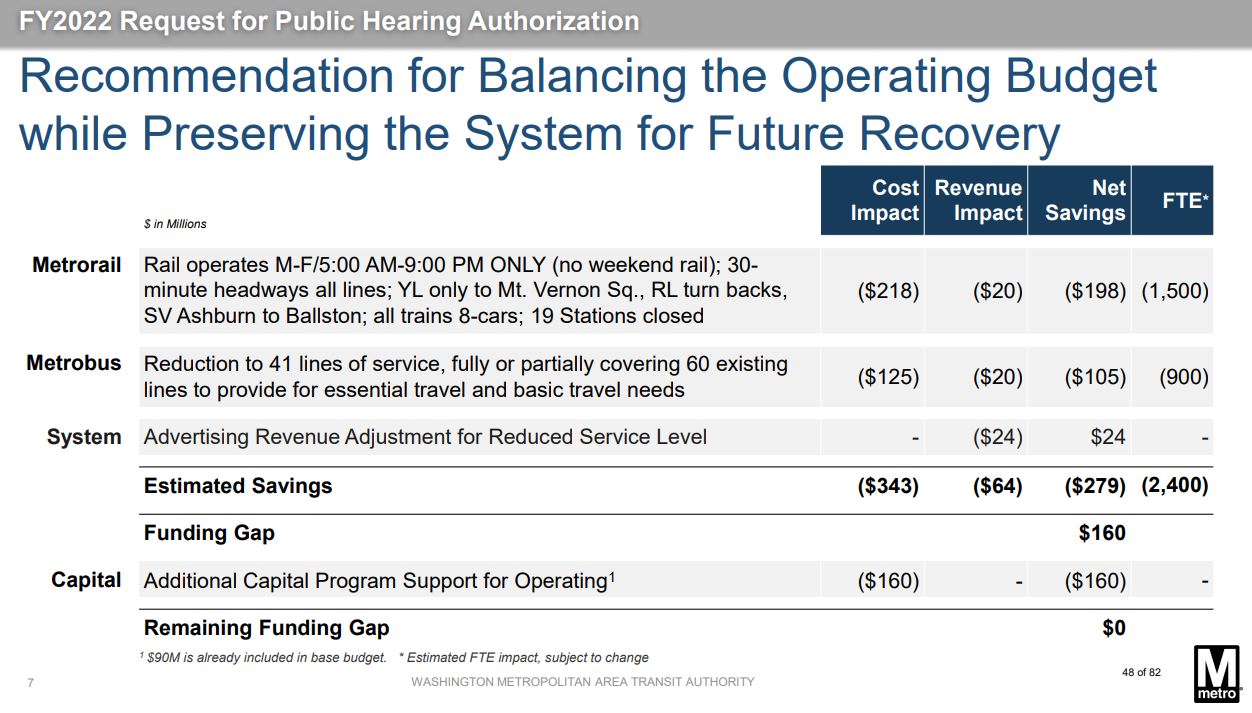
Metro’s proposed cuts that start in July are valued at about $343 million, according to Metro’s budget documents. It includes eliminating weekend train service, running trains every 30 minutes on all lines on weekdays, implementing turnbacks on the Red, Yellow and Silver lines, closing Metrorail at 9 p.m., closing 19 stations and eliminating another 2,400 jobs.
In all, it cuts rail service to 20% of pre-pandemic levels and bus service to 45% of pre-pandemic levels. Some board members said that level of service will force many to find travel alternatives or continue to work from home.
But now some of that could be off the table.
It’s unclear what exactly would be changed if additional funds do arrive. Metro has said federal relief is the only option for help it has left, and WMATA General Manager Paul Wiedefeld has repeatedly said it would be much easier to add back service if it came.
The board hasn’t addressed which service items would be restored first.
Metro board chair Paul Smedberg said the board has not discussed line by line priorities. He said he’s unsure if the board will hold another meeting before the end of the year if funds do come through.
Last week, the board voted to send the budget proposal to the public for comment in January and February.
“We obviously know public input will be negative,” board member Matt Letourneau said during the meeting. “People will not like this.
“But out of all these bad choices, which are the worst?… We have to be able to weigh them against each other.”
That information could help them make the most informed decisions when the budget is formally voted on in March.
Metro board members have expressed distaste for cutting weekend service, closing stations and the turnbacks specifically. Most say the budget is awful, but necessary.
If Metro is able to avoid the proposed cuts and sticks to its current service levels, it would represent about 50% of pre-pandemic rail service and 75% of pre-pandemic bus service. It looks like this:
- Metrorail hours: 5 a.m.-11 p.m.
- Red Line Trains every 5 minutes during peak hours; every 12 minutes during midday; and 15 minutes during evenings.
- Rest of lines: trains every 8 minutes during peak hours; every 15 minutes during midday; and every 20 minutes during evenings.
- Metrobus hours: 4 a.m. until midnight
- About 60 routes operating.
WMATA has been sustaining itself with about $800 million that it got from the CARES Act in May, but that money runs out early next year.
The American Public Transit Association says the industry needs $32 billion to survive.
Amalgamated Transit Union President John Costa said the aid is welcome and crucial to stave off layoffs and restore service for riders.
“However, let’s call it like it is,” he said. “This was literally a highway robbery, and the suspects are the Senate Republicans.”
Many Democrats say this bill is merely a “bridge” to a wider funding package in the new year.
More on the federal aid package in our region: