Matt Blitz
The COVID-19 vaccine arrived in the D.C. region, and it offers perhaps the first glimmer of hope for a coming post-pandemic era.
The first shots went into arms as coronavirus case numbers and hospitalizations continued to climb. More than a half a million people have contracted COVID-19 in the region over the past nine months.
Local leaders and health officials — some who have taken the vaccine themselves — have said that disseminating the vaccine efficiently and safely to the millions in the region could be, as Maryland Gov. Larry Hogan put it, “the most massive undertaking of this pandemic.”
Here what we know so far about the rollout of the COVID-19 vaccine in the D.C. area.
Who gets the vaccine first?
Health care workers, first responders, and residents of long-term care centers will be the first to get vaccinated in the region.
But this group includes hundreds of thousands of people, so there won’t be enough doses for all of them right away.
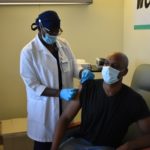
Front line hospital workers who interact with COVID-19 patients have been among the very first to get the vaccine. Maryland begins vaccinating long-term care residents this week. Virginia and D.C. plan to follow within the next two weeks.
After the first priority group, who comes next?
Jurisdictions will then move on to frontline essential workers and other high-risk adults. The CDC has recommended people age 75 and over be included in this next priority group.
Local officials have to decide which groups of essential workers to vaccinate first, but this could include law enforcement officers, grocery workers, teachers and other school staff.
Colin Brody from the Fairfax County Health Department notes the “critical workforce” designation could include some federal employees, like those who work in national security. Maryland’s top education official has called for the state to make school employees a priority among essential workers.
I don’t fall into any of these categories — when will I get the vaccine?
Most of the general public will not be able to get the vaccine for several months — possibly sometime between March and June.
Virginia Gov. Ralph Northam has said that, by early to midsummer, he hopes most residents will be vaccinated.
It’s not clear how long it will take to vaccinate all those in the initial priority groups, but officials have said they won’t necessarily finish vaccinating one group before moving onto the next.
How many people have been vaccinated in the D.C. region so far?
D.C., Maryland and Virginia have been allocated more than 400,000 doses of the Pfizer and Moderna vaccines so far. More than 30,000 people have received their first of two doses.
Maryland and Virginia launched dashboards tracking vaccinations in their state. The dashboards include the total number of doses administered, as well as data on the race and age of those who have received the vaccine so far.
D.C. officials said Monday that it had used 4,500 of its initial 6,825 Pfizer doses, with more than 30,000 additional doses on the way to the city.
Will there be enough of the vaccine?
Yes, eventually.
But the distribution schedule depends on how quickly manufacturers can produce and ship more doses — and how many other vaccines win federal approval.
Local officials learned last week their next shipments of the Pfizer vaccine will be smaller than expected. The head of Operation Warp Speed apologized, saying he was responsible for miscommunication to states about when doses would be ready.
Virginia had expected to receive enough doses of the Pfizer and Moderna vaccines by the end of the year for 96% of its healthcare workers to get their first of two shots, but officials have reduced that estimate to about 74%.
Both the Pfizer and Moderna vaccines also require a second dose, from the same manufacturer, several weeks after the first. So, it takes 100 doses to fully inoculate 50 people.
Is there a chance supply could run out before I get my second dose?
Don’t worry about your second shot. Regional officials are putting their initial shipments to first doses, but the federal government has promised they are storing away enough supply for all the corresponding second shots.
D.C. officials said they don’t think the city is getting enough doses. What happened? Why?
The federal government is allocating doses based on the residential population, and Maryland and Virginia both have far more residents than D.C. But D.C. Mayor Muriel Bowser has argued the city should receive more doses than it has been allotted because the city has a large work population. Roughly three-quarters of the city’s health care workers live in Maryland and Virginia.
Bowser sent a letter to the federal government’s Operation Warp Speed asking for the vaccine to be disseminated based on workforce population.
Maryland and Virginia officials now say they will each provide about 8,000 additional vaccine doses to the District, helping to boost its overall supply.
D.C. Health Director LaQuandra Nesbitt said this extra supply would allow the city to start vaccinating long-term care residents shortly, in line with CDC guidance. Earlier this month, the city had listed this group as part of its second-priority subgroup.
How will I get the vaccine?
Health care workers are getting the vaccine at local hospitals and medical centers. Long-term care residents will largely get the vaccine through a federal partnership with CVS and Walgreens. Teams from pharmacies will set up on-site at long-term care facilities to administer shots, nursing home associations say.
Local health departments in Virginia and Maryland said they are planning to administer some shots to people like first responders, public employees who work at coronavirus testing sites, or health care professionals who work outside a hospital setting. But eventually, as more doses become available, the general public could get the vaccine at doctors’ offices or pharmacies, much like the flu shot.
Some local health departments said they would like to focus efforts on vaccinating underserved communities, like those without insurance, to make sure everyone in the community has access.
Will it be like COVID-19 testing?
Not really.
Jurisdictions plan to rely on appointment systems for their vaccination sites, to prevent standing in line outside in the elements like is the case for a lot of the testing sites.
In Fairfax County, Brody says the health department will use a text messaging system that allows patients to sign in virtually and directs them into the clinic or tent when it is time for their shot.
Gayles says Montgomery County, too, is developing an appointment-based system that will also remind people of their follow-up appointment for a second dose.
Health officials in many local jurisdictions said you should expect to get a physical reminder card after your first shot (like ones given to members of Congress) or a text update when it’s time to come back for your booster.
How effective are the vaccines?
Very, according to clinical trials and the FDA. Both the Pfizer-BioNTech and Moderna vaccines have about a 95% efficacy rate. While the math is a bit complex, that’s very high. The companies recruit thousands of volunteers for clinical trials to test the vaccines. Pfizer’s trial had more than 43,000 participants, with half getting the real vaccine, half a placebo. In the study, 170 developed symptoms and tested positive for the coronavirus — all but eight were in the placebo group.
Side effects have generally been mild. Common ones include soreness at the injection spot, fatigue, headache, swelling, and even a slight fever. But all side effects should subside within a few days.
Can I stop wearing my mask soon?
In a word: no. For now, officials continue to stress that, even with the vaccine, we will still need to abide by safety measures like mask-wearing and social distancing, especially as case numbers skyrocket.
It will take time before large swaths of the public are vaccinated. Also, the vaccine clinical trials tracked whether participants got sick, but we don’t know for sure whether the vaccine prevents infection, or whether it’s still possible to be an asymptomatic carrier.
Do I have to pay for the vaccine?
You should not have to pay anything out of pocket for the vaccine, even if you are uninsured. The U.S. government purchased its supply with taxpayer dollars and is making the vaccine itself free. Providers, like doctors and pharmacists, can charge an administration fee, which will either be covered by insurance or federal funds, for those without insurance.