Martin Austermuhle
When Black Lives Matter protesters were arrested by D.C. police last year, many subsequently faced charges for rioting. Now a D.C. lawmaker wants to know if similar charges could apply to President Donald Trump for Wednesday’s deadly rampage at the U.S. Capitol.
In a letter sent Thursday, D.C. Councilmember Robert White (D-At Large) asked Attorney General Karl Racine to assess whether Trump could be prosecuted for inciting a riot.
Under existing D.C. law, it’s illegal for anyone to “willfully [incite or urge] other persons to engage in a riot,” which the law defines as a gathering of five or more people who, through their actions, create “grave danger of damage or injury to property or persons.”
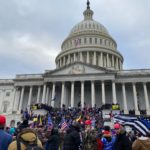
In his letter, White says that Trump could well have violated this law when he rallied supporters on the Ellipse just ahead of the chaos at the Capitol that left five people dead and suspended the counting of electoral votes for seven hours.
“[Trump] asserted that the presidential election was rigged and corrupt, and supporters heeded the President’s call to go to the Capitol and ‘fight like hell,'” wrote White, himself an attorney. “The resulting violent attack was deliberate and predictable.”
Anyone convicted of inciting a riot can be sentenced to six months in jail and a $1,000 fine. The law also specifies that if during a riot “a person suffers serious bodily harm or there is property damage in excess of $5,000,” the possible consequences get significantly more severe: 10 years in prison and a $25,000 fine.
“In response to the terrorist attacks on the Capitol, I took time to think through vulnerabilities going forward, and it quickly occurred to me that not only had the president incited a riot, but that he’s likely to continue doing this after he’s out of office,” White said in an interview. “So I wanted to make sure we have the ability to hold the president accountable both for the terrorist attacks he incited this week and for any time he may do this after he leaves office.”
A spokesman for Racine said his office was “reviewing the letter,” but had no immediate comment on whether prosecuting Trump for inciting a riot would be possible. Earlier today, though, he said on “Good Morning America” that investigations could happen.
“Donald Trump Jr., Rudy Giuliani, even the President of the U.S. were calling on their supporters and hate groups to go to the Capitol… we’re going to investigate not only those mobsters, but also those who incited the violence,” he said.
The U.S. Attorney for D.C. typically prosecutes most serious offenses, including rioting. But White — who used to work with Racine — said he wanted to bring up the idea of pressing charges with Racine since the attorney general “tends to think expansively about the powers of the office of the attorney general.”
Speaking to media earlier this week, prosecutors at the U.S. Attorney’s office seemed to be considering their options. U.S. Attorney Michael Sherwin said his office was looking broadly at who did what during the chaos — and also before it. “Yes, we are looking at all actors here, not only the people that went into the building, but… were there others that maybe assisted or facilitated or played some ancillary role in this. We will look at every actor and all criminal charges,” he said.
On Friday, though, prosecutors clarified that they “[didn’t] expect to bring charges of that nature.” Still, White says “we are just weeks away from a change in leadership at [the U.S. Attorney’s office].”
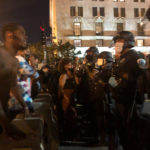
The city’s anti-rioting law has been a source of controversy for years, largely because D.C. police and federal prosecutors have used it against left-wing protesters. Hundreds of anti-Trump protesters at the 2017 inauguration were charged with rioting, and more than a hundred Black Lives Matter protesters faced similar charges last year. Virtually none of the charges actually resulted in convictions, though. Defense attorneys and civil liberties groups have been pushing for years for the anti-rioting law to be rewritten, largely because they say it is too vague and harsh.
That vagueness could be used to punish Trump, as the charge for “inciting” a riot is broadly written and ill-defined. Changes proposed by the city’s Criminal Code Revision Commission would scrap the incitement charge altogether, saying it’s an outlier when compared to state-based anti-rioting laws. The D.C. Council considered a bill to change D.C.’s anti-rioting law last year, but never got to a vote.
White says the law should be amended, but for the time being, it’s an option that should be considered — especially in the case of what happened at the Capitol.
“We do still have the opportunity to make sure it is a tool for accountability for people in positions of significant power, like the president, who deliberately seek to cause harm to our city and to our residents. One of the things we may look at in tightening our laws for the future is the person on the street saying we should fight like hell is different than the president of the United States or someone else who has reason to believe that they can incite a riot with their words,” he said.
Of course, standing practice is that a sitting president cannot be indicted or prosecuted. Trump only has 12 days left in office, though. But even if the U.S. Attorney for D.C. or Racine were intent on prosecuting Trump under the city’s anti-rioting law then, he’d enjoy one big get-out-of-jail-free card: his pardon power, which could be used before charges are filed. While presidents cannot issue pardons for state offenses, D.C. is — as often happens — an exception since it’s not a state. “The President’s pardon power extends to convictions adjudicated in the Superior Court of the District of Columbia,” according to the U.S. Department of Justice’s Office of the Pardon Attorney.
Earlier this week, The New York Times reported that Trump had been discussing using his pardon powers on himself.
This post was updated with new comments from federal prosecutors made Friday.