Colleen Grablick
COVID-19 cases are soaring across the D.C. area, surpassing fall and spring records just a little over two weeks after Christmas and as locals confront the aftermath of a violent insurrectionist attack on the Capitol that’s sent shockwaves through the D.C. region.
Even as regional vaccination rollouts progress to a broader swath of residents, and despite local leaders’ efforts to mitigate holiday spikes, a record number of cases, hospitalizations, and deaths show the pandemic’s lingering foothold across the region.
On Saturday, Jan. 9, the daily case count in D.C., Maryland, and Virginia hit an all-time high with 9,906 cases recorded in a single day. In the past week, the average daily case count per 100,000 residents increased by 44% in D.C., according to the Washington Post’s regional coronavirus tracker, while Maryland saw an 18% jump, and Virginia a 16% spike.
On Friday, Saturday, and Sunday last weekend, D.C. reported a daily case count topping 300 each day. (On Jan 6., the day of the Capitol insurrection, D.C. recorded 316 new cases.) On Monday, the city reported 202 new infections, but the average daily case rate per 100,000 residents hit 41.2 — an all-time high.
Meanwhile, D.C. Health data shows a decline in testing since the start of January, following pre-Thanksgiving and pre-Christmas spikes. As of Jan. 7, the city recorded 6,751 average tests administered per 1 million residents, comparable to the average recorded at this time in November. Even with the decrease in testing, the city’s average positivity rate (which measures the number of infections out of total tests administered) continues to climb, reaching 6.8% as of Jan. 7 — jumping more than 2 percentage points in two weeks.
The outlook is equally as grim for the city’s death counts and hospitalization metrics. While the percentage of acute care beds in use decreased to 77% in the first days of January, the number has ticked up to 86%. According to D.C. Health, 90% utilization or higher indicates insufficient capacity. Similarly, the percentage of the city’s hospitalizations due to COVID-19 has been trending upward this month. On Jan. 8, 12.8% of hospitalizations were COVID-19 positive. Any percentage above 10% is considered insufficient capacity by the city.
In the first 10 days of January, 30 D.C. residents have died from COVID-19. This is already above the monthly totals recorded for August, September, and December. 821 Washingtonians have now died of the virus.

In Maryland and Virginia, the pandemic’s effects are similarly severe. On Friday and Saturday last week, Maryland recorded its second and third highest ever daily case counts at 3,792 and 3,758, respectively. As of Sunday, Jan. 10, the state is recording a seven-day average positivity rate of 8.56% — up from the 7.11% metric recorded on Christmas Eve. On Sunday, the average daily case rate per 100,000 residents hit a pandemic record at 50.46 — a sharp jump from the 37.7 rate recorded less than two weeks ago, on New Year’s Eve.
In D.C.-adjacent and hardest-hit Prince George’s County, the daily case and positivity rates are surpassing the state levels. The county recorded an all-time high average daily case rate of 55.17 on Sunday and an average positivity rate of 11.07%.
In Montgomery County — the jurisdiction with the second-most COVID-19 infections in the state, behind Prince George’s — the positivity rate has declined to 7.13% after hitting a fall record last week of 8.45%. But the daily case rate per 100,000 continues to climb, hitting a peak of 47.58 on Monday.
The number of Maryland residents dying of COVID has been increasing since early December, and the daily counts continue to top those recorded during the summer and fall. From August to mid-November, the daily death counts in Maryland stayed largely below 15. Since Dec. 13, the state has seen more than 20 deaths every day — recording daily numbers as high as 64 on both Dec. 15 and Dec. 16. Maryland recorded 29 additional deaths on Monday, bringing the death toll in the first days of 2021 to 337. In total, 6,129 Maryland residents have died from the virus.
On Monday, Maryland reported the highest ever number of hospitalizations due to COVID-19, with 1,957 total beds in use. Of those, 1,510 are acute beds — another pandemic record.
In Virginia, the average positivity rate has increased by more than 5% over the past month — hitting 16.7% on Jan. 6, compared to 11.02% at that time in December. The rolling seven day average of daily new cases is more than 5,000 as of Monday — yet another record high for the commonwealth. In Northern Virginia — a hotspot for the pandemic in the state — daily case counts have topped 1,000 for every day of January so far.
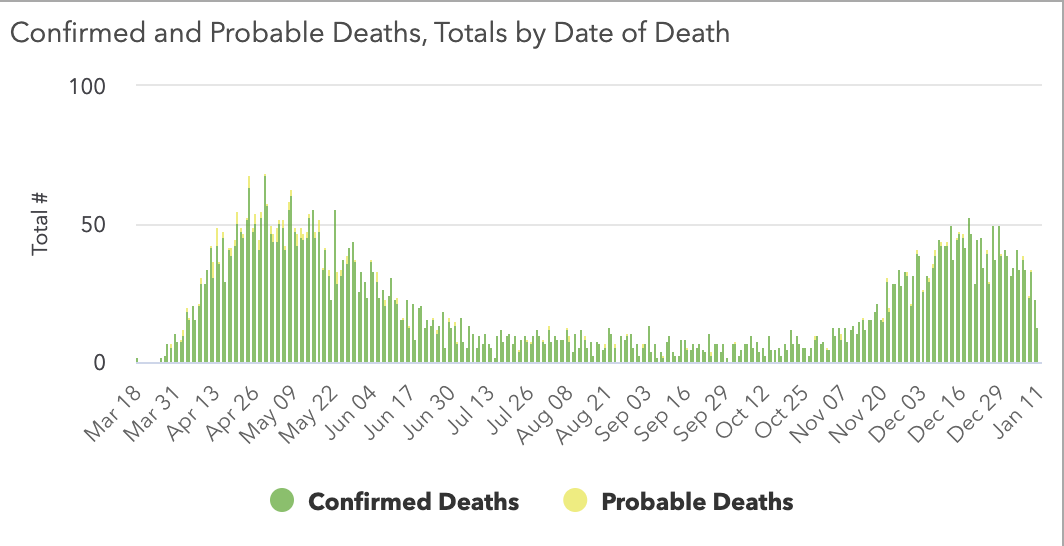
Like Maryland and D.C., the number of COVID-19 deaths are increasing in Virginia. On Saturday, the commonwealth reported its second-highest number of deaths recorded on a single day, with 69 Virginians dying of COVID-19. Since the start of the pandemic, 5,393 Virginia residents have passed away from COVID-19.
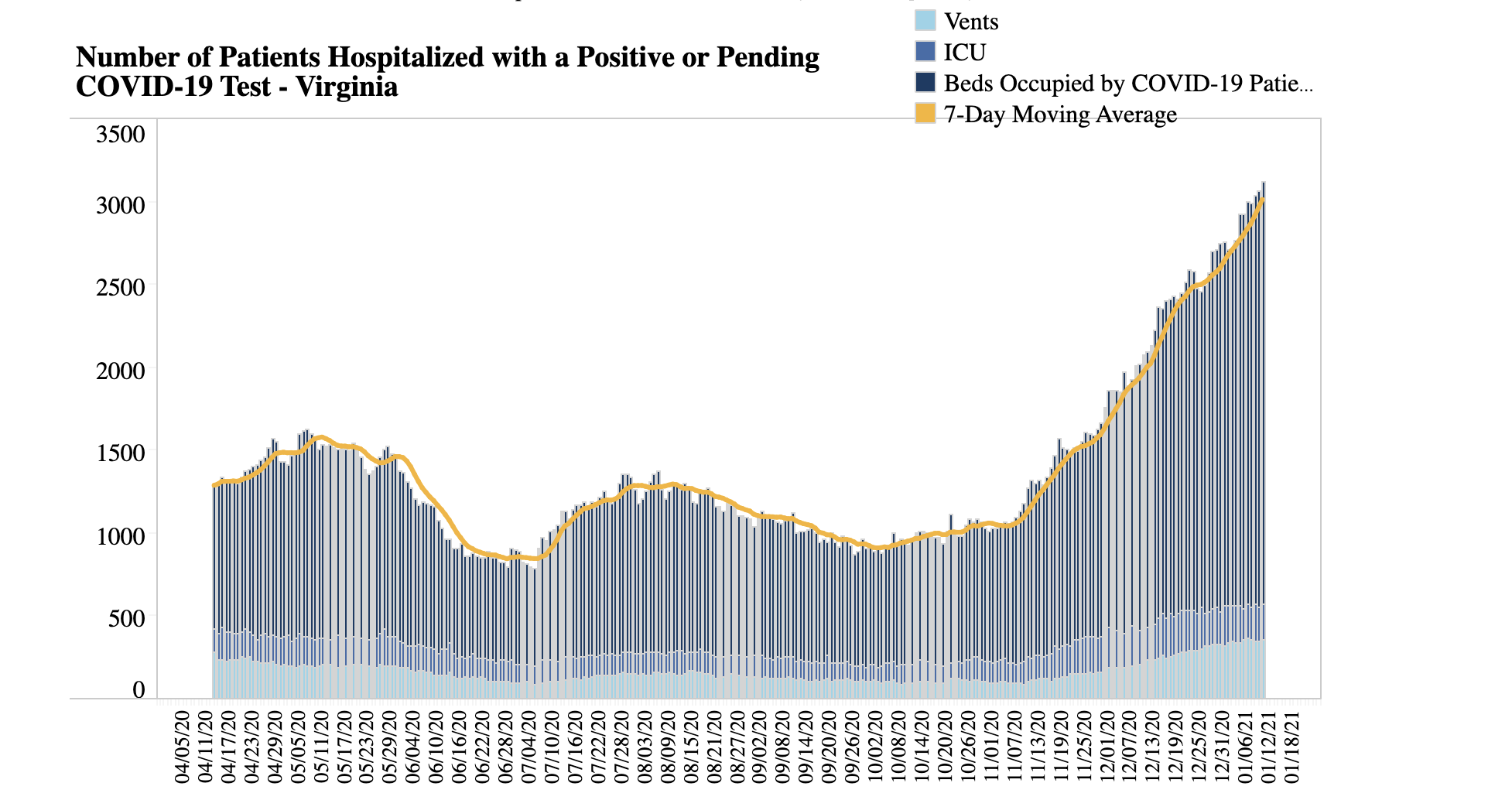
And hospitalizations, which have been trending upward since early November, are now well beyond spring metrics. 3,117 patients are hospitalized with the virus as of Monday. In the spring, that metric peaked at 1,625 on May 8.
Somewhat optimistically, the region is making headway in its vaccination efforts — which have kicked off sluggishly. On Monday, D.C. Mayor Muriel Bowser announced that residents ages 65 and older may now schedule an appointment to receive their vaccination. Per D.C. Health data, 26,672 doses of the vaccine have been administered so far to health care workers (and a few lucky D.C. residents who are not health care workers).
Following Virginia Gov. Ralph Northam’s directive to speed up the vaccination rollout, several Northern Virginia jurisdictions will gradually move into the next phase of distribution on Monday, providing vaccines to essential workers, residents over age 75, and residents in congregate settings like correctional facilities and homeless shelters. So far, the commonwealth has administered 189,283 total doses of the vaccine, with a goal of vaccinating 25,000 per day.
In Maryland, Gov. Larry Hogan has enlisted the help of the National Guard to quicken the vaccine rollout. Prince George’s County will likely remain in its first phase of the rollout for the month of January, according to County Executive Angela Alsobrooks, who called for additional support from the state last week. As of Monday, 139,506 Maryland residents had received the first dose of the vaccine, with 6,666 fully vaccinated.
As the vaccination process continues, much of the region will remain in the restricted reopening phases established by local officials ahead of the Christmas holiday. In Maryland, gatherings are limited to 10 people or fewer, and indoor dining capacity is reduced to 50%. Montgomery County and Prince George’s County have taken the further step of completely closing down indoor dining. (Prince George’s ban on indoor dining is set to last until at least Jan. 16). Indoor dining in Virginia was reduced to 25% in November, and Northam instituted a flurry of later restriction in December, including a modified stay-at-home order.
D.C.’s three week “holiday pause” on indoor dining and museum and library operation, went into effect on Dec. 23. The ban is set to expire on Jan. 15, though Bowser indicated she will likely extend the order until Jan. 24 during a press conference on Monday.