 Jordan Pascale
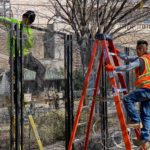
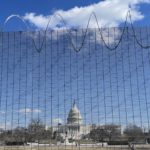
The fence went up after it was already too late — the day after extremists stormed the U.S. Capitol. Officials quickly sealed off the legislature’s campus with a three-mile-long, eight-foot-tall fence topped with razor wire.
Police officials say the fence isn’t just a necessary response to emerging threats, it’s also one they’d like to make permanent. But as residents have been forced to navigate a complicated new reality — with two major streets blocked off and access to what amounts to their “backyard” cut off — they’ve also started fighting back against that possibility.
D.C. Councilmember Charles Allen, who represents the Capitol Hill neighborhood, is calling for the razor wire and fence to come down immediately. “Things that began as temporary should have a habit of becoming permanent pretty fast in this town,” he said. “And we can’t allow that to happen here.”
After the Oklahoma City bombing, the street in front of the White House was closed to traffic. Following 9/11, the city’s museums added metal detectors and more and more bollards went up around federal buildings. More recently, a spate of White House intruders prompted a wider security perimeter and a new 13-foot fence surrounding the Executive Mansion.
Now Allen and others are worried that security creep is coming for the Capitol.
“It’s not a good look for democracy, but it’s also not the right solution for security concerns,” Allen said.
‘The Capitol’s security infrastructure must change’
Weeks after the Jan. 6 insurrection — when mobs of Trump supporters easily overran barriers and overwhelmed Capitol Police — the House’s Acting Sergeant at Arms Timothy Blodgett told Congress that more security is needed for the nation’s legislature. “We must harden this campus,” he said.
Acting Capitol Police Chief Yogananda Pittman agreed, writing to Congress last month that while the Capitol is open and welcoming to visitors by design, she believes ongoing security reviews will find that “the Capitol’s security infrastructure must change and that the Department needs access to additional resources — both manpower and physical assets.”
Assistant Capitol Police Chief Chad Thomas told residents he understands how security — like the fence — affects the city. But police need help from what he called “physical security enhancements.”
“No number of police officers that we might have available to us could possibly hold such a crowd back that was so highly motivated to attack us and penetrate the building,” he said during a recent town hall hosted by D.C. Del. Eleanor Holmes Norton.
‘Putting up a fence punishes the wrong people’
Residents of Capitol Hill say they understand the need to keep everyone safe. But they add that the fence is at odds with the Capitol grounds’ history as a communal space, one that’s especially valued by the people who live closest to it.
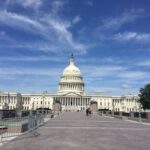
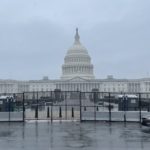
The temporary fence blocks off two major streets on Capitol Hill. It also encircles the U.S. Botanical Gardens, the U.S. Supreme Court and the Library of Congress. It’s also cut off a key connector for runners and cyclists.
Allen says his daughter has a tree next to the Supreme Court that she likes to read a book under. “This is a part of the fabric of our life in our neighborhood,” Allen said of the grounds.
Last week, Norton hosted a virtual town hall attended by hundreds of residents, with nearly all opposing the fence. Here’s what people had to say after the event.
Joella Jacobs, a Hill resident, says she would take her four-year-old daughter to play on the Capitol grounds at once or twice a week. “It was our main open space,” she said. “We’ve lost our green spaces, we’ve lost some major important thoroughfare roads that we use daily and we feel we feel really cut off from other parts of the city. And we just feel like people don’t understand or care.”
Michael Bekesha, another Hill resident and former Republican candidate for the D.C. Council, said he misses walking his dog near the Capitol. “There’s always a friendly Capitol Police officer that is out with dog treats, welcoming not only our dog but many other neighbors’ dogs that are out for a stroll, enjoying all the green space,” he said.
He’s also worried about what closing Constitution and Independence avenues is doing for emergency vehicles. He says he has to jump on the interstate at times depending on where he’s going. “Emergency vehicles, first responders are unable to get where they need to go,” Bekesha said. “It just it makes life difficult.”
“Putting up a fence punishes the wrong people,” says Allison Cunningham, who is part of the petition group “Don’t Fence The Capitol.” They’ve gathered 16,000 signatures so far.
Jeremiah Lowery of the Washington Area Bicyclist Association is advocating to keep the area open, largely because of the role is has played in allowing residents to get around without a car. “Bicyclists lose a major safe haven,” he said.
He’s also a lifelong resident of the region, and concerned about what could be lost. He remembers watching fireworks, grilling, eating ice cream, attending festivals, and organizing protests on the grounds. “All of that was just a part of growing up,” he said. “It was normal.”
It’s unclear how concerts or access to tours would be affected in the future, as officials didn’t return requests for comment. It’s also unclear what tourists will be faced with and how good of a family photo tourists could get if they’re forced to stand blocks away from the Capitol — and in front of an imposing fence.
“Access to these grounds is as much theirs as it is ours,” said Chris Geldart, D.C.’s deputy mayor for public safety and justice. “They, too, should be able to walk the steps, take photos and make the same memories we enjoy daily.”
A push to bring down the fence
Norton, D.C.’s longtime non-voting delegate to the House, is leading the effort to have the fence removed. “I’m going to do all I can to keep it the people’s house,” she said. “There are ways to accomplish security without making it into a fortress.”
Norton says the temporary fences should come down now that the impeachment trial has passed, and has introduced a bill banning a permanent fence from rising in its place. She’s had mixed success on getting results: Capitol Police did not open the Capitol’s hill to sledding at her request but did agree to figure out a way to send out emergency alerts about the Capitol to nearby residents to keep them in the loop in the future.
And in a Congress that’s grown more partisan, this is one issue that’s attracting support across the aisle; 42 House Republicans signed on to a letter demanding that the fence be removed. Some lawmakers are advocating for more personal security instead.
It’s not clear when a decision will be made on whether a permanent fence is needed. An outside security review commissioned by House Speaker Nancy Pelosi is due around March 5. Ultimately, the Capitol Police board and lawmakers will have to decide how to balance safety and access. Appropriations committees will have a say in whether to fund the effort.
Allen encourages residents to stay active on the issue.
“I think we’re all pushing together to get where we got to go,” Allen said. “But the biggest fear for me is just the sense of urgency with the Capitol Police wanting to study this thing to death. And we need to see action that takes care of this. “