Colleen Grablick
Update: The razor wire along the fence surrounding Capitol Hill appears to have returned after briefly coming down earlier this week.
U.S. Capitol Police did not immediately return DCist’s request for comment on the fencing, but the department tweeted earlier in the week that fencing was being “modified” to improve traffic flow around the Capitol.
Original:
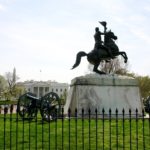
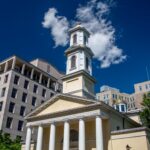
The mesh metal fencing that has enclosed downtown D.C.’s Lafayette Park and the historic St. John’s Episcopal Church for months is finally coming down.
Images of St. John’s Episcopal Church, free of the black barricades, spread on social media Monday morning — symbolizing for some a step towards brighter days ahead for the city.
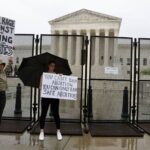
The church and neighboring Lafayette Square have been fenced off since June of last year, in the midst of demonstrations following the police killing of George Floyd. Crews erected the downtown enclosure encompassing St. John’s shortly after former president Donald Trump’s now-infamous photo-op at the church — a viral moment facilitated by law enforcement’s aggressive clearing of peaceful protesters from Lafayette Square moments prior.
The Secret Service and the National Park Service did not immediately return DCist’s request for comment on the fence’s removal. A spokesperson for the D.C. Police said they were not involved with the removal of the downtown fencing, and a spokesperson for D.C. Mayor Muriel Bowser’s office did not immediately return DCist’s request for comment.
Terry Lynch, executive director of the Downtown Cluster of Congregations, passed through downtown Monday morning and noticed the fencing had come down — a sight that marked, he says, a step in the “right direction.”
“Hopefully we’re moving forward to a better day, a more inclusive day, a more racially equitable day, where people are welcomed from all races and the bitter divides hopefully will continue to come down, and all that that symbolizes,” Lynch tells DCist. “That fence and the other fencing [in D.C.] symbolizes a lot of what’s been wrong with America over this past year, and our sincere, sincere hope is that things will be moving in a better way for all of us, and this is just one step that will hopefully continue both across the city and the country.”
In the months following the summer’s protests, white supremacist and far-right crowds descended on D.C. to protest then president-elect Joe Biden’s victory, in some instances targeting historically-Black downtown churches. Two Black Lives Matter banners, one at Asbury United Methodist Church and one at Metropolitan AME Church, were burned during a December MAGA rally that turned violent. Enrique Tarrio, chairman of the Proud Boys — a hate group with ties to white nationalism and a history of violence — admitted to destroying one such banner.
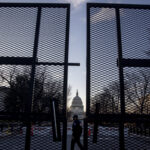
Still, two miles away from St John’s, Capitol Hill remains enclosed by a seven-foot-tall fence — a visual reminder for Washingtonians of the deadly Jan. 6 insurrection at the U.S. Capitol. There have been calls for its removal from residents, local officials, and congressional lawmakers on both sides of the aisle, but U.S. Capitol Police have reportedly discussed keeping the fencing up through September, fearing future attacks on lawmakers or right-wing violence.
On Monday morning, photos showed the razor wire being removed from portions of the downtown fence — a move most residents saw only as a first step in decreasing the heavy security presence that now surrounds the Capitol.
Razor wire removedhttps://t.co/ZM43TG0EGb
— PoPville (@PoPville) March 1, 2021
U.S. Capitol Police did not immediately return DCist’s request for comment on the removal of the razor wire, but the department tweeted that fencing was being “modified” to improve traffic flow around the Capitol.
This post was updated to include information from the U.S. Capitol Police regarding the Capitol fencing.