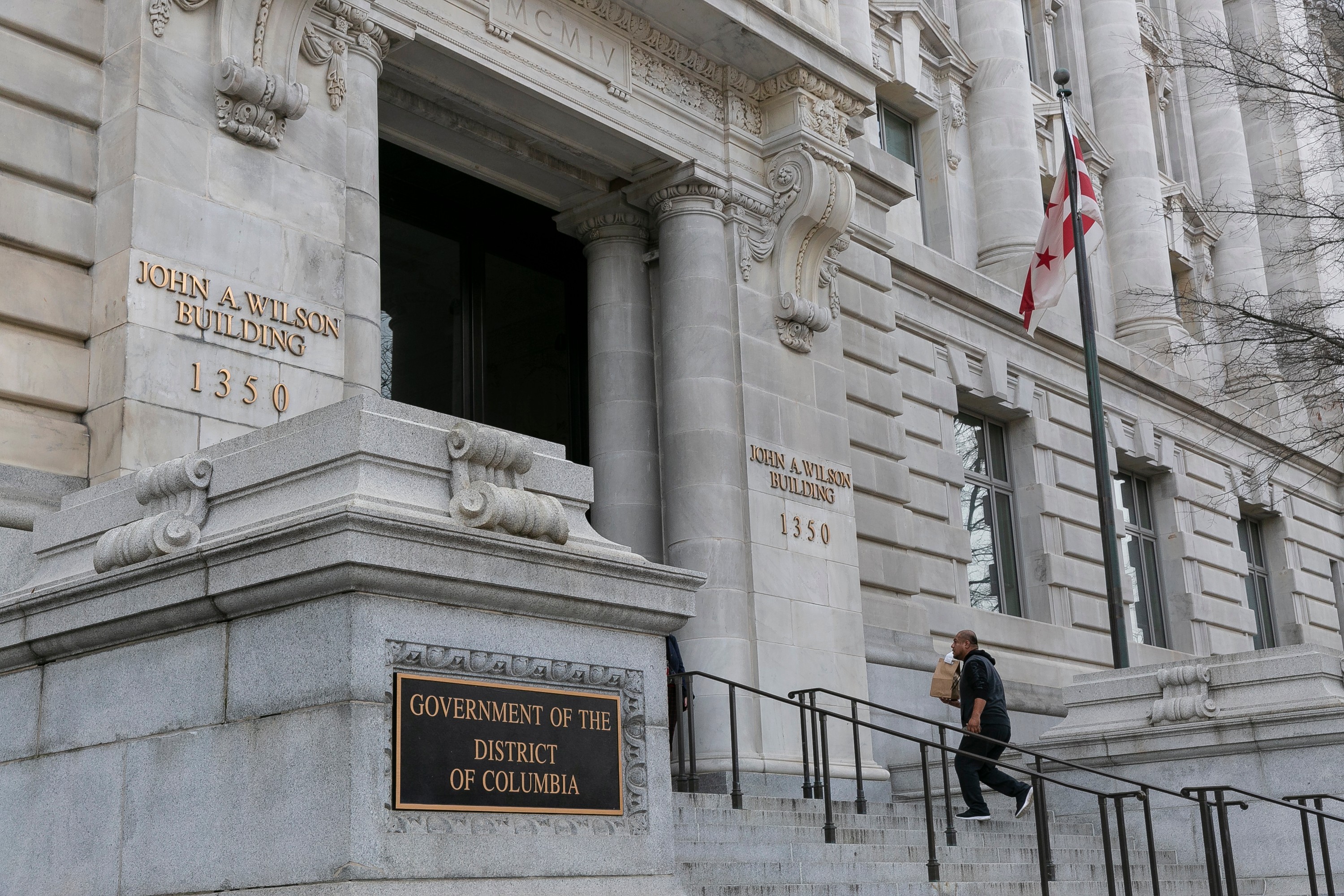
Well-off Washingtonians could be hit with a tax hike under a proposal in the works that aims to shore up the District’s pandemic-plagued coffers.
Ward 6 Councilmember Charles Allen tells DCist/WAMU that he and several other councilmembers are discussing the possibility of raising taxes on affluent residents through an amendment in the city’s next budget. The resulting revenue would go toward priorities like affordable housing, public transit, childcare, education, and parks, he says, and could be targeted at the communities hardest hit by COVID-19.
“Asking a little something out of people that are weathering this so well to help out those that are hurting and don’t know if they’re even gonna be in their homes come this time next year, let alone six months from now, I think is the right thing to do,” says Allen.
The plan, which hasn’t been previously reported, follows a failed push led by Allen last year to increase marginal income taxes by minor percentages on individuals earning over $250,000 a year — a move that was expected to raise millions of dollars in revenue annually and help bankroll the construction of desperately needed affordable housing, among other goals. It was voted down 8-5 in July.
The details of the renewed effort are still being hammered out, though Allen says he considers his original proposal as a kind of “scaffolding.” Those higher tax rates would have generated between $7 million and $13 million a year in revenue and were supported by progressive advocacy groups, who found in a poll last June that more than seven in 10 D.C. residents were on board too.
Since then, the composition of the D.C. Council has shifted to the left as a result of the November elections. Two of the former lawmakers who voted against the tax hike — David Grosso and Brandon Todd — were replaced by new lawmakers who said while campaigning that they supported it: Christina Henderson and Janeese Lewis George.
The behind-the-scenes discussions also come as Mayor Muriel Bowser’s administration crafts its seventh budget — its second during the coronavirus crisis — to submit to the council for review. Emergency legislation the council is set to take up Tuesday would give the mayor until April 22, three weeks after the current deadline, to transmit her budget. That would allow the administration to better account for whatever federal aid the District will receive in the next COVID-19 relief package.
While there’s a chance Bowser’s spending plan will recommend some kind of tax hike, she appears unlikely to support one if it can be avoided: She skews fiscally conservative among local politicians and opposed any increases last year, saying it was “foolhardy to raise taxes” amid so much economic uncertainty. (The council ended up raising some non-income taxes anyway.) Her office, which held virtual “budget engagement forums” to hear people’s input last month, didn’t respond to inquiries for this article.
Allen says he would welcome Bowser incorporating tax increases on high-income earners in her fiscal recommendations, but hasn’t spoken with her about the issue this budget cycle. “I don’t think there’s anything off the table,” he notes. “I’m not gonna speculate about what is or isn’t likely, but I think that the executive is looking at every option, and the legislative branch, the council, will do the exact same thing when it’s our turn to work on the budget.”
Although the council’s makeup spells stronger odds for upping taxes on D.C.’s rich than last year, it’s not a guarantee. In separate statements, both George and Henderson say they’ve been in touch with Allen about the proposal. “I look forward to considering changes to the tax code upon the Council’s review of the Mayor’s budget submission,” says Henderson, who described herself as a “pragmatic progressive” in the at-large race.
George, a democratic socialist who staked her Ward 4 campaign on promoting economic and racial justice, points out that the pandemic has devastated working-class families and exacerbated inequality. “Now that we have a good sense of who is hurting, we need to consider targeted, responsible revenue sources to fund the critical services that will lift those people up,” she says. “Long after federal dollars are spent we will still need resources to drive a just, sustainable recovery that doesn’t leave any DC resident behind.”
By the time Allen introduced his amendment last summer, Bowser had plugged a $770 million budget hole by tapping the District’s financial reserves and instituting a pay freeze for government workers, among other maneuvers. The city’s economic outlook looks a little rosier lately: In early February, D.C.’s Chief Financial Officer Jeffrey DeWitt revealed that the 2020 fiscal year ended in September with a $526 million surplus, leading some councilmembers to complain that this was money that could have been spent on coronavirus relief. Instead, in accordance with existing law, the surplus was automatically split between the District’s main affordable housing fund and another fund that underwrites infrastructure projects.
And late last Friday, DeWitt reported that, thanks to the anticipated federal aid and the stock market’s strong performance, D.C. was expected to bring in $227 million more in revenue over the next four years than his previous estimate in December found. (Just two weeks ago, he abruptly announced he would resign as of March 9 to take a job at the University of Kansas; Bowser is in the process of picking his replacement, who will be subject to council approval.)
Still, D.C. faces a $235 million deficit over that period that must be addressed, according to DeWitt — and plenty of economic risks remain. For one thing, despite the fact that D.C. is projected to receive more than $2 billion in federal aid, the overall $1.9 trillion relief package faces staunch opposition from congressional Republicans and could be whittled down. (D.C.’s fiscal year 2021 budget, inclusive of federal funds, totals $16.9 billion.)
In a Feb. 26 letter to Bowser and Council Chairman Phil Mendelson, DeWitt said that even though pent-up demand for entertainment will likely surge after the COVID-19 emergency ends, the District may struggle to fully bounce back in the long run due to continued concerns about indoor gatherings and travel as well as other factors like outmigration and telework.
A drawn-out recovery also worries Allen and those who have been advocating for higher taxes on wealthy residents, because the worst-off would suffer the pandemic’s harms for longer.
“Anybody who thinks that the recovery from this recession and this pandemic is a six- or 12-month type of event is just flat-out wrong,” he says. “This budget is the most consequential we’ve had in so long. We can’t look at this as just a back-to-normal, one-year-at-a-time type of budget.”
While he acknowledges that federal aid will greatly help the District, Allen says it’ll only be “one-time money” that won’t suffice to alleviate systemic inequities. On Monday, the D.C. Fiscal Policy Institute, a local think tank, echoed this message in a blog post urging lawmakers to implement an “income tax surcharge on residents with the highest-incomes—above $250,000—while laying plans for comprehensive reforms to make DC’s tax system more racially equitable.” (In a tweet, grassroots group DC For Democracy agreed with the sentiment.)
Others say raising taxes on high-income earners could end up impairing the District’s recovery. According to Jared Walczak, the vice president of state projects at the D.C.-based Tax Foundation, most small businesses, particularly in the hospitality sector, serve as passthrough entities where owners pay individual income taxes on their business profits, rather than corporate taxes. So, for businesses with tight profit margins, higher income taxes could result in higher prices, cost-cutting, or less growth — just when the city needs more commerce and jobs.
Walczak also says a tax hike could hinder D.C.’s economic competitiveness as compared to Maryland and Virginia and effectively drive people out of town, especially now that remote work is becoming more common. In the past, he notes, the District set up special commissions to oversee broad tax reforms, seeking a variety of perspectives. (Late last year, the council unanimously voted to reestablish such a commission in the future; the bill passed without Bowser’s signature and hasn’t been funded.)
“It seems like the discussion on tax increases has gotten ahead of the discussion on what it’s needed for,” says Walczak, who criticized Allen’s original proposal. “Instead of there being stipulated ‘here is exactly what the need is, here’s how much revenue we need to provide it,’ the idea is ‘let’s take a tax proposal from [the] previous year and then figure out how to spend it.’”
Yesim Sayin Taylor, the director of the D.C. Policy Center, another local think tank, says she understands the desire to identify new sources of revenue for social programs, calling the issues raised by Allen “terribly important.” But she cautions that raising income taxes when the city has reserves to draw from and was seeing slower population growth even before the pandemic would be “ill-advised” at this point.
“I think it makes more sense to wait and see what resources we have first,” Taylor says of the prospective federal aid D.C. will get. “We need to be really careful about what is the right fiscal strategy. You want to tax things in a way that creates the most revenue but the least amount of disincentive [for economic activity].”
The bottom line? The District is once again holding its breath for Congress to act.