Elliot C. Williams
One afternoon last May, an officer with the Montgomery County Police Department responded to a call about an adult man walking around a townhome community in the White Oak area of Silver Spring, Maryland. The man was carrying a butcher knife, the caller said.
Police footage shows 30-year-old Finan Berhe, a Black man, step into the parking lot with the knife in hand. Sergeant David Cohen, the officer who responded, then aims a gun at Berhe. “Put the knife down,” Cohen yells, adding that he doesn’t want to shoot him. Berhe briefly backs away before charging at the officer.
Cohen fires five shots, fatally wounding Berhe. “Man down,” the officer screams.
A neighbor later told NBC Washington he wished the county had the resources to send mental health professionals to accompany the officers, as they might have declared it a mental health crisis and prevented any violence. Police Chief Marcus Jones hinted that the 911 call — made by a resident of the townhomes who said Berhe had thrown a rock at his window and told him to call the police — “could have been one of those cases.”
Berhe was reportedly an Uber driver who had recently been laid off.
Still, the Howard County State’s Attorneys Office, which reviews police shooting investigations in Montgomery County, determined there was “no conclusive evidence” that Berhe was having a mental health crisis. No charges were brought against Cohen.
County leaders have been considering changes to the county’s crisis intervention protocols following multiple similar incidents over the years, in which a county officer shot and killed a Black man who may have been having a mental health crisis. A summer of racial justice protests spurred by the killings of George Floyd and Breonna Taylor have only led to more demands for change.
In Montgomery County, these demands have led to a slew of bills, proposals, and grant applications to invest in affordable housing, create a “homeless court” to resolve minor offenses while connecting unhoused individuals to necessary services, and to remove police from schools.
And as momentum to reimagine policing in Montgomery County grows, similar debates over law enforcement and mental health resources have proliferated in council hearings and meetings across the region — legislators have made similar proposals and created police reform groups in the District and Prince George’s County.
Along those lines, Montgomery County Council President Tom Hucker is leading a push to expand the capabilities of the county’s existing crisis center. In July, Hucker spearheaded the redirecting of nearly $600,000 in funding to expand the Mobile Crisis Team — a two-person, 24-hour service that responds to everything from family disputes to substance abuse situations and has been around for at least two decades in different iterations. When called upon, the team supports residents who have witnessed a family member commit suicide and provides medication and a temporary bed for individuals experiencing homelessness.
Hucker’s special appropriation, which the council unanimously supported, made room for six positions, which will comprise three Mobile Crisis Teams in total (each will have two staffers). While the recruitment process has taken longer than county officials expected, the crisis center has now filled three of the positions and is in the process of filling the remaining three. Hucker says that while there’s no guarantee that expanding the number of crisis units will completely prevent police officers from shooting people, expanding the county’s mental health resources could fundamentally change how certain crises play out.
“Often, police officers get the mental health training, but they’re not trained social workers. Very often that can lead to tragedy,” Hucker told DCist/WAMU. “In a county like Montgomery County, the only trained professional we have to send to our residents when they’re in a behavioral health crisis shouldn’t be an armed police officer; it ought to be a trained mental health professional.”
Last week, County Executive Marc Elrich proposed cutting 29 positions in the police department with the goal of investing more money in mental health and social services. His proposed $521,140 budget item would add another six support staff to make up a total of six Mobile Crisis Teams, if the council approves the investment by June 1.
“For far too long, the county, like most jurisdictions across this country, has allowed major social problems to become problems that have been left to the police to address, such as incidents involving residents presenting mental health issues,” Elrich wrote in his budget proposal. (The arguments around #defunding, divesting, demilitarizing, and unbundling the police often go hand-in-hand with arguments for not relying on officers to handle every first response situation, from traffic patrol to tax collection.)
“The goal is really separating law enforcement from behavioral health services,” Hucker says. “We send police officers to fires as well, but we don’t expect them to put out the fire. We train firefighters for that, with different equipment. And this is not that different.”
Hucker says having more therapists on the ground and a better trained emergency call center would make police officers’ jobs easier and allow them to focus on situations where their skills are needed: “Nobody really likes to do a job that they’re not well trained for. So this is going to be, I think, much better for the police as well as for the residents.”
Marcus Jones, the chief of Montgomery County’s police department, told Bethesda Magazine in August that he thinks officers will “never be totally out of the mental health business,” but there are other professionals who are “better equipped” to deal with mental health crises.
“What I’d like to see is that it wouldn’t be solely the police, and that we would provide the support when needed,” Jones said. “Whatever we do has to have a public-safety connection.” (The proposals haven’t gone over without criticism — the union representing Montgomery County police recently tweeted, “DEFUNDING the police has started in MoCo. We pray for our residents.”)
The county’s lone two-member crisis team that assists officers with mental health calls is currently strapped for time and resources.
Based out of the Department of Health and Human Services building in Rockville, the team often has to choose which calls to respond to based on the severity of the situation and proximity to their location. The crisis center gets more than 100 calls and 15 walk-ins per day, and the mobile crisis team completes an average of 40 responses a month. It can take up to an hour in traffic for the Mobile Crisis Team to respond to cross-county calls.
“We’ve seen our mobile crisis outreach numbers really soar,” says Dorné Hill, the teams’ coordinator and acting senior administrator for the county’s crisis and trauma services. According to Hill, the COVID-19 pandemic has created an uptick in mobile crisis outreach, as more people are concerned about physically walking into the crisis center. An added benefit of the crisis unit, she says, is that the team can directly connect residents to services, diverting more patients from hospital emergency rooms.
With the newly approved funding, the department hopes to open its new units at fire stations or other county buildings further north in Germantown, along with another unit in Silver Spring, which would allow members to respond more quickly.
The Montgomery County Fire and Rescue Service’s Emergency Communications Center answers all 911 and non-emergency police calls, as well as dispatches the appropriate first responder to the scene. Depending on what information the call center employee receives about the severity of the crisis, it’s typically the responding police officer who is responsible for determining whether to request the help of the police department’s own crisis intervention team or the county’s Mobile Crisis Team. (The officer also determines whether the individual needs to be referred to or transferred to an emergency room, juvenile services, or the county’s mental health services.)
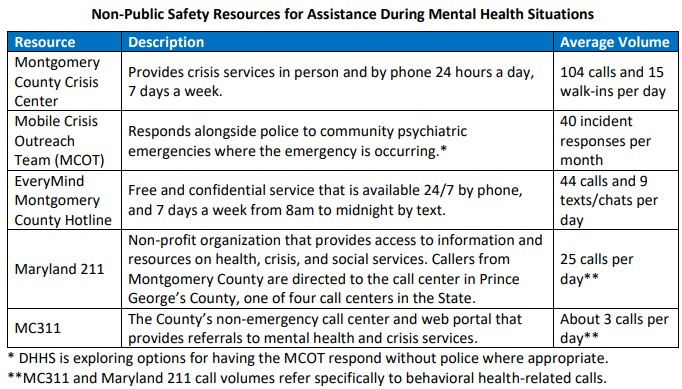
While the system provides multiple avenues through which residents can get access to behavioral health resources, each agency is overwhelmed. Montgomery County police alone respond to an average of 19 mental health situations daily, and these calls take longer than other 911 calls, according to a study by the county’s Office of Legislative Oversight.
Black individuals are strongly overrepresented in these mental health situations. Even this data doesn’t represent the whole picture, since many Black and Brown individuals don’t call first responders out of fear of an aggressive response from law enforcement, Hucker says.
While the Mobile Crisis Team currently responds to situations alongside officers, the team is working on a new approach, drawing from nationally recognized models like Crisis Assistance Helping Out On The Streets (CAHOOTS) and the Crisis Now programs.
The crisis center is also working with public safety officials to improve communication. “We are having internal meetings to discuss a more formal triage so that no matter what number is dialed, based upon the caller’s statements, we will determine who fields that call and responds,” Hill says. “It still may be a joint response [of police and mental health professionals] based upon the identified situation.”
She says she’d also like to hire peer-support staff — people with personal experience with mental health or substance-abuse issues who can better relate to those they serve.
Nationwide, story after similar story has ended in violence — an estimated one out of every four police shootings involve a person with a severe mental illness — and while some activists call for little to no police involvement in these cases, others have called for police departments to adopt a Crisis Intervention Team model. This approach involves a 40-hour training program and emphasizes community partnerships.
During last week’s virtual meeting with the public safety/health and human services committee, Chief Jones said 67% of the police department has received crisis intervention training, but he added that officer training doesn’t completely resolve the issue.
“Every call that comes in — although we think we know what we’re going to — we sometimes get to a call and it’s something completely different,” Jones said. “For example, you may be thinking you’re going to a simple assault call, but it does involve a case of an individual that’s having a mental health crisis. That case would’ve been classified as an assault, and there’s no check box [in the report] that says this was a mental health situation.”
Jones said that while additional social workers might help the problem, 911 call center employees also need training on how to distinguish a mental health episode from other kinds of emergency calls.
Hucker has also proposed that the county create a search function within an internal database so the emergency call center can find out if someone is a repeat caller and has been involved in mental health situations in the past.
Ultimately, county officials envision a more holistic response to emergencies: one in which the call center knows which questions to ask and can give proper information to the first responders, who then show up promptly with as much training and information as possible.
“In a county like Montgomery, as humane and well resourced as we are, we should should have a more sophisticated approach,” Hucker says. “I’m glad we’re moving into the 21st century here.”