 Dominique Maria Bonessi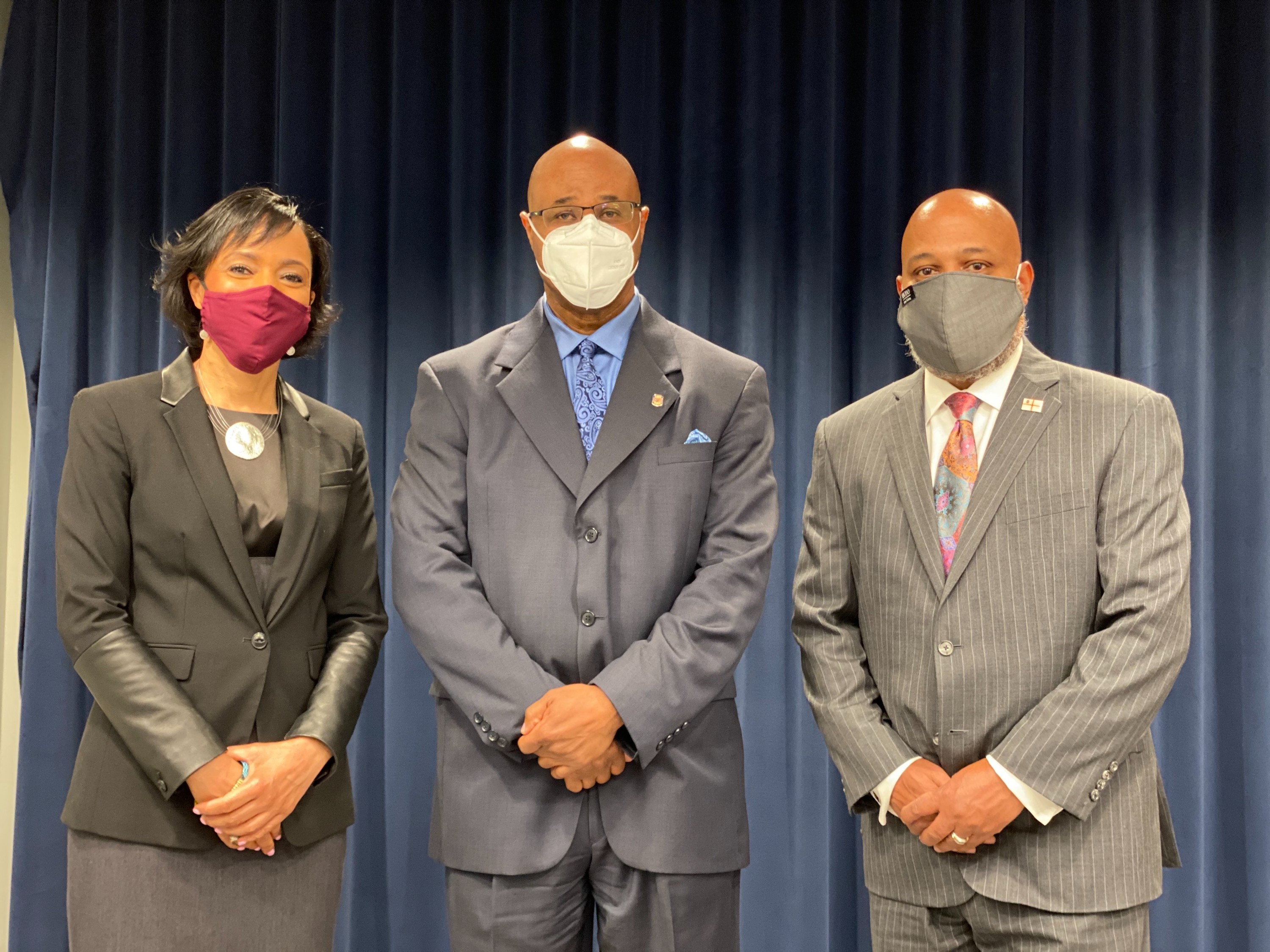
Prince George’s County Executive Angela Alsobrooks announced her nominee for the county’s new police chief Friday.
Alsobrooks tapped the Dallas Police Department’s Deputy Chief Malik Aziz, a 29-year law enforcement veteran, to serve as the county’s new police chief. He also previously served on President Barack Obama’s task force for 21st century policing and was invited to the White House to speak with Obama about his community policing philosophy.
“I looked at his actions before I heard his words,” Alsobrooks told reporters at a press conference Friday. “Your record says everything about who you are. Over a 29-year career unblemished and his record was the thing that spoke most loudly to me.”
Aziz said community policing and reformation in the department takes top priority.
“My take is to actually inject myself in policing into that [reform] era because we’ve always been adapting and evolving,” Aziz said Friday. “The national crisis is police community relations in which we have stopped talking to each other and now we’re just talking at each other and we’re not listening … along the lines of procedural justice, legitimacy, and trust.”
PGPD’s former Chief Hank Stawinski resigned in June, following the release of an unredacted report claiming that an environment of racism and retaliation persists in the Prince George’s County Police Department and has not been adequately addressed by department leadership. The report was part of a lawsuit filed against the department in 2018 by officers of color, who claimed they experienced racial discrimination and retaliation. Alsobrooks said at the time that Stawinski’s decision to step down had nothing to do with the report.
While Aziz said it would not be “proper right now” to meet with those officers who brought a lawsuit against the department for alleged discrimination, he did say he intended to produce an “equitable environment for every officer.”
Aziz received his bachelor’s in criminology from the University of Texas at Arlington in 1998 and master’s in business administration at the University of Dallas in 2000. He began his work with the police department in Dallas as a sheriff’s deputy and later patrol officer.
Alsobrooks said Friday there was a lot of community involvement in her final decision, but Martin Mitchell, president of the county’s Young Democrats organization, and Angelo Consoli, president of the county’s police union, say they were not involved in the process.
“We would have liked to have more involvement,” Mitchell tells WAMU/DCist.
Consoli adds that there was a survey sent around by the county, but other than that “there was zero transparency in the process.”
Mitchell hopes Aziz will work on getting the county mobile crisis units. Nearby Montgomery County has beefed up its own mobile crisis units, which respond to substance abuse situations, mental health crises, family disputes, and other needs, over the last year.
“I hope he will be able to champion mental health crises and substance abuse, and things that don’t always need police officers,” Mitchell says. “And hopefully support ways to fund it.”
Aziz comes from a right-to-work department in Dallas, which Consoli says could be an issue in a county that has a system of bargaining rights for officers.
“If there’s anywhere we might disagree it’s there,” Consoli says. “I’m not sure he knows how close he needs to involve [the union] in the decision making process.”
Aziz will start as acting chief of the department May 9 until he is confirmed by the county council. His salary has yet to be determined, according to county officials. Aziz was highly sought after to lead police departments around the country including Miami and Milwaukee.
For the past eight months, Hector Velez has served as interim chief of the department.
This story has been updated to include comments from Martin Mitchell and Angelo Consoli.