Jacob Fenston
Maryland is receiving $3.9 billion from the latest federal stimulus legislation, and today state leaders announced how they plan to spend the money: on unemployment benefits, school reopenings, access to broadband, and other priorities.
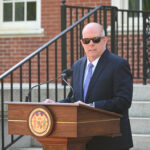
Governor Larry Hogan (R) called it “an historic bipartisan agreement” that he said “effectively targets relief to Marylanders most in need.”At a press conference at the State House in Annapolis, Hogan was flanked by Senate President Bill Ferguson (D) and Speaker of the House of Delegates Adrienne Jones (D).
$1.1 billion — nearly one-third of the federal funding — will go to replenishing the state’s unemployment insurance trust fund.
“This shoring up of the unemployment system will help us to continue helping those who need it most, while also ensuring that we can provide continuing tax relief for struggling businesses,” said Hogan.
An additional $800 million will go to supporting the state’s existing emergency economic relief programs.
Schools will get a large portion of the funding — more than $600 million — aimed at helping them bounce back from the pandemic and safely reopen in-person classes. This includes $481 million to address “pandemic-related costs,” $80 million to upgrade school ventilation systems, and $46 million to address the long-term impacts of learning loss during the pandemic.
The state will spend $300 million of the funding on what Hogan called “a game-changing broadband technology initiative,” expanding internet connectivity to underserved parts of the state. This will include $180 million to improve internet infrastructure in the state, $75 million subsidizing internet service and devices, and $45 million in grants to municipalities to boost broadband coverage.
Senate President Bill Ferguson lauded the broadband initiative. “The question is not how much does it cost to bridge the digital divide. The question is, how much will it cost if we don’t act right now, and who will be left out of the opportunities of today and tomorrow?” Ferguson said at the press conference. “We cannot and will not let dis-connectivity exist in the state of Maryland.”
Hundreds of millions more will be spent to assist Marylanders in need, including nearly $200 million to fund the state’s temporary cash assistance program, and $50 million to help residents struggling with late utility bills.
House Speaker Adrienne Jones thanked the Biden administration and other state leaders, and said the funding package will “help small businesses, students and struggling Marylanders get back on their feet.”
The funding comes from the $1.9 trillion COVID-19 relief bill, known as the American Rescue Plan, signed by President Biden on March 11.
D.C. is set to receive more than $2 billion from the rescue plan, including $755 million it didn’t get under President Trump’s CARES Act, which treated D.C. as a territory. Virginia will get $3.7 billion, and counties in the region will also receive hundreds of millions.