Colleen Grablick
D.C.’s public health measures — like mask mandates, indoor dining closures, and capacity limits on businesses — helped the city mitigate the spread of coronavirus last fall and winter better than nearly every other state, according to a new report from the Office of the D.C. Auditor.
The District ranked sixth in the nation for “apparently lessening the severity of the fall surge of COVID-19,” resulting in some of the lowest COVID-19 cases and fatality rates per capita. That’s in large part thanks to speedy direct interventions by health officials, a resident population that widely followed pandemic policies, and financial relief measures — like hazard pay and eviction moratoriums — that encouraged people to stay home, the findings concluded.
The report from Talus Analytics and Georgetown University Center for Global Health Science and Security analyzed how well local leaders blunted the soaring case and death rates from coronavirus in the fall and winter, with a specific focus on the D.C. region.
“The report finds that the District’s ‘enabling and relief policies’ such as foreclosure delays and leave entitlements combined with early mask mandates and measured reopening policies contributed to the District’s success in ‘bending the curve’ of cases,” reads a letter in the report from D.C. Auditor Kathleen Peterson. “A key central message … is that early action increases the success of public policy intervention slowing disease spread and saving more lives.”
As the U.S. failed to contain the fall and winter surge of coronavirus cases with a unified pandemic response, D.C. saw among the best outcomes. For its part, the District saw large surges in December and even more devastating case counts in January, setting grim records that surpassed case counts during the initial spring 2020 wave. And on Thursday, D.C. dipped out of the “substantial” community spread zone for only the second time since November — a testament to the severity of the pandemic’s hold on the city over the past several months. As of Friday, nearly 1,100 Washingtonians have died of the virus.
The bottom line: things were still bad, but they could have been much worse.
“A major caveat on the region’s success has been the country’s failure: even the areas in the United States that had the most effective response to the pandemic had many more cases than other parts of the world,” Patterson wrote.
The report looked comprehensively at D.C.’s, Maryland’s, and Virginia’s responses to the pandemic throughout 2020, but narrowed in on fall and winter months of the year, at which point stricter stay-at-home orders had largely fallen away, replaced by cycles of restrictions easing and tightening with the changing case trends.
While D.C. recorded higher cases per capita than an average state during the initial spring wave last year, city officials’ early and swift public health interventions (as well as residents’ adherence to such measures) kept the city’s average case counts lower than state averages for the latter half of the year, according to the report.
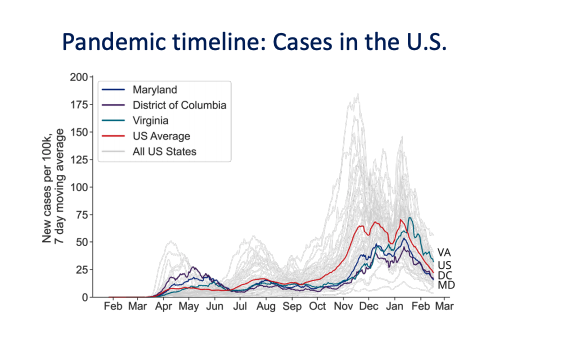
Universal messaging around state-level mask-wearing in any public setting helped diminish coronavirus spread immensely, according to the report. D.C. Mayor Muriel Bowser was the first regional leader to mandate mask-wearing whenever residents leave their homes, implementing the policy last July. Maryland Gov. Larry Hogan (R) followed a week later, while Virginia Gov. Ralph Northam (D) did not expand the mask-mandate into outdoor spaces or retail establishments until December. DC Health director LaQuandra Nesbitt has said the city has no plans to change its current mandate, though some have questioned the necessity for such a sweeping mandate now, with recent scientific evidence pointing to lessened risk during brief outdoor encounters.
D.C. also took a more conservative approach when easing restrictions on indoor dining and increasing capacity limits on mass gatherings. Hogan increased indoor dining capacity from 50% to 75% last September, while D.C. kept indoor dining capacity at 50%, later reduced it to 25%, and eventually closed it completely in late December and early January during the height of the winter surge.
Beyond public health measures, the report found that financial relief mechanisms like moratoriums on evictions and utility shut-offs also correlated with spread mitigation, as more people were encouraged to stay home.
“The mobility changes in D.C. also indicate that policies worked — the initial stay at home orders had the largest impact, but D.C. residents stayed at home more often than people in Maryland, Virginia and across the United States,” reads the report. “Part of the success can likely be attributed to the key enabling and relief policies that were put in place in D.C. that helped support citizens through relief funding, leave entitlement adjustments, modification of unemployment benefits and eviction and foreclosure delays.”
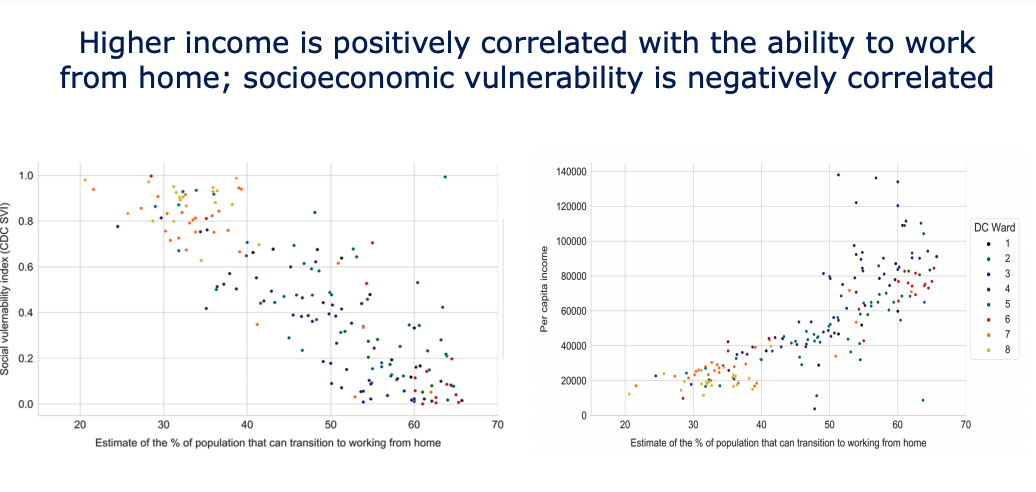
However, that’s not true for all of D.C. Wards 5,7, and 8, majority-Black wards, which have seen the highest death rates from the virus, house the highest populations of essential workers who face a disproportionate risk of exposure and were not able to pivot to working from home.
And actually receiving pandemic relief wasn’t always easy or accessible to everyone equally. Some residents reported waiting months for their unemployment checks and spending hours on hold with D.C.’s beleaguered Office of Employment Services. For undocumented residents — who were excluded from traditional unemployment benefits — the city’s direct cash payments barely covered essentials.
D.C.’s success relative to the rest of the country suggests that Bowser, her administration, and the D.C. Council have done comparatively well in their response to the pandemic, though the mayor has faced criticism for easing some COVID-19 restrictions too early, and even manipulating some of the data to do so. It also comes despite the federal constraints that limited D.C.’s pandemic relief measures; the original coronavirus relief package in March 2020 shorted the city $755 million due to its non-statehood status, even as D.C. recording more coronavirus cases than 19 states at the time.