Elliot C. Williams
A D.C. Council hearing kicked off Wednesday morning on an intense note. At-Large Councilmember Elissa Silverman said, “I am simply done with excuses. I’m done with it.”
That tone remained constant throughout the oversight hearing, which focused on issues with unemployment insurance in D.C. during the pandemic. Several councilmembers convened for the hours-long meeting with Department of Employment Services director Unique Morris-Hughes and D.C.’s Chief Procurement Officer George Schutter.
Like many jurisdictions across the country, D.C. DOES has been overwhelmed by unemployment claims throughout the pandemic, receiving five times as many claims from March to September 2020 as in all of 2019. And there have been major, sustained problems with that process: claimants have received inexplicable error messages, or not been given information in their spoken language, or have been placed on hold for over an hour at a time. Or, as one testifier told the council in September, when they finally reach a representative at the call center, claimants are often told to call back or that their claim has been elevated to a “subject matter expert.” The seemingly chaotic rollout of benefits has led to a number of council hearings over the status of unemployment insurance in the District, and increasing frustration from both claimants and councilmembers.
The council invited the agency’s contractors to Wednesday’s meeting — On Point Technology, which operates the unemployment insurance online portal, and Capitol Bridge and Codice, the two vendors that run the DOES call center — but none attended. Capitol Bridge and Codice instead submitted written testimony. Morris-Hughes also submitted written testimony prior to the meeting.
At points, the hearing elevated to crosstalk and raised voices, with councilmembers asking for silence to finish their thoughts, while Morris-Hughes asked for the same. Morris-Hughes threatened to end the hearing ahead of schedule, frustrated by the council’s interpretation of the issues. (Morris-Hughes also mentioned that her staff has been on the receiving end of harmful comments from angry claimants while on the job.) The meeting seemed to represent the frustrations that have plagued the unemployment insurance system and its applicants for more than a year.
At a hearing last week, D.C.’s Office of the Inspector General announced it would conduct an audit of DOES following months of claimants reporting delays in payment, technical glitches, and contradictory information from the call center and agency leaders, leaving many unemployed workers frustrated and struggling to pay their bills. Dozens of those claimants testified last week. This week, the grilling continued.
“As one claimant wrote to me, ‘It’s like entering DOES purgatory,'” Silverman said of the DOES call center. She added that good people are working at DOES, but their work has been stymied by poor management and workflow — she said she witnessed this firsthand when she visited the call center last summer.
“Let me just say this: The call center is a disaster. That’s what I learned from last week’s hearing,” Silverman said. “This is a human problem, this is not an IT problem.”
Ahead of the hearing, Silverman tweeted that she was calling for a “complete overhaul of the system,” including the call center. She doubled down on that statement during the hearing, saying she was prepared to ask her colleagues on the council to use “every legal tool” to change the current system, unless she could be persuaded otherwise.
To defend the agency, Morris-Hughes presented previously unreleased data that outlines the problems DOES faces. She said the core of the issue has been the changing guidance from the U.S. Department of Labor, as well as issues with individual filers.
“Not a single person on this Zoom meeting can tell anyone with certainty all of the requirements that we are required to implement,” Morris-Hughes said. “So can you imagine a call taker who is entry level, learning all of these things and memorizing them, having the scripts, tabbing the scripts out to be able to search and answer a question? It is a difficult task.”
DOES has received 200,000 claims filed by 176,000 individuals since March 2020, and 114,000 people have received payments. By April of this year, more than 133,000 issues were logged based on claimants’ filing errors, according to DOES data:
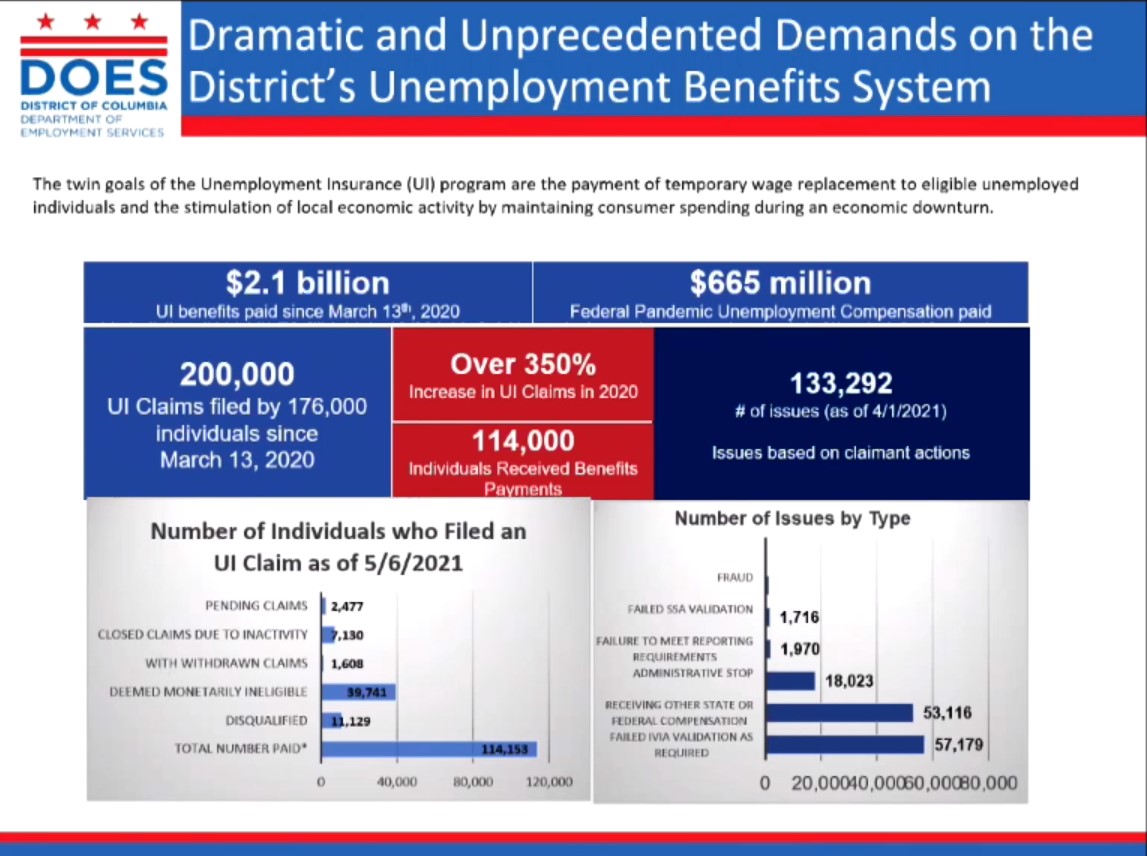
Pressed for answers by Ward 4 Councilmember Janeese Lewis George, Morris-Hughes explained some of the most common error codes that come up in the online portal, though she was a bit reluctant to do so. The codes can signify various issues, from the filer receiving income in another state to failed ID verification.
There were 52 major changes in federal unemployment policy in 2020 — three times as many as 2019 — each one requiring technology updates and completely new training for staffers. The federal government doesn’t provide any training or guidelines for how to train staff to meet these new requirements, Morris-Hughes said, so DOES has had to come up with its own training on the fly.
The pandemic has brought on what she called an “alphabet soup” of programs, like the Pandemic Unemployment Assistance (PUA) program, and while a number of states reduced benefits or stopped federally funded UI programs altogether, the District adapted to administer seven more benefits programs than in a typical year. Part of an $11 million investment from the city went towards hiring more DOES workers and updating the agency’s technology to accommodate the many changes.
DOES is planning to overhaul the current technology and modernize the system, a process Morris-Hughes said could take up to 18 months to test out and launch, pending approval from the council.
“We are not doing this perfectly,” Morris-Hughes admitted. “I also think there are issues from the claimant side that prevent them from getting payment. We should not expect that every person who applies will receive UI. Sometimes there are issues on our side. It’s not either/or, it’s both.”
Ward 2 Councilmember Brooke Pinto asked the director why D.C. hasn’t completely changed technology vendors — from On Point Technology to a new one — as its system has been widely criticized as being antiquated. Hughes-Morris answered that On Point has run the system since 1999 and that, “It is in my best professional opinion to not bring in another vendor in the middle of the pandemic to try to operate and manage the system.”
Many people, failing to receive tech issue solutions from DOES, have instead turned to Reddit, Twitter, and Facebook groups to air out their concerns and crowdsource information over the past year. During the hearing Wednesday, multiple councilmembers read social media posts from their constituents to provide examples of the most common issues.
“I don’t adjudicate claims over Twitter or phantom claims,” Morris-Hughes said at one point.
“These are not phantom claims,” Silverman replied. She followed by reading a statement from another claimant who wrote that it is “very insulting” for the DOES director to dismiss their online claims as fake.
The roundtable went on like this for a while, and by the end of the hearing, Silverman didn’t seem convinced by Morris-Hughes’ assessment of the issues: “I’m going to say that there’s a reality gap between what you’ve testified today and what claimants have told us.”
It’s unclear what, exactly, the council’s next steps will be, but members of the public can still submit written testimony to labor@dccouncil.us or by voice mail by calling (202) 455-0153, by 5 p.m. on May 26.