Colleen Grablick
Maryland’s Department of Transportation announced a proposal to drastically reduce its Beltway expansion project, a part of the state’s years-long effort to reduce congestion on the Beltway and I-270.
The large scaling-back comes after the state’s original proposal faced strong pushback from local officials and environmentalists, who criticized the plan for its contribution to car-centric urban sprawl, and its environmental and financial toll on the state.
In a statement on Wednesday, MDOT announced that the new proposal for the Beltway expansion will focus solely on building a new American Legion Bridge, and adding two high occupancy toll (HOT) managed lanes in each direction on the bridge from I-270 to I-370 in the northern region. For now, the proposal is nixing any lane expansion in the eastern portion of I-495 and I-270.
HOT lanes would allow vehicles with three or more people, including transit buses, to ride for free, while others could opt to pay a variable toll to escape a congested lane. The idea is designed to cut down on congestion.
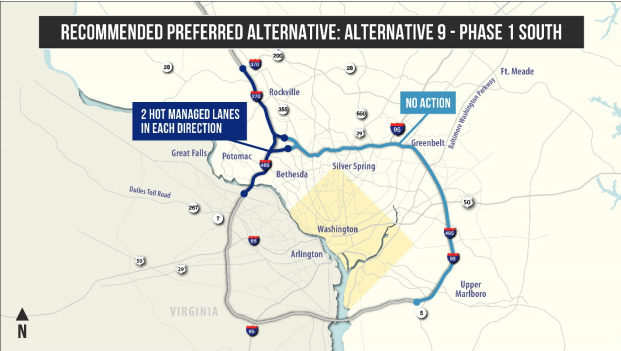
While the state, for now, is sidelining its HOT lane expansion goals for the eastern portion of the state, it’s not completely off the table.
“This Recommended Preferred Alternative [RPA] does not suggest that improvement will not be needed on the top side and east side of I-495,” reads MDOT’s statement on Wednesday. “If a new RPA is selected at the conclusion of the Managed Lanes Study, consideration of improvements to remaining parts of the interstate system would advance separately, subject to additional environmental studies, analysis, and collaboration with the public, stakeholders, and agency partners.”
Still, the about-face on the controversial project came as a small victory for some of its opponents on Wednesday.
Montgomery County Council President Tom Hucker said the reduced plan is “definitely good news,” and a testament to the residents who signed petitions, visited town halls, and wrote state officials voicing their opposition.
However, he says that even a reduced version of the Beltway expansion doesn’t meet the local transportation needs in his county and other jurisdictions in the D.C. region.
“You can add lipstick to the pig, but it still doesn’t make it an attractive proposal,” Hucker told DCist in an interview Wednesday. “It’s out of alignment with our climate goals and our transportation equity goals.”
“It’s essentially a 1970s-style highway expansion, at a time when we need a multimodal, 21st-century solution that moves people, not just cars,” he added.
Hucker said that the originally planned expansion was created without input from local governments, but hopes that the state’s back-pedaling will mean more opportunities for collaboration going forward.
“[MDOT’s plan] fails to invest in transit or to incentivize employers to keep cars off the road in a meaningful way,” Hucker said. “We’re hopeful that MDOT will recognize their mistake and now begin to work with local governments to create a plan that our residents want, and that our transportation planners believe will actually work.”
The Maryland Transit Opportunities Coalition shared in Hucker’s muted celebration on Wednesday, recognizing the state’s new proposal as a representation of the “power of public protest,” while also expressing concern over the addition of HOT lanes in the north.
“This new scheme makes even less sense than what came before it,” said Ben Ross, MTOC chair, in a statement. “Three more lanes of traffic will get dumped into the already-backed up merge where I-270 joins the Beltway at Wisconsin Avenue. The delays will be catastrophic.”
MTOC’s vice-chair Samuel Jordan noted that the state’s pull-back on its original proposal is one more step towards eventually scrapping the project completely.
“This latest retreat by MDOT from their original poorly conceived plan is another important step toward the cancellation of the entire misbegotten project,” Jordan said.
Hucker and other local leaders have pressed Maryland Gov. Larry Hogan and state transportation officials to invest in transit projects beyond those solely focused on vehicular traffic, like repairing the American Legion Bridge, building out better bicycle lanes, and expanding rail lines. In early April, Congressman Anthony G. Brown (D), who represents parts of Prince George’s and Anne Arundel counties, wrote to Transportation Secretary Pete Buttigieg, asking him to reconsider the impacts of the Beltway expansion project.
“This project will do little to address the sources of congestion in the long-term,” wrote Congressman Brown. “Modern transportation planning shows that road-widening only induces demand, limiting the benefit of extra roadway. The best way to address the Capital area’s traffic problems is to create options to take cars off the road, with public transit and other solutions. Building additional roadways only encourages people to drive and does not address the source of traffic.”
But during a press conference Wednesday afternoon, Hogan said that the American Legion Bridge “has always been the top priority.”
“We reached an accord with Gov. Ralph Northam, the Beltway accord, that connects the two states, it’s the most critical, it’s where the biggest bottleneck is,” Hogan said. “But moving forward it all has to get fixed or it’s not going to do much to solve the traffic.”
The Beltway expansion project has also drawn scrutiny for its precarious reliance on private companies. The expansion is a public-private partnership (P3), a type of agreement between public agencies and private companies, often to complete a transportation or infrastructure project.
The Purple Line, Maryland’s troubled light-rail project, is a P3 that failed last year when the private contractors quit the job over cost disputes. The breakup ultimately cost the state $250 million. According to the Washington Post’s report earlier this year, the Beltway expansion could cost Maryland up to $50 million if it the contracts didn’t move forward.
A spokesperson for MDOT did not immediately return DCist’s request for comment on the decision to scale back the project. It comes as Hogan wraps up his final term in office next year. The toll lane proposal has been one of his most prominent transportation plans.
Late this summer, the Maryland Department of Transportation State Highway Administration and the Federal Highway Administration will submit an environmental impact report for the new proposal, and take feedback from the public, and stakeholders at the federal, state, and local level.
This story has been updated with comments from Gov. Larry Hogan.