 Jordan Pascale
A new prototype device on Spin scooters aims to loudly address one of the biggest complaints about the two-wheeled electric devices: people often ride on busy sidewalks or park them poorly.
The new “Spin Insight Level 2 Powered by Drover,” as it’s called, is basically a small box on the front of the scooter with a camera pointed to the ground, sensors, and an onboard computer to run artificial intelligence — or AI — software. If it detects a rider is on the sidewalk, it’ll make a beeping sound to tell the rider to go back into a bike lane or roadway. (It doesn’t turn off or slow down the scooter like some other tech.) Once a rider returns to the street or bike lane, the scooter beeps again, albeit more positively.
Scooters are allowed on sidewalks except for the usually busy Central Business District. The District capped scooter speeds at 10 mph, which also makes them slightly too slow to keep up with vehicle traffic. Bike lanes are probably best, but unfortunately, they’re not everywhere.
I demoed the tech this week and it works well, almost instantaneously beeping at me once I rode up onto the sidewalk.
The AI has been programmed to know what streets, bike lanes, and sidewalks look like. It was even able to discern that I was on a sidewalk when it changed from brick to stone tiles or concrete. It will also beep if parked in the middle of a sidewalk and give rewarding beeps for parking the scooter near a curb, out of the way of pedestrians. It processes all of this in real-time, since the computer is on the scooter.
Spin reps say riders will be briefed in the app about what the noises mean so there’s no confusion. The noises can be changed to a voice telling you to move off the sidewalk, too. All of the noises and responses are configurable, Spin says.
The tech is still in the pilot stage, and Spin is getting feedback on how it’s received by users. There’s no word on when it could be used on Spin’s 3,000 or so scooters in the District.
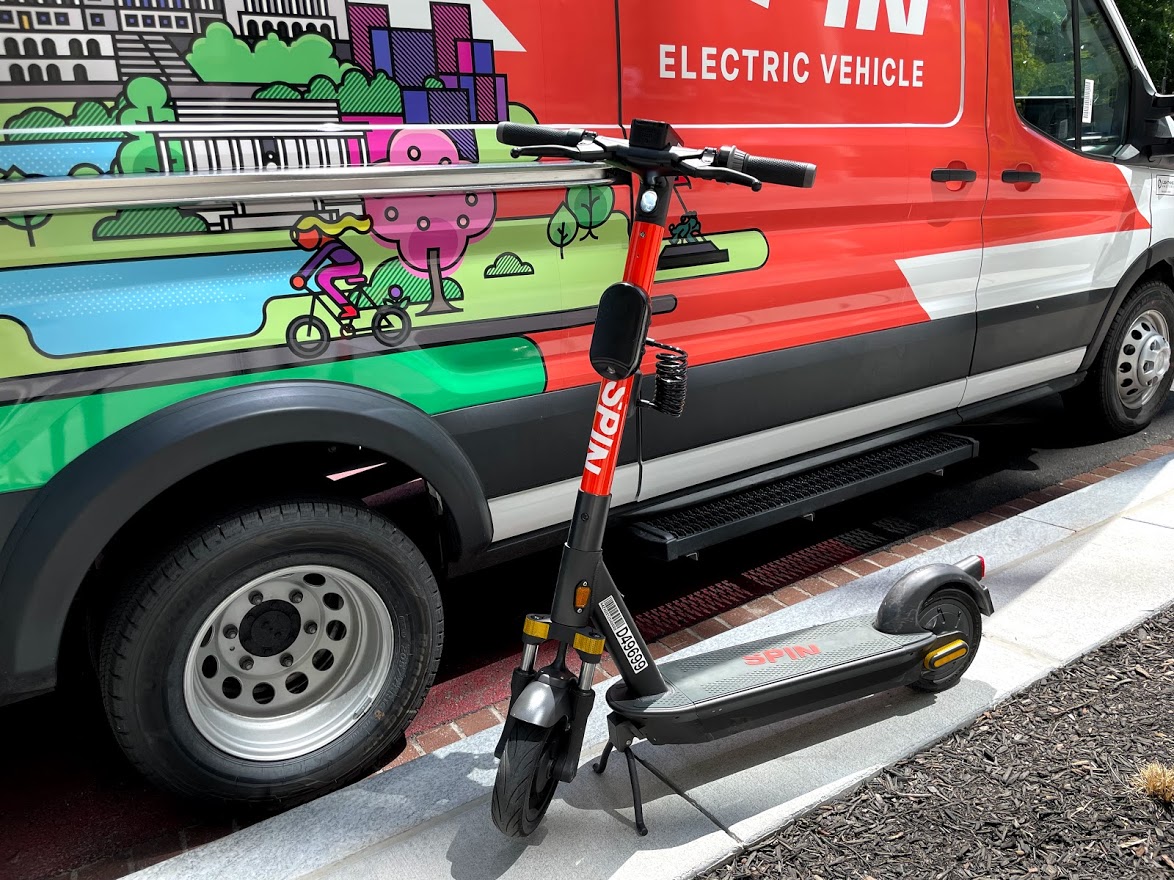
Granted, with drivers running cars off the road and into schools, buildings, other vehicles, pedestrians, and cyclists, many could argue that sidewalk scooter riders are relatively minor nuisance by comparison. Still, poorly parked scooters can block access for people who use wheelchairs and other devices.
The D.C. Council controversially sought to put restrictions on the new technology back in 2019. Ever since Twitter users have pointed out what the council should be focusing on: car crashes. Users highlight the disparity by posting text about how “dangerous these dockless scooters are” with an image of the latest awful car crash.
Those social media snipes aside, trying to develop creative solutions is the right thing to do, says Dan Winston, Spin’s regional general manager. The company has also launched docking stations in some areas to encourage better parking.
“Our customer is the whole community. That includes, first, the city, the regulators. It includes our riders, of course, but it also includes people who don’t ride scooters, particularly individuals who might be in wheelchairs or senior citizens, anyone who is going to be impacted by our technology or our scooters in the city,” Winston said. “And so we were bringing this because we really believe it can have a huge impact, not just on our riders and helping them understand what they should be doing, but and everybody else.”
Winston declined to talk about how much this tech adds to the cost of building a scooters, but said it won’t impact prices for riders if it is ultimately launched across the company’s scooters in the city.
“This is part of how we invest in the longevity of micro-mobility and how we build systems that really serve the communities, he said. “Because we know that’s the only way that we’re going to ensure we become part of the transportation network, just like Metro or Capital Bikeshare.”