Colleen Grablick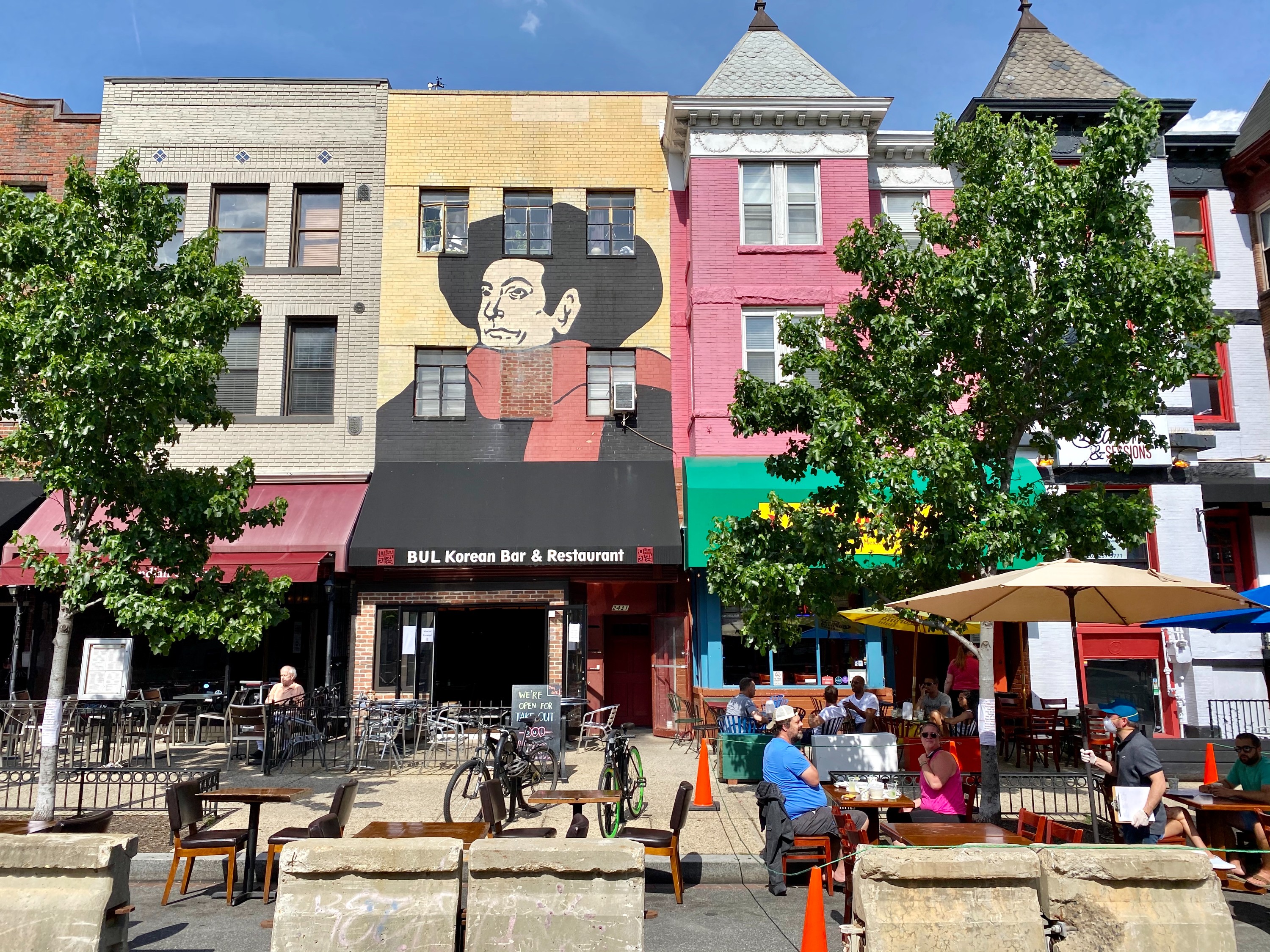
On Friday night, 18th Street NW in Adams Morgan buzzed in a way the neighborhood hadn’t in more than a year.
It was the first night of fully lifted pandemic restrictions for most restaurants – meaning no more capacity limits, no six-people per table rules, and (if a business chose to follow Mayor Muriel Bowser’s order), no masks. Nightclubs and taverns also increased their capacities to 50%, with a full reopening date set for June 11, and bar seating made a return.
Images of lines snaking around street corners and pints sweating on bar counters littered social media with the hashtag #backtothebarDC. Pitchers, which lifted its mask policy for vaccinated guests shortly after Bowser ended the city-wide mandate, saw gaggles of people waiting outside. A similar scene played out on 14th Street outside of Trade, which also lifted most of its pandemic restrictions, and ended its mask requirement for fully vaccinated guests.
But not all businesses across the city immediately took the plunge into full service. (In wards 7 and 8, where vaccination rates have lagged but coronavirus cases were highest, this was especially true.) After a year of pivoting and adapting, often on short notice, some business owners weren’t ready — or simply couldn’t — return to business as usual.
“Change is happening so fast, and it’s great and it’s exciting, but everyone’s at different levels of comfort right now,” says Rachel Fitz, a founding partner of Anxo Cidery.
Despite indoor dining opening at limited capacity last summer (and now permitted to open completely), Anxo is keeping its dine-in service limited to outdoor spaces at both locations and maintaining its mask-wearing policy. These procedures will stay in place, according to Fitz, until all employees are fully vaccinated, which she expects will be in about a month.
“We decided to keep the mask mandate partly for our staff and partly for other guests who have been visiting us this whole time, and come to us because they feel safe,” Fitz says. “I’m not saying that not wearing a mask isn’t safe — I believe the CDC — but just kind of wrapping your head around that, it takes a little bit.”
Beyond just making logistical changes like rearranging the cidery’s dining room or adding more tables, Fitz says that the pandemic has changed how the business operates in the big picture, which makes quick shifts difficult. Anxo increased its minimum wage for employees during the pandemic, so bringing in the necessary staff to run either location at full capacity is going to require a financial calculation.
“We’re a different business than we were when [the pandemic] started,” Fitz says. “We took COVID as an opportunity to reassess a lot of policies..I think a lot of businesses made changes and it’s going to take a little time to kind of adapt and build up towards full service, whatever that looks like – whether it’s the number of employees you have, whether it’s figuring out the financial side of things. It’s just a little more complicated than whether we want to have people inside or not.”
For Paul Carlson, the owner of The Royal and Lulu’s Winegarden, Bowser’s May 10 announcement to lift nearly all business restrictions on May 21 – less than two weeks later – felt like going from “zero to 60.” For weeks, business leaders and councilmembers had been calling on the mayor’s office to release a reopening plan that gave businesses time to prepare. But while other states plotted out restriction changes in accordance with vaccination rates, Bowser’s all-at-once shift came as a surprise for business owners.
Carlson says his staff’s comfortability with the loosened restrictions was a large factor in his decision to maintain most of his businesses’ pandemic precautions through the weekend. One day after Bowser announced that masks were no longer mandated in D.C., and instead could be required based on a businesses’ decision, Royal announced that it wouldn’t be changing its operations immediately: It will continue maintaining its mask policies and keeping tables spaced six feet apart. (Lulu’s did add two additional tables for the weekend, Carlson says.)
“During the whole COVID process, I would say that probably some of the most cautious people that I’ve come across are my own employees, and with good reason. They interact significantly with the public. They interact with people when they haven’t been wearing a mask,” Carlson says. “So a lot of our decisions were based on communicating with our staff and making sure that we’re all kind of on the same page and in line with how we were going to open.”
It’s going to take waiting and watching before he alters more policies, Carlson says. He’ll continue to monitor customer behavior to see whether guests really are going to come out in full force, or if the return to dining out will be more gradual, as people adjust and recover mentally from the pandemic.
Like many restaurateurs, Carlson says the relatively short notice end to the city’s pandemic-era precautions left little time for Carlson to recruit and hire staff, another hindrance to a full reopening last weekend.
“The reason why [restaurant leaders] were also startled, with not getting that much of a plan, is because I think we’re all seeing the effects of many different variables of COVID right now, and the staffing thing is a huge thing,” Carlson says. “How do you put an ad out to hire in such a competitive market, bring that person on, train them appropriately, and get them ready in less than two weeks? It’s just…incredibly hard and not very likely.”
A lack of staff is partially the reason that Cotton & Reed didn’t seat a full house over the weekend. Co-owner Jordan Cotton says that some employees aren’t fully vaccinated, so the Northeast rum distillery moved tables on the outdoor patio five feet apart (one foot closer than the previously required six), but didn’t pack as many people as they probably could have. The mask mandate also stayed in place.
“For one, we do not have enough staff to work that many tables, and two, our whole staff is not two weeks out from their second shot, so we are trying to basically be pretty cautious,” Cotton says. “Three, of course there are varying levels of guest comfort with just diving right back into everybody being mashed together like sardines, like we used to before the pandemic. So we’re trying to ease our way back to normalcy.”
Cotton did add four standing-only tables in the indoor warehouse to test guests’ appetite, but he says there wasn’t as much interest as expected.
“We’re learning as we go,” he says.
Other restaurants that have moved forward with some changes have done so in a measured way. Flight Wine Bar was one of the earliest local businesses to announce it was dropping its mask mandate. Co-owner Swati Bose says she was surprised by Bowser’s change to the mask order only a few days before more restaurant operation changes were coming, but with a small staff of only eight people (all of whom are fully vaccinated) Bose says she and co-owner Kamir Abir ultimately decided to follow in-step.
“We were kind of worried about a backlash either way, like you kind of felt like this might be a no-win situation,” Bose says of making the decision to no longer require masks.
Most guests have adapted well, according to Bose, often returning “I’m vaccinated too!” in response when they find out about the new no-mask-necessary rule. Still, she says she’s hesitant to increase capacity or push tables closer together until staff can gauge guests’ comfort level.
“More than lifting the mask mandate, I am more nervous about the distancing issue,” Bose says. “I wonder how comfortable guests are going to be seated closer to each other, so for now, that’s the part I’m keeping an eye on.”
The varying, restaurant-by-restaurant reopening approach is likely to continue as businesses address and adjust to their own staffing challenges, and respond to customers’ behaviors. The next major change in D.C. will come on June 11, when large venues and sports arenas can operate at full capacity. But despite some businesses’ reluctance to loosen restrictions, Cotton says that the distillery was markedly busy over the weekend, a sign that some people saw the May 21st “reopening” date as the beginning of a new, less restrictive era after months of precautions — even if some businesses didn’t change anything at all.
“I think the switches are flipping in more people’s minds,” Cotton says. “And I think a big one flipped for a lot of people this weekend.”