 Jordan Pascale
Update: Metro’s board has approved a list of fare changes and service improvements that will go into effect after Labor Day.
The transit agency will change fares as follows:
- Discount monthly passes by 40% for 30 days in September as workers head back to the office.
- Discount day and weeklong rail and bus passes by 50%. These would also be temporary 30-day discounts to woo riders back to the system.
- Lower the weekly bus pass from $15 to $12 indefinitely.
- Indefinitely eliminate the $2 cost to transfer from bus to rail service.
- Create a flat $2 fare for weekend train rides.
- It’s also looking at longer-term ideas to restructure the way rail fares work.
For service changes, Metro is focusing on providing more consistent service throughout the day as the transit agency expects less busy rush hours with the potential for more telework.
- Rail service would see 12-minute or less waits during most of the day. Peak hour service would have trains every five to ten minutes.
- Rail would stay open until midnight seven days a week starting in July and increase to 1 a.m. on Fridays and Saturdays starting this fall.
- Twenty of the busiest bus routes would see 12-minute or less waits during the day. Sixteen other bus lines would have service every 20 minutes or less.
The board unanimously approved the changes at its Thursday meeting.
General Manager Paul Wiedefeld says each customer has unique needs, but overall the proposal improves transit.
“This combination of service and fare changes are being recommended, first and foremost, to support regional economic recovery. [But also] the social recovery… really getting everyone back into the community, and providing that social fabric that we all that we’re all longing for,” he said. “We want to encourage ridership and trip making not only for those that had traveled with us in the past but also attract to attract new riders.”
Finance Committee Chair Steve McMillin said the board has sought to provide the level of service required to meet the region’s needs throughout the pandemic.
“This moves us to the recovery phase that delivers more frequent service, in more places, more affordably, for more riders,” he said. “We believe that a consistent, reliable service pattern throughout the day will help attract more riders back to transit as the region reopens.”
WMATA Board Chair Paul Smedberg said the package of service and fare changes will make it easier for riders to return to Metro and get comfortable with transit again.
“This provides more frequent trains and buses, addresses the historic transfer fee to promote connecting from bus to rail, and includes special weekend fares that will encourage visitors and area families to take transit as they start traveling again,” he said.
But board member Michael Goldman said he wanted to go further with the proposals: extending the pass discounts through the rest of the year (as not everyone will go back to the office in September), eliminating or discounting parking fees and extending $2 flat fares from Friday though Monday.
Original story, June 3: Metro officials are pitching lower fares and more frequent all-day service as two initiatives to lure riders back to the system this fall and meet the needs of current ridership. The transit agency’s board had requested a top-to-bottom look at fare and service in April as a means to prepare for a gradual return to post-pandemic normalcy.
One of the most significant changes would be the creation of a core group of 20 bus routes across the region and all six rail lines that would offer services at a minimum of every 12 minutes from 7 a.m. to 9 p.m., seven days a week.
WMATA says increased bus service would reach more people — especially in high-density areas — and promote transit equity.
Rail hours could be extended from 11 p.m. to midnight this summer and to 1 a.m. on Fridays and Saturdays this fall. That would be a saving grace for hospitality workers who often don’t get off that early and have grown to rely on more expensive ride-hailing services, said Lucinda Babers, the new board member from D.C.
The board will cast a preliminary vote on which ideas to adopt at its next meeting on June 10; whichever initiatives are approved would be implemented later this fall.
Buses have had more riders than trains during the pandemic because they most often serve essential workers. Meanwhile, many office workers have been able to work from home and may be able to do so after the pandemic ends, altering the makeup of the rush-hour commuting base.
Metro data shows the rush hours have significantly flattened, thus spawning the push for more all-day service to serve people who don’t work traditional 9-to-5 jobs. Metrorail ridership, WMATA’s largest passenger revenue source, is only about one-sixth of its usual clip.
Part of the agency’s proposal would change rail frequency from increased peak service pre-pandemic to more consistent all-day service. For instance, Red Line trains arrived every five minutes during rush hour before the pandemic, but in the future they could come every six minutes throughout the day. The Orange, Blue, Silver, Yellow and Green lines used to come every 10 minutes during rush hour, but would go to 12 minutes through most of the day.
“We do have a fairly high level of confidence that frequent and reliable service is going to drive ridership and be attractive to people moving around our communities in our region,” said Tom Webster, Metro’s vice-president for planning.
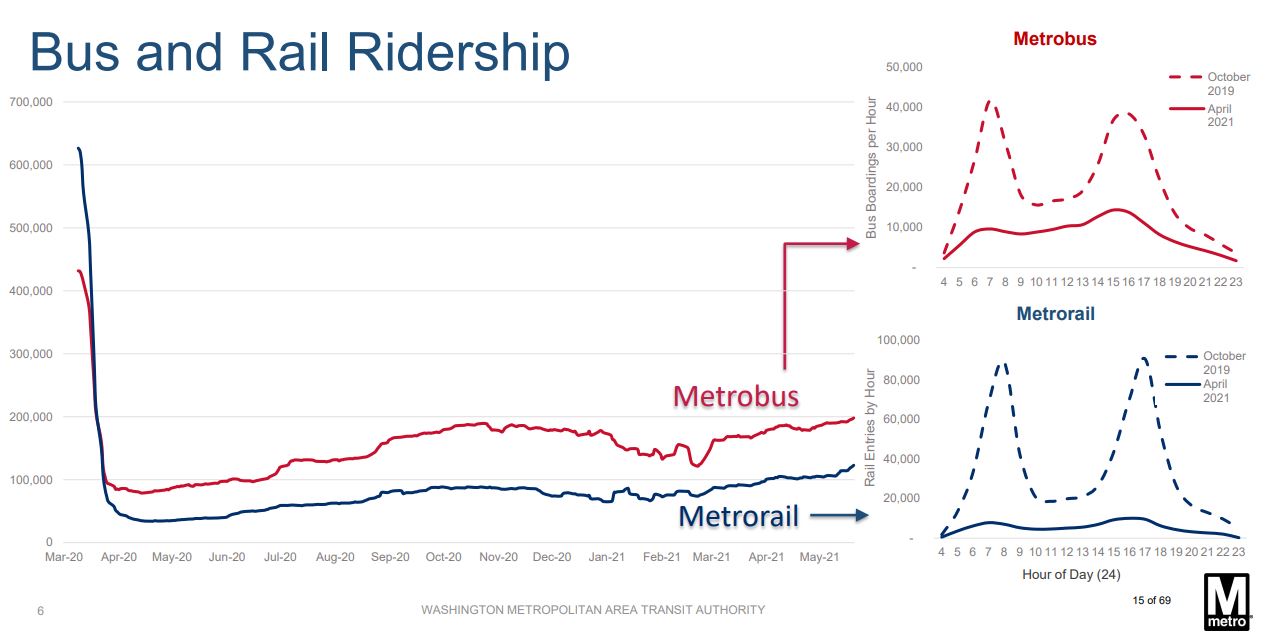
Metro isn’t expecting to get back to pre-pandemic levels of ridership until after 2024. Webster said there’s still a lot of uncertainty around how and when travel trends will change, but he suspects different types of activity will resume at different rates. Offices will likely return later than retail, events, and other travel, he said.
But at least three board members were reluctant to stray away from peak service periods. Matt Letourneau of Virginia said he thinks a lot of office workers will return after Labor Day.
“I think we will still continue to see some peak,” he said. “Things might be more spread out… there’ll be more telework, I still think you’re gonna see a surge in the morning and a surge in the evening, as we’ve sort of had in the past. I don’t want us to go overboard (on non-peak hour service) and make sure we have adequate service, even if that means need to scale back a little bit during the day.”
Among the fare proposals, Metro officials are floating implementing some ideas that were delayed because of the pandemic. Those include eliminating bus to rail transfer cost, reducing weekly bus passes from $15 to $12, and a flat $2 weekend rail fare.
Maryland Transportation Secretary Greg Slater said that as worker commuting habits change, Metro should create discounted packs of 10-15 rides instead of a monthly pass that assumes people are going into work every weekday.
Metro also pitched longer-term ideas that could take more than a year to implement. Among them are $1 bus fares, lowering rail fares in part by reducing the cost of longer trips, simplifying the zone fare system which charges more the farther you go, and trying a fare program for low-income residents. They could also cap how much a person spends per day, week or month on trips.
Board member Michael Goldman says Metro needs to ditch charging peak fares if there is no peak-period service during the pandemic.
“It makes no sense,” he said.
One idea that may entice more suburban riders: free or reduced parking through the end of 2020.
Metro went from a dire financial picture last year to now being able to get through the next couple of years thanks to $2.5 billion in federal aid from three congressional relief packages. While Metro is flush for now, Letourneau worried about the future with a $190-250 million deficit looming in 2024.
“I’m very cognizant of that as we discuss all this because the more money that we use now to restore service or improve service, the less we will have down the road,” he said. “And I agree with the sentiment that we’re not likely to see significant federal funding coming in, so I would tend to take a more conservative approach.”