Colleen Grablick
Casa Ruby, the multicultural nonprofit organization that provides housing and other support services to D.C.’s LGBTQ+ youth, has gone international.
The organization expanded in March, opening its first office in El Salvador. (Washington Blade first reported on the opening). Now, a small team of about five staff members is coordinating outreach programs and at-home services in San Salvador, working to protect LGBTQ+ residents from violence and provide financial support.
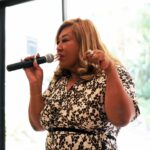
“The Salvadorian LGBTQ people are dying in a system, in a country, that does not even acknowledge that they exist,” says Ruby Corado, Casa Ruby’s founder. “I will never leave my work in D.C., I will always be an advocate, but I think that there’s a special connection to global LGBT rights.”
For Corado, who spent the first 18 years of her life in El Salvador before immigrating to the U.S., the expansion was a homecoming — a “full circle moment.” She left the country 31 years ago, during the later years of the Salvadoran Civil War. Now, as she prepares to step down from her role at the helm of the organization she founded, she sees creating a shelter back home as both a point of personal closure and an obligation as a LGBTQ+ advocate.
“I cannot be blessed with the privilege that I have today in D.C. and look the other way,” Corado says. “I know what I had to go through, so I’m trying to help one person.”
In 2020, Corado reconnected with her father, who she had not seen since she left El Salvador in the early 1990s. After moving to the United States, he offered Corado his house in San Salvador – a building that’s been converted into six apartments — to be used a Casa Ruby emergency shelter. Meanwhile, Corado has been building out Casa Ruby’s international network for years, connecting with organizations like the Meridian Institute and the Latin American and Caribbean Network of Trans People, establishing a coalition of advocates in El Salvador.
Now, as Casa Ruby plants its flag, Corado says she wants to focus on supporting the LGBTQ+ activists already working on the ground in El Salvador, and use her influence to garner support from D.C. donors.She plans to split her time between D.C. and El Salvador as the project gets underway. Casa Ruby posted a GoFundMe on Thursday, seeking donations to establish a mutual aid network for Salvadoran clients needing financial assistance. Eventually, she’s planning to start a scholarship program for homeless LGBTQ+ youth in the country and launch a support service for Salvadorans seeking to immigrate to the U.S.
“I really want this project to be funded by the diaspora,” Ruby says. “I have so many clients [in D.C.] who I helped for the last 20 years who are doing quite well. What I want to do is hold fundraisers in D.C., little events with the diaspora, because a lot of them are not educated about donating online but they’ll go to club events, and they’ll donate for Casa Ruby El Salvador. I’m going to have to do a lot of that, and it’s going to take me time, but I think that’s it’s not a crazy idea.”
For members of the LGBTQ+ community in El Salvador — especially transgender women and sex workers — living life freely and openly identifying as transgender or gay puts them at a high risk of violence, says Corado. Unlike in the U.S., she says safe spaces or progressive enclaves for LGBTQ+ community building are exceedingly rare. While law enforcement often doesn’t provide accurate statistics on hate-based violence and homicides in El Salvador, Comcavis Trans, a Salvadoran organization that serves transgender survivors of violence, has documented more than 600 killings of LGBTQ+ Salvadorans since 1992. The life expectancy for a transgender woman in El Salvador is just 35 years old.
Corado quotes from a recent documentary, “Imperdonable,” about Salvadoran gay men involved in gangs and the violence they face for their sexuality: “it’s easier to be forgiven if you kill a man, than if you a love a man.”
“You can be gay in 2022 [in the U.S.] Now, you’ve gone through a lot of hell, but you can still be gay,” Corado says. “You can be LGBTQ and you can move to a progressive city with some resources. In El Salvador, the way to have any quality of life is you have to be in the closet.”
Corado says she hopes to start moving residents into the emergency shelter in the next 90 days, as the organization secures more funding and support both from Casa Ruby’s international and D.C. networks. On Saturday, she’s flying to El Salvador to celebrate the 25th anniversary of the first pride march.
“I will go, I’m not leaving them alone.”