Margaret Barthel
COVID-19 cases in the D.C. region are steadily rising once again, driven by pockets of unvaccinated people, the highly contagious new delta variant, and some asymptomatic or mild breakthrough infections in vaccinated people.
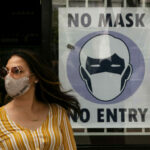
The worsening situation led D.C. Mayor Muriel Bowser to reimpose an indoor mask mandate for everyone over the age of two, even vaccinated people. Starting July 31, masks will be required indoors in D.C., including in workplaces, retail stores, gyms, and restaurants. The news follows new federal recommendations for indoor masking in areas with significant transmission of the coronavirus, a threshold D.C. met this week.
“We want to get ahead of it and nip it in the bud,” Bowser said at a press conference announcing the new mandate. “We know that masks can be very effective in doing that.”
D.C. hasn’t added other capacity or spacing restrictions alongside the new mask policy.
Virginia and Maryland have so far avoided instituting statewide mandates. But some local jurisdictions have adopted stricter rules on their own.
Montgomery County and Prince George’s County will institute indoor mask mandates in public spaces in coming days.
Virginia Gov. Ralph Northam strongly recommended indoor masking for vaccinated people, but stopped short of requiring it. Public health directors in Alexandria, Arlington County, Loudoun County, Fairfax County and Prince William County issued a joint letter emphasizing the importance of mask wearing indoors, regardless of vaccination status.
Wait, but I’m vaccinated. Why do I have to wear a mask again?
The pandemic is a collective problem, not an individual one. The public health response is aimed at reducing the burden of disease in our communities as a whole, and that’s where vaccinated people masking up comes in.
The Centers For Disease Control and Prevention now recommends that vaccinated people in areas with substantial or high community spread of the coronavirus wear masks indoors. Several localities in the D.C. region have surpassed that threshold. You can check here to see whether your locality currently falls into either of those categories.
The delta variant is driving these increased infections, and it’s changed the game in the local and national pandemic response. The mutation is now the prevalent strain of the coronavirus across the country and here in the D.C. area. The CDC estimates that 66% of new infections in the Mid-Atlantic region — D.C., Maryland, and Virginia, plus West Virginia, Delaware, and Pennsylvania — were caused by the delta variant in mid-July.
There’s a lot scientists don’t know yet about this particular strain, but the information emerging from research is concerning. According to internal information from the CDC, the delta variant is as transmissible as chicken pox, and more transmissible than the common cold. The risk of severe disease or hospitalization is greater.
So it’s not a surprise that cases are once again on the rise in the D.C. region, trending steadily up from rock-bottom numbers earlier in the summer. In D.C., the average daily case rate is nearly 7 times what it was at its lowest point, in June. Virginia and Maryland are seeing similar increases. Those case increases are largely being driven by unvaccinated people: 99% of cases in Virginia are in people who are not fully vaccinated, for instance.
“Basically, if you are unvaccinated and you’re not taking the proper precautions, you will get infected,” says Dr. Amira Roess, an epidemiologist at George Mason University. “So it just makes sense at this point to go ahead and reimpose the mandates.”
But what about vaccinated people? All three U.S. vaccines are highly effective against the delta variant, so if you’re vaccinated, you have a lot less to worry about. Breakthrough infections are rare, but they do happen — the CDC currently estimates that there are as many as 35,000 new ones per week — and when they do, they tend to lead to mild or even asymptomatic disease. There’s also evidence that the vaccines tend to clear breakthrough infections quickly, meaning that vaccinated people will be contagious for shorter periods of time.
So vaccinated people can breathe a little easier about their personal risk. But that doesn’t mean that a vaccinated person carrying the virus can’t cause harm to other people who are unvaccinated, immunocompromised, or too young to receive shots. Preliminary information from a study of a major recent outbreak in Massachusetts appears to show that vaccinated and unvaccinated people had the same amount of virus in testing samples, suggesting that vaccinated people can be equally contagious as unvaccinated people.
Roess acknowledges that vaccinated people may feel very frustrated by the return of masking indoors, especially after health officials told the vaccinated public that they could take off their masks a few months ago.
“I think the decision makers are really trying to do the best that they can and are trying to be responsive to the current situation,” she says. “So when they made that decision to do away with the mandate, they were really looking at a situation that’s very different than now.”
D.C.’s mask mandate includes penalties for people who fail to comply. The order provides for suspension or revocation of District-issued licenses, permits, and endorsements, and it suggests that employers can take action against employees who break the rules. Individuals can rack up civil fines of up to $1,000.
Will I have to wear a mask at work?
People who work indoors in D.C. are now required to wear a mask on the job. In D.C., businesses may also choose to impose stricter regulations like requesting proof of vaccination on employees or people entering their establishments.
Federal employees will need to mask up at work, too. The White House has said it will require all people in federal workplaces in areas with high or substantial community transmission to wear masks. D.C. currently meets that description. Check here to see if the locality where your federal workplace is located does, too.
On the Hill, members and staff on the House side of the Capitol will be required to wear masks again even if they’re vaccinated, according to new guidance from the Office of the Attending Physician. Republican House members responded to the new requirement by taking selfies at an unmasked gathering in the Capitol Rotunda. The rule does not apply to the Senate.
Virginia and Maryland do not currently have statewide indoor mask mandates, so if your workplace is in one of those states, you may not need to wear a mask. It’s worth noting that Maryland localities may set their own masking rules, even in the absence of state action.
But if you work in certain settings in Maryland and Virginia, though, you will still have to mask up. Those places include medical settings like a doctor’s office or hospital, correctional facilities and homeless shelters, indoor child care and some schools, and on public transportation.
What about in a restaurant? Can I take my mask off to eat?
In a word, yes. Just as with the District’s previous mask mandate, diners indoors will be required to wear masks if they are not actively eating and drinking.
DC Health director Dr. LaQuandra Nesbitt told press that the District’s contact tracing information indicates that dining out is one of the main activities that people who are testing positive lately say they’ve engaged in, along with travel and larger social gatherings.
The D.C. mandate did not come with other capacity restrictions or distancing requirements, so what restaurants look like inside will not change beyond added masks for people who aren’t eating.
Restaurant employees will again have to wear masks on the job, though Restaurant Association of Metropolitan Washington President and CEO Kathy Hollinger says many workers were still wearing them, even before the new mandate was announced.
“Many of our operators, their employees were already wearing masks,” she said. “So this is really about diners making sure they’re coming in, understanding that, you know, they have to wear masks.”
Hollinger said she was “disappointed” by the news of the new mandate because it represents another blow to an exhausted industry. She also expressed concerns that enforcing the new indoor rules could ultimately fall to overstretched restaurant operators and their employees, already reeling from the impacts of the pandemic and staffing shortages.
“I think the biggest challenge is really that restaurants are not in a position to also police,” she said.
What are area school systems saying about masks and the return to school this fall?
The indoor mask mandate applies to all schools in D.C. Schools will also be expected to implement social distances of three to six feet as much as possible, provided it doesn’t prevent schools from being able to accommodate all students returning to in-person instruction.
Other local school systems, including the two largest, have also said they’ll require masks when students go back to class. Montgomery County Public Schools plans to extend its indoor mask mandate, which has already been in place during summer school programming, to the beginning of the school year. MCPS students will also need to wear masks on the bus, but they won’t be required outdoors.
Fairfax County Public Schools is also planning to require indoor masking for students, unvaccinated staff, visitors, and vaccinated staff in the presence of students. Masks will not be required outdoors.
Alexandria’s school board approved a mask mandate on Aug. 3. It requires masks at all schools facilities and vehicles regardless of vaccination status. The mandate is for the fall and the school system will reassess guidance later this year.
Where else do I need to mask up?
In D.C. and across the region, masks are still required in healthcare settings, on public transportation and in rideshares.
What about outside? Am I allowed to feel the sun on the lower half of my face?
The D.C. mask mandate only applies to indoor settings. Transmission of the coronavirus is generally lower outdoors, where airflow is greater and it’s harder for enough virus to make it from person to person and cause infection.
That said, especially given the contagiousness of the delta variant, some people may want to consider wearing a mask outside, especially in crowded gatherings like sporting events or parties, D.C. officials said.
“We want to be particularly clear that people who live with young children who are not yet eligible to be vaccinated, who live with people who have are immunosuppressed which means they may not mount the proper response to the vaccine, and to people who may have a more severe illness if they were to get COVID-19, you’re benefited from wearing a mask,” said DC Health’s Nesbitt. “It helps to protect those other folks in your home who can’t get that protection just by their own actions.”
This story has been updated to include information about Alexandria schools’ masking policy, a joint letter from Northern Virginia health officials recommending masking, and a mandate for masks in Prince George’s county-owned buildings.