 Jordan Pascale
Proud Boys leader Enrique “Henry” Tarrio was sentenced Monday to more than five months in jail for burning a Black Lives Matter banner that his group stole from a historically Black church and for an unrelated weapons charge for carrying two high-capacity magazines into D.C., where they are illegal.
Tarrio, of Florida, pleaded guilty to the charges in July — one count of destruction of property and one count of attempted possession of a large-capacity ammunition feeding device. He was sentenced to 90 days for destroying the banner and 150 days for carrying the magazines.
At a hearing on Monday, Judge Harold L. Cushenberry Jr. suspended all but 155 days of that time on the condition that Tarrio successfully completes three years of probation. Tarrio also must pay $1,000 in fines and $347 in restitution to the church. Tarrio, 37, is to begin serving his sentence at the D.C. Jail in two weeks.
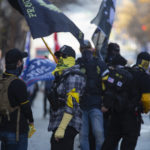
According to the office of the U.S. Attorney for D.C., Tarrio and a group of Proud Boys — a far-right organization identified by the Southern Poverty Law Center as a hate group and classified by the FBI as having white nationalist ties — were near 11th and K Streets NW on Dec. 12, 2020 when an unknown member of the group took the sign from the church. They then used lighter fluid and lighters to burn the banner. Tarrio posted a picture to his Parler social media account and admitted to burning the banner on social media and in comments to the media.
On Jan. 4, 2021, he was detained for the property crime as he arrived in D.C., and police found two high-capacity firearm magazines in his bag. Tarrio told detectives that he had intended to transfer the magazines to a customer who was also going to be present in the city.
During the sentencing, Rev. Dr. Ianther Mills of Asbury United Methodist Church said the church displayed the banner after Tamir Rice was killed by police in 2014. She said Tarrio’s actions were physically and financially minimal — the banner cost $347 — but that the church had to shoulder more significant security expenses in the wake of the incident.
The psychological impact, she said, is far heavier, comparing it to visions of slavery, the Ku Klux Klan, and lynchings. She said the burning was an “act of intimidation and racism” that caused “immeasurable and possibly irreparable harm” on the community.
“His careless act of violence and hatred, targeted at a congregation of individuals with a lived history of social and racial injustice, had the presumably desired effect,” she said. “Asbury was forced to reckon with the very tangible evidence that we continue to live in a world where people radicalize hate based upon race and skin color.”
Tarrio’s lawyer, Lucas Dansie, said his client made a poor decision and wasn’t thinking clearly. He said Tarrio made a mistake and wants to do community service at a church in Miami.
Tarrio apologized, saying he was “profusely” sorry for his actions, calling them a “grave mistake.”
“What I did was wrong,” Tarrio said during the hearing, which was held via videoconference.
Tarrio is also facing a separate civil suit filed by the Metropolitan A.M.E. Church for the destruction of another Black Lives Matter banner.