 Jordan Pascale
The Smithsonian National Museum of American History is gathering written and recorded memories of 9/11 for the 20th anniversary of the attacks.
You can submit your written memories, photos, or a video to the Smithsonian’s “9-11: An Evolving Legacy” website. You can also read what has been submitted so far.
The museum is also hosting three virtual panel discussions and a website featuring new collections as well as artifacts and photos from the museum’s collection.
“After two decades, the nation continues to feel the lasting effects of the terrorist attacks of September 11, 2001,” the Smithsonian wrote about the initiative. “The outreach effort seeks to create a more robust national collection of objects and stories that include diverse experiences, not only recording and exploring the day and immediate aftermath of September 11, but also the longer-lasting and varied effects on people’s lives. The collection will demonstrate the repercussions of decisions made during the intervening two decades and how they still affect our political, social, and economic discourse.”
The project will go on for five years, spanning the 20th through 25th anniversaries of the attacks.
“We really want to wrestle with what is the story nationally,” says Shannon Perich, a curator who specializes in photos. “A lot of other venues have a site-specific reference, and we want to think about it differently. By listening to the public and hearing what their stories are and analyzing the data that comes in through the website will be able to better shape our 25th-anniversary story.”
The museum is especially seeking voices from diverse communities and actively sharing their stories and the experiences of Americans in a post-9/11 world.
Already, people like Carl L., who lived in Centreville at the time of 9/11, have submitted their memories. He was supposed to be at the Pentagon that morning, but a meeting was canceled. He recalls the aftermath later in the day.
“Normally, the sound of planes taking off from Dulles and the honking of horns and traffic from the interstate through the woods created a constant hum of activity and noise,” he wrote. “Now, I could not even hear the sound of birds in the woods that separated my complex from I-66. Over the next few days, the silence became deafening and disturbing. It felt as if the world was ending.”
“We commit to working hand-in-hand with our publics to document, record, interpret, and share the ways in which the September 11 attacks have affected the world we live in today,” says the museum on the project’s website. “We also commit to sharing the experiences of those who witnessed this tragedy in order to provide understanding for those who have grown up in a world shaped by these events.”
Smithsonian curators gathered artifacts from across the country
The Museum of American History was designated by Congress as the repository for 9/11 artifacts.
You can see a few of those items on display today: an airphone from Flight 93 where passengers called loved ones as they knew the fate of the hijacked flight; then NYC Mayor Rudy Guiliani’s cell phone he used that day; a piece of the World Trade Center’s hulking steel; and a turban from Balbir Singh Sodhi, who was killed in a hate crime just four days after 9/11. Hundreds more artifacts are in storage.

“To all who lost loved ones and colleagues, to my museum colleagues who worked and continue to do the difficult work around that day — we owe our lasting empathy and compassion as we broaden the lens of understanding of that moment,” museum director Anthea Hartig wrote in a message about the collection.
Smithsonian curators from the D.C. region fanned out across the country after the most deadly attack on American soil. Peter Liebhold went to a small airport in Connecticut where the remnants of Flight 93 were held in shipping containers.
“It was some little teeny tiny pieces… much smaller than I expected,” Liebhold recalled in an interview with DCist/WAMU this summer. “And it smelled awful because it was still soaked in jet fuel and had been sitting out in the hot sun for a couple of years.”

Liebhold says curators went back and forth about how best to document and collect artifacts from the day in the immediate aftermath of the event. Curators collected history, but this was a current event.
“We generally collect the virtues, the achievements, the winners, the firsts, the unique, the greatness of the country,” he said. “And with September 11th, what makes it even more challenging is not just the rapid collecting technique, but the notion of collecting trauma, of collecting what’s wrong with America.”
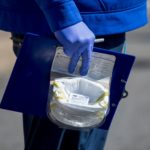
Jennifer Jones, a military history curator, helped collect hazmat bags filled with unidentifiable personal effects at the Pentagon.
“It gives you a different sense of being very introspective about the lives of people who were lost,” she said. “It gives you a sense of what your mission is and how important it is that you’re doing this in order to preserve the history and tell the story. And so I think we all looked at it as not just our opportunity, but a privilege to be able to go in and work through and find things that represented not only the men and women who serve in the Pentagon, but also it is an office building. And so we really had to think, what are the things that are key to identifying people who work here?”
She collected ID tags, a Pentagon map, and an M&M machine that she assumes was on someone’s desk.
“Everybody has their candy jars that you share with your office,” she said. “It’s a much more human connection, something that you can tangibly understand and connect to that isn’t about the military. It isn’t about attacks. It isn’t about terrorism. It’s a very human connection. And I think we looked for those items as well because they resonated for us as workers in a federal building.”
Bill Yeingst said the toughest part about collecting is that objects are silent.
“So we really have to look for how objects can tell us stories and reconnect these objects with people and then connect people with history. One of the most memorable items he collected was a simple name tag,” he said. “It’s a pathway to this amazing story about Lieutenant Commander David Tarantino, who, along with Navy Captain David Thomas, rescued Jerry Henson, who was a retired naval aviator, in one of the heaviest impacted areas with the Navy command center at the Pentagon. They rushed into the scene after the plane hit and found Henson trapped under a desk.”
“Dave Tarantino did crew, so he had great quads,” Yeingst added. “He was able to get on his back and use his legs to push the debris up off of Jerry Henson so that they could free him and pull him to safety. And so this name tag really was meant to be a way of documenting who this guy was, who was going repeatedly in and out of this, you know, horror scene, helping people and rescuing people.”