Rachel Kurzius
Customers at Compass Coffee used to be able to tip when they paid with credit cards. But the homegrown chain stopped providing that option in March 2020, making it an outlier among local coffee shops.
Baristas at Compass previously made minimum wage or more, plus tips. When management got rid of tips, with the reasoning that customers didn’t want to pay gratuities, an hourly pay raise was introduced to counteract the paycheck loss. But many employees say that the raise wasn’t nearly enough, and their overall wages decreased — even as customers asked why they couldn’t tip anymore.
Former barista Jess McCune says that, “when the tipping was taken away, it was explained that the raise — our wage increase — made up for that. It might have been true for maybe two cafes, but for the vast majority of us, we were losing significant amounts of money.”
D.C. establishments, advocates, and voters have been wrestling with the role of tipping in hospitality wages for years. During the pandemic, some D.C. restaurants and bars have added automatic service fees to bills, either in addition to or instead of tipping, which customers can see itemized on their receipts. The conversation about gratuities is sure to continue, especially if another initiative to eliminate the tipped minimum wage makes it onto the ballot in 2022. (The change in pay at Compass would not be impacted by the measure, because workers there had received gratuities on top of the full minimum wage and the initiative does not get rid of tipping.)
Compass Coffee has prided itself on offering a slew of benefits to its employees, including healthcare benefits, sick leave, and paid time off, in an industry that rarely does so. Since opening its first shop and roastery in Shaw in 2014, the company now has a dozen shops in D.C. and Northern Virginia, plus a huge roastery in Ivy City, and its brews have been spotted in the White House.
Management framed the change in tipping policy as something that would be beneficial to employees, because it was coupled with a pay raise and because it would improve “team interaction,” according to a memo obtained by DCist/WAMU. But employees who spoke with DCist/WAMU say that, far from improving the work environment, the change simply reduced their wages.
The messaging around the eradication of tips also made some current and former baristas feel as though they were misleading customers. Six Compass employees at different locations say they were trained to tell customers who asked about tipping that Compass raised its drink prices so that tips weren’t necessary. Compass co-owner Michael Haft says that messaging isn’t a part of the official training documents.
A memo that went out to Compass employees before the change went into effect on March 1, 2020, stated that the decision was based on a comprehensive customer survey and evaluation of their tipping rates. (The memo was sent before the pandemic began to impact D.C.)
“We have determined that the majority of our customers tip out of a sense of obligation rather than genuine individual desire,” the memo said. “We have decided that, going forward, the price on the menu will be inclusive of customer service.”
Haft provided DCist/WAMU with data showing that, on average, 42 percent of customers did not tip and 30 percent chose the lowest amount — 10 percent. He says the data came from three months of customer payments. Then, according to Haft, Compass used a secret shopper program to figure out how patrons really felt about tipping, and determined that those who tipped 10 percent did so out of obligation. Compass extrapolated from that data to conclude that the majority of customers did not want to tip.
But some baristas are skeptical of that reasoning. They say that customers, especially the regulars who are the staple of neighborhood coffee shops, wanted to tip, and they’re not sure why Compass wouldn’t give them the option as part of the payment process.
Nat Baldino, a former employee who started in the entry-level role of a barista apprentice in early 2018 and was ultimately promoted to a café manager-in-training, is among the current and former employees who tell DCist/WAMU that the eradication of tipping led to more awkward customer interactions, rather than fewer. “It became even more uncomfortable than moving a screen because people would be like, ‘How do we tip you?’ Like, ‘You’re not allowed to tip us anymore,’ “ says Baldino.
Haft says that customers can still “leave cash for a barista, you can leave them a gift, you can leave them a note.” But the current and former employees DCist/WAMU spoke to all said that managers discouraged them from accepting cash tips, and the coffee shop counters did not have a tip jar. Moreover, they say, Compass’ shift to limiting cash transactions made it less likely that patrons would pay with bills.
Compass received some emails from customers complaining about the change and heard from some employees who were “very upset” at a team meeting prior to the switch, per Haft. “There’s certainly some people who really like tips,” he says. “But I think, for the vast majority of people at Compass, this was a positive change.”
Compass Coffee previously offered its employees the minimum wage as a starting hourly wage, plus tips. While the amount of tips varied based on the Compass location, the average was $5.71 per hour as of fall 2018, Haft told DCist in a previous story about wages at coffee shops. With that pay scale, an entry-level role like a barista’s apprentice could make close to $20 an hour.
That changed in March 2020, when the starting hourly wage increased to $15 an hour — a rate that would become the citywide minimum wage in July of that year — but without the addition of tips. For an entry-level employee, that could amount to nearly $4 less per hour, compared to the minimum wage plus average tip amount in the fall of 2018. But the amount of tips an employee received depended on the location they worked. Downtown shops, for instance, saw much higher tip averages than the shops in Spring Valley or Northern Virginia.
In addition, more senior positions, like supervisors, saw a larger pay raise than junior ones. That increase “wasn’t comparable to what we [supervisors] made with tips, but it was still a raise,” says Baldino, whereas those in more entry-level roles “just got [the new $15 minimum wage] they were going to get in July anyway.”
Haft acknowledges that “getting rid of tipping was probably harder for somebody who was a barista and had no intentions of advancing to become a barista trainer or a supervisor.”
Still, he maintains that, even without tips, Compass wages remain competitive for the food and beverage industry. “I’m not embarrassed sitting here talking to you” about the wages, Haft says, pointing out that the company offers health care, commuter benefits, paid time off, and sick leave, among other perks.
Many other hospitality employers pay a version of a tipped wage, meaning that employers pay workers less than the regular minimum wage, with tips making up the rest. Employers are legally obligated to make up the difference if tips don’t bring pay to the full minimum wage, but opponents of the two-tiered system say that it’s too complicated and often leads to wage theft. D.C. may see a measure on the ballot to eliminate the tipped wage in 2022 — voters approved a near-identical measure in 2018, but the D.C. Council overturned it. Under that measure, patrons could still tip workers, but it would be on top of employers paying them the full minimum wage.
The previous formula Compass used to pay workers — starting at the minimum wage plus tips — is the one favored by a majority of restaurant workers, according to a new poll commissioned by the advocates working to eradicate the tipped wage.
Compass Coffee’s eradication of tipping was quickly overshadowed by growing concerns about the COVID-19 pandemic. Less than three weeks after getting rid of gratuities, Compass laid off 150 of its 189 employees. The 20 percent of staff who remained were all moved to a $15 per hour wage, regardless of their position.
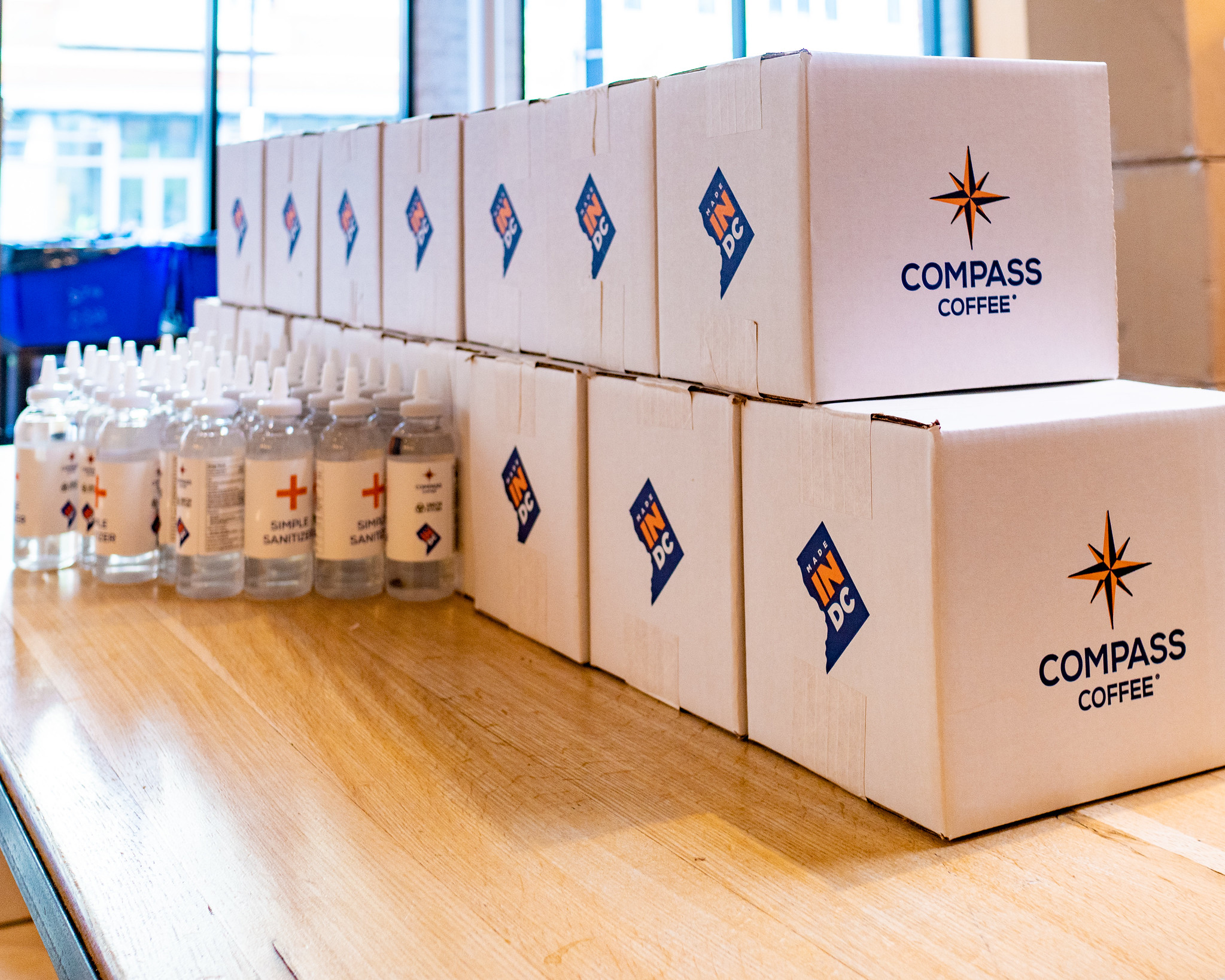
“We very nearly went bankrupt in May of 2020,” says Haft. “It was just horrific to watch the entire business evaporate pretty much overnight.” Compass was among the D.C. businesses commissioned by the city to produce hand sanitizer during the health emergency’s early days, but the company had temporarily shuttered more than half of its brick-and-mortar locations. (All of the locations are now reopened.)
But employees working at Compass during the pandemic missed out on opportunities to earn bigger tips — multiple analyses of credit card data showed that Americans increased gratuities in 2020.
The mass layoffs also threw a wrench into an ongoing effort by Compass employees to organize a union. McCune and Baldino were lead organizers, and they say they were optimistic about the outcome — according to their records, they had majority support and were weeks away from delivering the union cards to management.
They say that getting rid of tips was one of the drivers in the campaign to unionize. Workers at the company’s different locations compiled their hourly wages in a shared spreadsheet to determine whether the pay change coupled with the elimination of tips actually constituted a pay raise. They found that, in nearly every case, loss of tips was greater than the hourly pay increase.
Ultimately, Baldino and McCune were among the more than a hundred employees who lost their jobs during the mass layoff, effectively ending the unionization effort.
Haft says that sales at Compass are still significantly down compared to before the pandemic, and government assistance has allowed them to continue operating. Compass received $1.3 million from the first round of the Paycheck Protection Program in April 2020, $1.8 million from the second PPP round, and received the second-largest Restaurant Revitalization Fund grant in D.C. at more than $6.8 million.
An employee who began working at Compass over the summer, and who was unaware of previous organizing efforts, told DCist/WAMU that they feel like the lack of tipping at Compass, paired with the messaging that raised drink prices goes towards employee pay, is deceptive to customers. (We are granting this employee anonymity over their concerns they could be retaliated against for speaking to the media.)
The employee makes $15.50 an hour, 30 cents more than the current minimum wage in D.C. That’s the hourly wage for barista apprentices and baristas at Compass currently, though Haft says employees are encouraged to become barista trainers, which start off at a $16 hourly wage. He notes that the company is currently seeking additional managers, roles typically hired from within.
The employee says that, when they first started at Compass, “a customer came in and they asked, ‘How do I leave a tip?’ and I didn’t know what to say. And my manager immediately jumps in and she’s like, ‘Oh, we actually increased the prices of our drinks so that you don’t have to tip.’ “ The employee says they were trained to respond to any inquiries about tips that way, but it didn’t sit right with them. “People are purchasing these drinks with the assumption that they don’t have to tip because it’s included in the drinks.”
The employee says that coworkers don’t want to speak out against the lack of tips because people “want to try to move up as fast as you can so you’re making more money [because] clearly, you’re not getting it in tips.”
Previously:
Dolcezza Lowered Its Baristas’ Wages. Here’s Why, And What It Says About D.C.’s Economy