Martin Austermuhle
The National Park Service on Friday cleared a homeless encampment located on a small parcel of federal land at 3rd Street and Massachusetts Avenue NE, drawing criticisms from homeless advocates who say the effort amounts to little more than a game of whack-a-mole that doesn’t address underlying issues driving homelessness.
Those advocates also say that D.C. and federal government need to work together better on addressing encampments on the many plots of federal land across the city, which are out of D.C.’s jurisdiction and therefore left to federal agencies that may be less capable of helping the unhoused residents there.
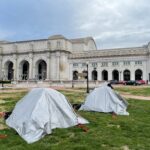
A majority of the encampment’s estimated 12 residents had left by the time crews arrived on Friday morning, having been given two weeks notice of the planned closure. Items left behind — including tents, mattresses, boxes, clothing, and garbage — were carted off and trashed, and by 10 a.m. a chain link fence closed off access to the triangular plot of land next to Schneider’s liquor store.
“We decided this area needed to be closed because it presented health and safety concerns,” said Sean McGinty, an NPS spokesman. He cited the use of a generator and grills, which could pose a fire hazard, and trash and sanitary issues that had been raised by neighboring businesses and residents.
In a separate statement on Thursday, NPS said that while the agency was largely following CDC guidance on not clearing homeless encampments during the pandemic, “it’s our responsibility to consider the overall health and safety of all park users and neighbors and the condition of park resources.”
NPS recently closed another encampment a block away, and in August cleared a larger encampment at Burke Park in Mt. Vernon Square, and also one at nearby Gompers Park.
Homeless advocates credited NPS and the U.S. Park Police for giving advance notice of the clearing and letting the encampment’s residents move their possessions out even after the deadline passed, but still said that the clearings themselves can be a difficult experience for people experiencing housing instability.
“These individuals now have to be relocated, and that’s a problem that they have to deal with. And it’s draining,” said Andrew Anderson, the outreach director with the People for Fairness Coalition, an organization that works with unhoused residents in encampments.
Anderson, who had himself been unhoused after completing a prison sentence in 2019, said many of the people who had been staying at 3rd Street would likely just move to other encampments in the city. He said he told some people to go to existing encampments in Foggy Bottom — something Anderson conceded wouldn’t be a long-lasting solution.
“We’ve been encouraging people to go there because those encampments are already set up,” he said. “But you know, it’s kind of like, maybe you shouldn’t have done that because eventually they’re going to close those encampments as well. And so the process is going to start all over again.”
In its statement, NPS said the goal wasn’t just to evict people, but to connect them to services. “NPS is committed to taking a social services-first approach and will continue to work closely with [D.C.] and community partners to connect people living in encampments with resources and housing,” said the agency.
A representative of Community Connections, a social services organization called in by D.C., was at the encampment on Friday, but said they could not speak to the media. A follow-up phone call to the organization’s headquarters was not immediately returned.
Friday’s clearing comes as D.C. has also embarked upon an effort to close down various large encampments on non-federal land across the city. Under a pilot program unveiled late in the summer, D.C. worked with outreach workers to offer residents at various encampments access to housing and other services, and then planned to permanently close the encampments and prohibit anyone else from staying there. The pilot program has been implemented at two encampments in NoMa so far, though it has also drawn controversy and opposition from some lawmakers over how it was executed, whether the residents will have access to permanent or temporary housing, and the city’s decision to create no-tent zones in the sites it closes.
Earlier this week, eight members of the D.C. Council wrote a letter to Deputy Mayor for Health and Human Services Wayne Turnage supporting the goal of the pilot program while urging him to ensure all encampment residents gain access to housing before encampments are closed. Last week At-Large Councilmember Elissa Silverman sent Turnage her own letter asking for a broader citywide strategy for housing encampment residents.
Silverman was on hand at 3rd Street on Friday to observe the clearing, and she criticized what she said was a lack of coordination between D.C. and NPS, as well as the fact that no D.C. officials were present.
“We need to work together. Yeah, it’s federal property, but these are District residents in the camp,” she said. “I don’t think it’s right for us to just kind of throw up our hands and say this is a National Park Service problem. We need a memorandum of understanding or agreement between [NPS and D.C.] on how to deal with the federal encampments. It shouldn’t be one process for the city encampments and one process for the federal encampments. We need to formalize what kind of engagement happens. We should make sure that our approach is uniform.”
Anderson echoed Silverman’s point, saying the health and safety hazards that developed at the encampment could have been mitigated had D.C. worked to place porta-potties and additional garbage cans there, as the city has at other sites.
In a statement on Friday night, Sward Tondoneh, a spokeswoman for Turnage, said D.C. had and would work with NPS to address any future encampment clearings on federal land.
“We continue to work with NPS regularly to learn of any closures in advance so that we can properly engage the encamped residents beforehand; and encourage all encamped residents to utilize District shelter options and to regularly engage in outreach provider service connection efforts. We know that many of the residents have relocated to other areas of the city and our providers will continue to support them along their journey towards independence and housing stability,” said Tondoneh.
Silverman also said she recognizes that managing encampments is challenging, and that nearby residents and businesses had raised concerns about health and safety hazards. But she said it could be done better if government agencies put their heads together, and without that, the 12 former residents of 3rd Street would likely just move to other parks in the neighborhood.
“This is not easy,” she said. “But with the difficult issues, we need more engagement and more collaboration to come up with the solutions.”