 Jenny Gathright
The District announced Wednesday that it has entered into an agreement with the federal government promising to improve living conditions at the D.C. Jail. The announcement followed a week of intense scrutiny of the facility after a federal inspection revealed serious lapses and prompted the feds to begin moving 400 jail residents to another facility.
The memorandum of understanding between the D.C. Department of Corrections and the U.S. Marshals Service says that the two parties will work together “to provide a collaborative, accurate assessment of conditions of confinement” at the jail and then create and execute a plan to fix problems.
Deputy Mayor for Public Safety Chris Geldart announced the agreement at a D.C. Council oversight hearing on Wednesday, which lawmakers had called to demand an explanation for the conditions outlined in the federal report. USMS inspectors described cell toilets clogged with human waste, a pervasive smell of marijuana throughout the jail, and witnessing guards punitively withhold food and water from jail residents, among other problems.
Geldart provided few specifics in the hearing about the exact steps DOC would take to fix conditions but promised a “top to bottom” examination of operations at the jail.
Meanwhile, witnesses who testified at the hearing corroborated many of the allegations in the USMS report, describing issues with food and water access, human waste in cells, and mistreatment from staff.
Witnesses also stressed that the poor conditions in the jail have been ongoing for years.
Daniel Rosen, who had spent time at the D.C. Jail himself, told lawmakers Wednesday that “it may serve the DOC’s purposes to feign surprise” about the conditions and make “promises to become more vigilant.” But, Rosen added, “None of this is news.”
Calls for action on D.C. Jail conditions accelerated last week, after the USMS decided it would transfer 400 people from the D.C. Jail to a federal prison in Pennsylvania. (The USMS has custody of people being held in the D.C. Jail pre-trial on federal charges, as well as people who are awaiting assignments to federal prisons after sentencing, and people who are in the D.C. Jail as they go through certain legal processes or make court appearances.)
The USMS said it made the decision after a surprise inspection it conducted in October — which came after sustained complaints from the lawyers of people charged with crimes connected to the violent Jan. 6 Capitol insurrection, 40 of whom are being held pretrial in the D.C. Jail.
But though the complaints of white Jan. 6 defendants helped to kickstart this round of scrutiny to jail conditions, attorneys with the Public Defender Service testified Wednesday that about 87% of the D.C. jail population is Black, and 93% of the jail population is nonwhite. And Jan. 6 defendants are not among the people the USMS has been moving to Lewisburg, because they are being held in an area of the D.C. jail complex that the USMS labeled up to federal standards.

Geldart said that as part of the MOU between DOC and the USMS, the USMS will provide a “detention liaison” to help DOC staff and its consultants assess the problems with the facility and make a plan to fix them. The MOU also stipulates that neither DOC nor the USMS can “issue a publicity release or conduct a media interview” on D.C. Jail conditions without consent of the other.
Geldart said during Wednesday’s oversight hearing that he was hopeful the agreement would halt future transfers from the D.C. Jail to Lewisburg, the Pennsylvania prison where the USMS said it would be sending people in its custody following its surprise inspection of the jail. Geldart said 90 people were transferred out of the D.C. Jail on Tuesday and another 47 were scheduled to be transferred Wednesday. He was not aware of any other planned transfers this week.
“We’re hoping that through this process we can get the folks who have been transferred back,” Geldart said. But the MOU makes no mention of returning federal prisoners to D.C.; Geldart told lawmakers on Wednesday that the USMS has sole authority over where to detain the people in its custody.
Allen told Geldart that it “boggles” his mind that the MOU would be “cast as some sort of victory,” arguing that it was too vague to be effective in either changing conditions or preventing D.C. residents from being sent to a federal prison far from home.
Meanwhile, Ward 7 ANC Commissioner Joel Castón, who is currently incarcerated in a side of the D.C. Jail complex called the Correctional Treatment Facility, described an atmosphere of fear inside the jail. He said many people are worried they’ll be transferred to the prison in Lewisburg, where they are concerned they will face additional mistreatment and struggle to access lawyers and family members. (Castón himself was recently concerned he may be moved from the jail, though it appeared to be unconnected to this decision from the USMS).
Castón also said that he wanted to see officials create an immediate plan to focus on building a new facility to replace the jail. But in the meantime, he told officials, “people still have to live here.” He asked officials to form a committee of D.C. Jail residents with the capacity to report on conditions — and he wants to see successful D.C. Jail programs like the Young Men Emerging mentorship program expanded to more jail residents.
“Everybody wants a piece of something that makes them feel like a human being,” said Castón.
Other incarcerated D.C. residents who shared their experiences in testimony on Thursday described the D.C. Jail facility as a dehumanizing place, saying they had been abused by staff and deprived of basic necessities. Attorneys with the Public Defender Service for D.C. played recordings of their clients for officials and the public to hear.
Davon Patterson, who is currently incarcerated at the D.C. Jail, said in the recording that “you feel like an animal” in the facility. According to PDS, Patterson is 30 years old and has been at the jail for more than 600 days without an indictment or trial date.
“It’s not right, because at the end of the day, we are human beings,” Patterson said.
Others described being deprived of food — or being given so little food that pain medication became painful to digest. Some described standing human feces left in their cells, and one man said guards let human waste remain on the wall of his cell for months.
Defense lawyers who testified also said they had independently heard about the conditions described in the USMS inspection for years. They said clients were being denied food, recreational time, medical care, water, cleaning supplies, and access to personal hygiene, like showers.
Two former DOC employees also testified and said they personally witnessed similar abuses. Brittany Vazquez, who said she worked as a social worker on the Correctional Treatment Facility side of the complex, said she had witnessed corrections officers refuse to allow “certain residents” access to drinking water. Amy DeYoung, a licensed professional counselor who provided individual and group therapy to incarcerated people at the jail between 2017 and 2020, described an environment of terror and retaliation in the facility. She said she witnessed an officer tell a suicidal resident in the jail how to successfully hang himself, “to make sure to finish the job.” And she said she believed leadership was aware of these abuses.
“I can assure you that the administration is very much aware of every one of the atrocities occurring,” said DeYoung. “I consistently reported these issues and they continued to happen.”
D.C. DOC Director Quincy Booth did not testify at Wednesday’s oversight hearing. Geldart said Booth was out on personal leave.
In his testimony, Geldart largely responded to complaints about jail conditions by saying that, through the MOU with the USMS, DOC was taking a “top to bottom” look at all aspects of its operations. Geldart said DOC denies that water has ever been shut off or denied to residents for days, as the USMS inspection report alleges. He said DOC inspected all pipes in the units and ensured that its food vendor will start delivering extra drinks with all meals.
“We realize there are some systemic issues that have persisted at DOC,” Geldart acknowledged, but he said he did not believe the issues were so pervasive that the Central Detention Facility — the main subject of the USMS report on conditions and the space from which they have evacuated people in federal custody — has become “uninhabitable.”
Geldart said that DOC performs hundreds of repairs on its aging facility each year, including many on toilets, but added that DOC is suffering from staffing issues and staff have been working 12-hour shifts since April 2020. Despite the early pandemic decline in the jail population, court backlogs now mean that the population of the DC Jail is as high as it was in 2018, he says.
Geldart said the construction of a new facility is the best solution to the extreme physical challenges in the jail — but declined to commit to a timeline for building one.
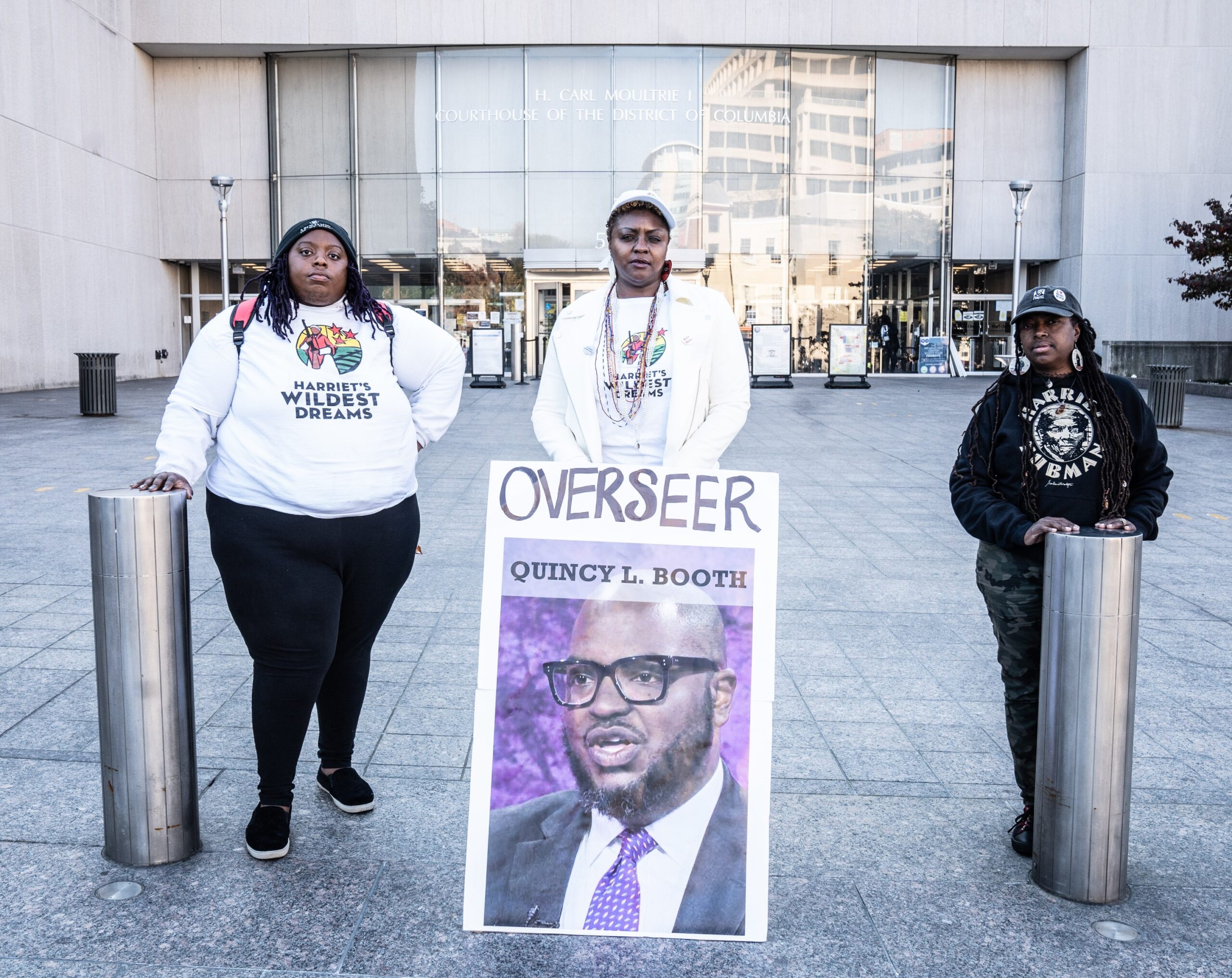
As DOC leadership grapples with how to address conditions in the facility, advocates are calling for authorities to release every person possible from the D.C. Jail. Their suggestions ranged from amending the pretrial release statute to say that judges should consider D.C. Jail conditions before recommending detention to creating smaller, more therapeutic halfway houses where people can stay while awaiting trial instead of the jail. Qiana Johnson, the executive director of Life After Release and co-conductor of Harriet’s Wildest Dreams, pointed out that some people in the D.C. jail are being held on technical parole violations. The jail’s population is also largely composed of people who are being held pre-trial and have not yet been convicted of a crime.
“Even though we’re talking about conditions and we’re talking about conditions of the jail, the people in this building right here — the judges, the parole commissioners, the U.S. attorneys, they’re the ones that hold the power to release them,” said Johnson, speaking outside D.C. Superior Court on Wednesday morning, at a rally where about 50 people gathered to protest the jail conditions. “The courts can stop this, and they can let our people go. We have an immediate call to free them all.”
But as the unfolding situation at the D.C. Jail is garnering attention from local — and national — lawmakers, others worry the spotlight on the situation will quickly fade.
Patterson, in his recorded testimony from inside the jail, said he felt like things would return to normal as soon as the USMS moved the people in its custody out of the facility.
“Soon as this blows past,” he said, “everything gon’ be the same.”
This story was updated to correct the spelling of Brittany Vazquez’s last name.