Martin Austermuhle
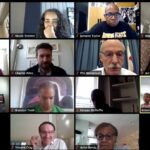
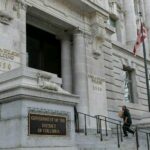
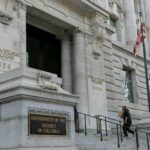
It was almost 20 months ago that the COVID-19 pandemic forced the D.C. Council into a new world of virtual hearings and votes, but now lawmakers say it’s time to return to the Wilson Building in person. And while many of the details of how that will happen have yet to be ironed out, at least one thing is expected to stick around: virtual public hearings.
Councilmembers spent two hours Tuesday morning discussing the when and how of an in-person return, with most seeming to side with a plan to come back in some capacity between mid-January and early February. Chairman Phil Mendelson said compliance with the mandate for vaccines among lawmakers and their staff has been high, and that members of the public who will want to access the building will most likely have to show proof of vaccination and wear a mask.
“It’s hard to do this on Zoom,” said Councilmember Brianne Nadeau (D-Ward 1) of the council’s daily work debating and passing legislation. “It’s hard not to have those hallway interactions and time on the dais to work things out.”
“It’s harder to work out compromises virtually,” added Councilmember Elissa Silverman (I-At Large).
“I think we’re getting to the point where the mayor is going to troll us on this,” offered Councilmember Christina Henderson (I-At Large), noting that other legislative bodies around the region and country — as well as the D.C. government itself — have largely returned to in-person operations.
There was less consensus on some of the particulars of the return, though. While most lawmakers said they support in-person legislative sessions and meetings of the Committee of the Whole — where all 13 councilmembers are represented — council staff warned that maintaining social distancing in some of the Wilson Building’s chambers could be a challenge, especially if the public and press are also invited back.
Nadeau said lawmakers and their staff who have young children (she is among them) could be hesitant to return to traditional in-person hearings for the time being, and Councilmember Trayon White (D-Ward 8), himself the father of a young child, additionally said the emergence of the omicron variant should prompt a slow reopening. Silverman proposed what she termed the “incremental” approach — votes cast in person, but the rest of the council’s daily functions kept virtual or hybrid until there is a better sense of what the new variant means.
And while the council’s initial adoption of Zoom for virtual hearings and legislative sessions was clunky — and some members still have to be reminded to mute themselves when not talking — most lawmakers speaking Tuesday said they wanted to ensure the public still be allowed to offer testimony virtually.
“The virtual hearing has dramatically increased the level of participation in the public process. There’s a lot to be said for what we have gained in public participation,” said Councilmember Charles Allen (D-Ward 6).
Earlier this month, a man experiencing homelessness testified over Zoom from an encampment about the city’s plans to eventually clear it, and another spoke from inside the D.C. Jail about conditions there. Members of the public have testified virtually from cars and airport bathroom stalls, and the parents of a man killed by D.C. police last year also spoke during a hearing — the father from a construction site he works at, the mother from the street where her son died.
It’s likely that individual council committee chairs will be given flexibility on deciding whether to hold in-person hearings, virtual hearings, or a hybrid. At least one lawmaker left little doubt in her plans.
“I’m going to keep my meetings virtual until the numbers and the variants calm down,” said Councilmember Mary Cheh (D-Ward 3), who chairs the transportation and environment committee.
Still, some quirks still have yet to be worked out. With the budget oversight season kicking off early next year — when the council grills senior city officials about annual agency performance and spending — lawmakers said the council needs to increase its capacity to simultaneously broadcast multiple hearings at a time. Currently, some councilmembers have had to rely on their own Facebook pages to stream hearings, and many hearings simply cut off after a certain amount of time.
“It can’t be a scavenger hunt to figure out where the MPD oversight hearing is,” said Silverman.
Other issues left to be resolved include how much access the public will have to the Wilson Building and whether individual councilmember offices will have to be open and fully staffed. Mendelson said he will present a proposal to the council next week, with the expectation that plans for a return to the Wilson Building be finalized before the holidays.